
Intercaste and Interfaith Marriage in the Chart
Intercaste marriage astrology looks at traditional indicators such as Rahu or Ketu linked to the seventh house, connections between the fifth and seventh lords, and a seventh lord placed in a distant house. These describe difference and independent choice, not judgment. A chart never ranks communities, and the couple's decision stays their own.
Key takeaways
- A birth chart is calculated from the time and place you were born.
- The houses involved are introduced in the overview of houses in astrology .
- Older commentaries sometimes framed these placements as misfortunes, reflecting the social rules of their time.
- Families who value matching can still use it.
- For many couples, the chart is the easy bit.
A couple sits down with a reader. She is from a Gujarati Jain family; he grew up Catholic on the Southwest Side. Or: two Hindus from families of different castes, one Telugu and one Punjabi, whose grandparents would never have expected the match. Or: a Sikh woman and a Muslim man who met in graduate school. Each couple wants to know what the chart says. Each set of parents wants to know too, sometimes for very different reasons.
This post explains the traditional indicators readers point to for unions across caste, community or faith, and how to read them with the respect the couple deserves.
First, what a chart does not do
A birth chart is calculated from the time and place you were born. It contains no information about your family's caste, religion or community, and it cannot rank them. Any reader who suggests that one community's chart is superior, or that a marriage is cursed because of birth, is bringing their own prejudice into the reading. That is not tradition worth keeping.
Even within Guna Milan, the scoring system many families use, the Varna koota is often misunderstood. It is assigned from each person's Moon sign, grouped by element, not from the family's caste, and it carries only one of the 36 points.
Traditional indicators readers mention
When astrologers talk about marriages outside one's community, they usually point to signs of difference, distance and independent choice. The houses involved are introduced in the overview of houses in astrology.
- Rahu or Ketu linked to the seventh house. Rahu is associated with the foreign, the unconventional and crossing boundaries. In the seventh, or with the seventh lord, readers often describe a partner from a different background.
- Venus with Rahu. Attraction to what is unfamiliar or outside one's expected circle.
- Fifth and seventh lords connected. The fifth house is romance and personal choice; the seventh is marriage. Their link is a classic indicator of a love marriage, sometimes called a love marriage yoga.
- Seventh lord in the ninth or twelfth. The ninth is linked with distant places and other traditions; the twelfth with foreign lands. Both can describe a partner from far away, culturally or geographically.
- Saturn's influence on the seventh. Some readers link it with a partner from a different social background or with a relationship that breaks convention.
None of these placements "causes" an intercaste or interfaith marriage, and plenty of people with them marry within their community. They describe a tendency toward difference, which is all a chart can describe.
Reading difference as difference, not as a problem
Older commentaries sometimes framed these placements as misfortunes, reflecting the social rules of their time. A respectful reading today treats them as descriptive: this chart shows a person drawn to someone outside their expected circle. That is neither good nor bad. It is simply part of the story.
The history of Hindu marriage itself includes several recognized forms of union, among them marriage by mutual choice. Love across lines is not new to the tradition, even when it is new to a family.
Matching across communities
Families who value matching can still use it. A kundli matching session works the same way for any two people with birth details: Guna Milan, Manglik checks and the deeper comparison. For couples where one family uses a South Indian system and the other a North Indian one, both can be run. For Chicago couples blending cultures, the post on chart matching for intercultural marriages covers practical details.
Interfaith couples
When one partner is not Hindu, a few questions come up often:
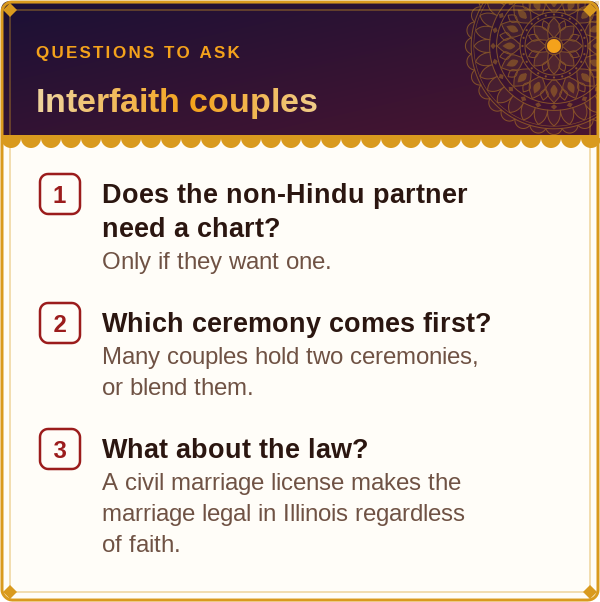
- Does the non-Hindu partner need a chart? Only if they want one. Some welcome it as a way to honor their in-laws; others prefer not to take part.
- Which ceremony comes first? Many couples hold two ceremonies, or blend them. A muhurta can be chosen for the Hindu ceremony while the other is scheduled by its own tradition.
- What about the law? A civil marriage license makes the marriage legal in Illinois regardless of faith. In India, the Special Marriage Act allows interfaith civil marriage without conversion. A lawyer can advise on registration in either country.
When family is the hard part
For many couples, the chart is the easy bit. The hard bit is parents, grandparents and community. A love marriage and family approval session with Astrologer and Psychic Vijayram focuses on that, with chart insight offered as neutral ground rather than ammunition for either side. For the earliest stage, telling your parents about your partner offers a conversation plan.
If family opposition ever turns into threats or pressure toward a different marriage, that is a safety matter: call emergency services or reach the Forced Marriage Initiative for confidential help.
The limit
Astrology can point to traditional themes of difference and choice. It cannot judge a caste or a faith, decide whether a couple belongs together, or replace the long work of building a shared life. That decision belongs to the two people making it.
Common questions
Does the Varna koota in Guna Milan check our castes?
No. Varna koota is assigned from each person's Moon sign, not from their family's caste. It carries one point of the 36 and is read as a broad temperament grouping. Two people from the same community can score zero on it, and two from different communities can score full.
Can a chart say whether an interfaith marriage will work?
No. A chart can describe temperaments and timing for both partners. Whether two people can build a life across faiths depends on their values, communication and families, which no chart decides.
Is kundli matching meaningful if one partner is not Hindu?
It can be, if both partners want it and have birth details. The chart is calculated from the time and place of birth, not religion. Some non-Hindu partners find it a respectful way to meet their in-laws' tradition.
My parents say our charts show the marriage is wrong. What should I do?
Ask to see exactly what was found, and get a second, careful reading of both charts. One factor is never a verdict. The post on patience and prayer when a family hesitates may help with the conversation.
Related service
Keep reading

Age Gaps and Compatibility
Age gap relationship astrology: what Vedic charts can show about two people at different life stages, and the questions only the couple can judge themselves.
Read article →
Guna Milan Was Written for Bride and Groom: Adapting It for Same-Sex Couples
LGBTQ astrology compatibility in the Vedic tradition: which Guna Milan kootas assume a bride and groom, how readers adapt them, and methods that never did.
Read article →
Synastry and Kundli Matching: Two Ways to Compare Charts
Synastry vs kundli matching explained: Western aspects between two tropical charts against Vedic kootas, Moon stars and dosha checks, and when each one helps.
Read article →Quick answers
Should I keep waiting for my ex while I get readings?
Can a psychic bring your ex back? Get-your-ex-back work is offered as prayer, mantra and puja for reconciliation, with no result promised. Waiting versus healing.
Read answer →Can I ask about someone else's feelings in a love reading?
Questions to ask in a love reading when you want to know someone else's feelings: why readings stay with your side, and how to reframe the question.
Read answer →Talk to Astrologer and Psychic Vijayram
Tell us what you are facing. If a reading is unlikely to help, you will be told that plainly.