
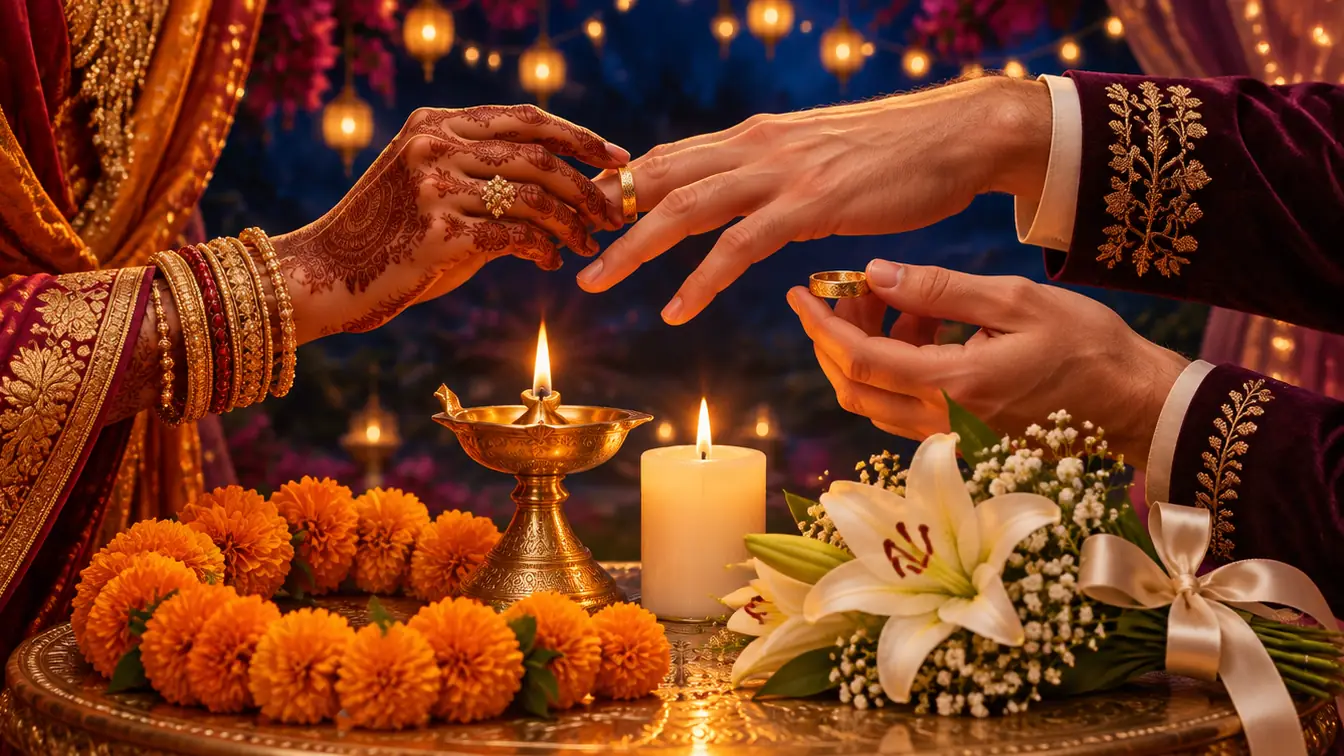
Two Traditions, One Wedding Date: Intercultural Couples in Chicago
Intercultural couples in Chicago usually start with the fixed pieces: the church, gurdwara or courthouse availability, then look for a muhurta inside those openings. A muhurta can be chosen from the panchang and one or both charts, even if one partner has no birth time. Astrology adds one input; it does not outrank either family's faith.
Key takeaways
- A muhurta is flexible in a way a building calendar is not.
- Often one partner was never given a horoscope, and some do not know their birth time at all.
- Many couples hold two ceremonies on one weekend: a church wedding one day and a Hindu ceremony the next, or a morning service and evening pheras on a single day.
- Sometimes the date question hides a different one.
- For the ingredients of a suitable date, read what makes a vivah muhurta auspicious .
Picture the planning call. One side of the family has asked a pandit for a muhurta and already has three autumn dates in mind. The other side has spoken to their parish, or to the gurdwara committee, or simply wants a short civil ceremony followed by dinner. Nobody is wrong, and nobody wants to be the family that "won". Most intercultural couples in Chicago reach this moment, and it is usually settled by the order in which questions are asked, not by argument.
Start with what cannot move
A muhurta is flexible in a way a building calendar is not. A church may book its sanctuary many months ahead, some parishes limit weddings during Lent or Advent, and a gurdwara committee keeps its own schedule. Civil marriage has its own rules too: in Chicago and suburban Cook County, both partners appear together to obtain a license, as the Cook County Clerk's marriage license page explains.
So the practical order is to collect the windows each institution can offer, and only then ask which of those dates and hours suit the Hindu calendar. Working the other way round, fixing a muhurta first and then hunting for a venue, is how families end up with an ideal date and nowhere to hold the wedding.
Does the partner without a chart need one?
Often one partner was never given a horoscope, and some do not know their birth time at all. That does not block a wedding date. A muhurta can be chosen from the panchang alone: the tithi, the weekday, the nakshatra of the day and the rising sign at the hour of the ritual. When birth details exist, a reader also checks the date against each partner's Moon sign, but that is a refinement rather than a requirement.
Kundli matching is a separate matter. If the partner without a chart is willing and a birth time can be found on a hospital record, both charts can be compared. If not, matching is skipped, and that is acceptable in many families on both sides. The post on intercaste and interfaith marriage in the chart looks at how readers handle that conversation with parents.
Three common pairings, and how dates are found
Hindu and Christian
Many couples hold two ceremonies on one weekend: a church wedding one day and a Hindu ceremony the next, or a morning service and evening pheras on a single day. The muhurta is chosen for the Hindu ritual, usually the pheras or the saptapadi, and it does not need to govern the church service at all. Ask the parish early whether it is comfortable with a Hindu ceremony on its grounds or would rather it happened elsewhere.
Hindu and Sikh
The Sikh wedding, the Anand Karaj, follows its own order around the Guru Granth Sahib. Its history includes a reform movement that called for astrologers and Brahmin priests to be left out of the ceremony, as the overview of the Anand Karaj records. The gurdwara date is therefore set by the gurdwara and the families, and the Hindu side may want a muhurta only for its own rituals, such as a haldi or a separate pheras. Respecting that difference heads off a quiet clash.
Hindu and nonreligious
Here the civil ceremony is often the legal wedding, and the Hindu ceremony is a family celebration with full religious meaning for one side. Some couples sign the license on a convenient weekday and keep the muhurta for the ceremony their parents will attend. The note on ordering the Illinois license and a Hindu ceremony sets out the usual sequences.
When a parent asks whether the stars approve
Sometimes the date question hides a different one. A parent who asks for "a good muhurta" may really be asking whether the marriage is acceptable at all. Astrology should not stand in for that conversation. A reading can describe a chart, suggest timing and offer prayers for the couple's wellbeing; it should never be used to declare a partner from another culture unsuitable.
Every faith has its own rules and debates about marrying across traditions, as the overview of interfaith marriage shows, and those debates belong in honest family talk. Guidance for couples seeking family approval is designed for this stage: patience, chart insight if it helps, and respect for everyone at the table.
A planning order that tends to work
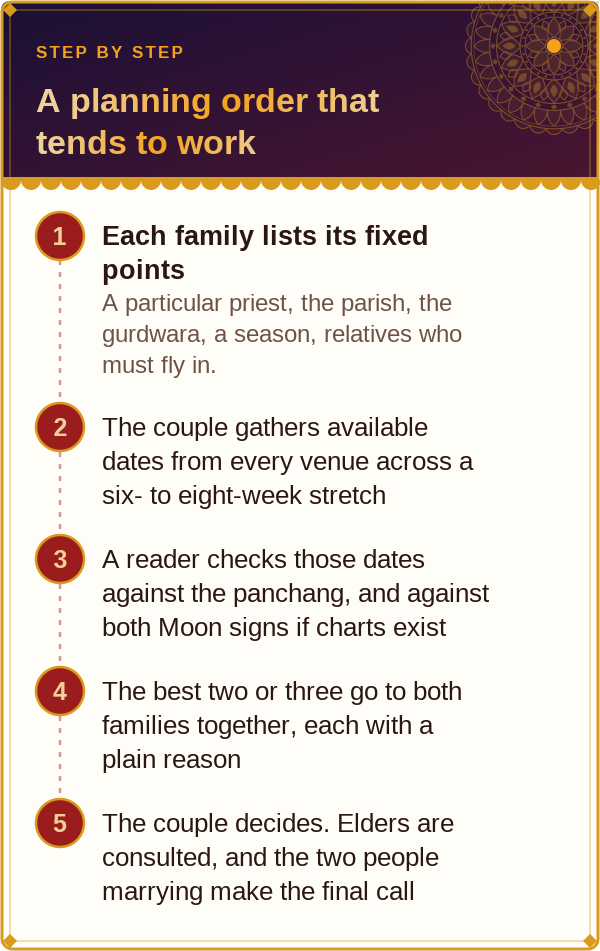
- Each family lists its fixed points: a particular priest, the parish, the gurdwara, a season, relatives who must fly in.
- The couple gathers available dates from every venue across a six- to eight-week stretch.
- A reader checks those dates against the panchang, and against both Moon signs if charts exist.
- The best two or three go to both families together, each with a plain reason.
- The couple decides. Elders are consulted, and the two people marrying make the final call.
For the ingredients of a suitable date, read what makes a vivah muhurta auspicious. The full wedding muhurta consultation works outward from your venue windows in the same way.
A Chicago note on seasons
The city's wedding calendar crowds into late spring, summer and early autumn, when halls are hardest to book. Many Hindu families also set aside the four months of Chaturmas, which overlap that same stretch. When both pressures squeeze the same months, an indoor winter date can become the compromise both sides accept. The guide to winter wedding muhurta dates from December to February explains which weeks tradition allows.
What astrology cannot do here
No chart can make two families agree, and no date can carry the weight of a relationship on its own. A muhurta is a traditional way of choosing a respectful starting point. Astrologer and Psychic Vijayram offers it by phone, WhatsApp or video, as one input beside the couple's faith, both families' customs and the practical calendar, never as a ruling over any of them.
Common questions
Can one muhurta cover both of our ceremonies?
Only when both happen within a few hours of each other. Usually the muhurta is set for the Hindu ritual, and the other ceremony is scheduled by its own church, gurdwara or clerk on the same day or the same weekend.
My partner's family worries that astrology conflicts with their faith. What can we tell them?
That the muhurta applies only to the Hindu ritual and asks nothing of them. Nobody on their side needs to take part in it or believe in it, and their own ceremony follows their own rules and clergy.
Do we need kundli matching for an interfaith marriage?
No. It is optional. Some families value it as information; others set it aside once the couple has chosen each other. If one partner has no reliable birth time, matching is simply not done, and the wedding date can still be chosen.
Can both sets of parents join the same session?
Yes, and it often helps. When both sides hear the same reasons at the same time, nobody feels a decision was made behind their back. Ask for every suggested date to be explained in plain words rather than jargon.
Related service
Keep reading
Finding a Match in Chicagoland: Where Kundli Fits Today
Indian matrimony in Chicago today: apps, family introductions and temple circles across Chicagoland, and where kundli matching fits among other inputs.
Read article →
Kundli Matching by Video With Family in India: Running the Session From Chicago
Kundli matching across different countries: how Chicago families run one video session with elders in India, handle the time gap and share both charts.
Read article →
Civil Paperwork and a Hindu Ceremony in Illinois: Which Comes First?
Planning a Hindu wedding in Illinois from Chicago? How couples order the county license, a civil ceremony and the muhurta, and where to check legal steps.
Read article →Quick answers
What is Guna Milan?
What is Guna Milan? The eight kootas behind the 36-point kundli matching score, what each one compares, and what the number cannot tell a couple or family.
Read answer →Is 18 out of 36 enough for marriage?
Is 18 out of 36 a good kundli matching score? Why 18 is the usual threshold, how doshas and cancellations change it, and why the full charts matter more.
Read answer →Talk to Astrologer and Psychic Vijayram
Tell us what you are facing. If a reading is unlikely to help, you will be told that plainly.