
Finding a Match in Chicagoland: Where Kundli Fits Today
In Chicagoland, most Indian matches now begin on apps and matrimony sites, through family introductions, or in temple and community circles. Kundli matching usually comes after two people show real interest, as one input beside values, family fit and plain conversation. A score should start a closer look, never end a promising match on its own.
Key takeaways
- Dedicated matrimony platforms, which grew out of newspaper matrimonial columns, let families and individuals filter by community, language, education and location.
- Some match before the first meeting, using the score as a filter.
- A full date, time and place of birth is the kind of detail banks and agencies use to confirm identity.
- The same caution applies to anyone, including astrologers, who says a match can only proceed if you pay for an expensive ritual.
- For some households it is near the top; for others it is a formality.
A generation ago, a family looking for a match in Chicago might have started with a phone call to relatives near Devon Avenue. Today the search is spread across the whole region. A WBEZ analysis counted more than 13,000 South Asian immigrants in Naperville, about 9,000 in Schaumburg and 8,000 in Aurora, and the same report described how temples and cultural events now sit close to those suburban homes (WBEZ on the rise of suburban South Asian hubs). Indian matrimony in Chicagoland has followed the same map: more doors, more distance, and more decisions made by the couple themselves.
The four doors people use now
Apps and matrimony sites
Dedicated matrimony platforms, which grew out of newspaper matrimonial columns, let families and individuals filter by community, language, education and location. The history of matrimonial websites shows how they shifted the first step from relatives to profiles. Many profiles still list a Moon sign, nakshatra or Manglik status, which is where astrology first appears for most people.
Family introductions
An aunt in Schaumburg knows a family in Naperville; a cousin in New Jersey knows someone who just moved to the West Loop for work. The biodata still travels this way, often as a PDF on a family group chat, sometimes with a horoscope attached.
Temple and community circles
Volunteering at a temple festival, a garba night in the suburbs or a regional association picnic puts people in the same room without the pressure of a formal meeting. Families who meet this way tend to bring up kundli later, once both sides already like each other.
Friends, school and work
Plenty of couples meet the way anyone in a big city does. They often arrive at matching last, usually because a parent asks for it.
Where kundli fits in the sequence
Families broadly fall into two camps. Some match before the first meeting, using the score as a filter. Others wait until two people have spoken several times and want to continue. Neither is wrong, but the second order avoids a common problem: a good prospect dropped over a number that a fuller look might have softened. The guide to how the 36 Guna Milan points are weighted explains why the total alone misleads, and what to do with a low matching score covers the next step when it comes in under 18.
When a match is serious, the kundli matching consultation goes beyond the points to the seventh house, Venus, the navamsa and each person's planetary periods. Families from Tamil, Telugu, Kannada or Malayali backgrounds may expect Porutham instead, and the post on Porutham and Guna Milan for Chicago families explains how the two systems differ.
Birth details are personal information
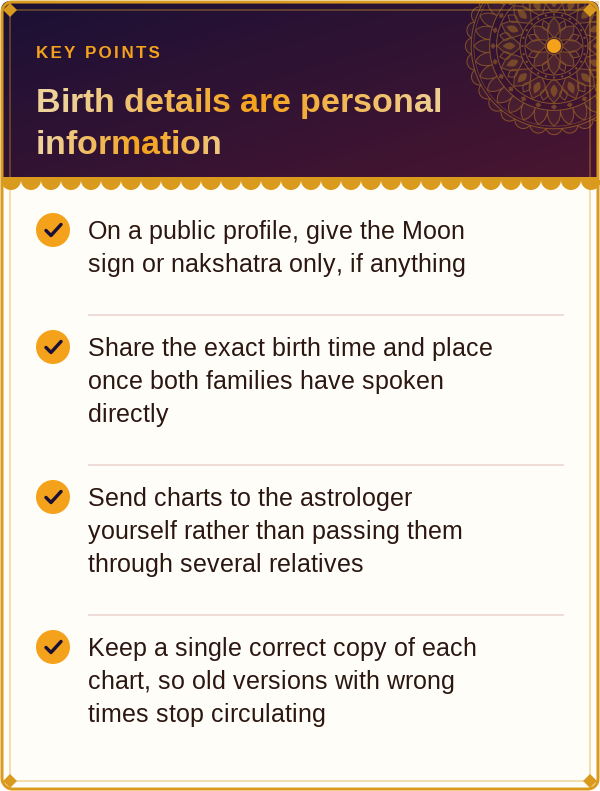
A full date, time and place of birth is the kind of detail banks and agencies use to confirm identity. It is reasonable to hold it back until there is real interest on both sides. A practical approach:
- On a public profile, give the Moon sign or nakshatra only, if anything.
- Share the exact birth time and place once both families have spoken directly.
- Send charts to the astrologer yourself rather than passing them through several relatives.
- Keep a single correct copy of each chart, so old versions with wrong times stop circulating.
A caution about matrimony scams
Most people on these platforms are genuine, but romance and marriage scams exist. Warning signs include a match who cannot video call, a sudden emergency that needs money, or pressure to move the conversation off the platform quickly. Never send money to someone you have not met, and report fraud to the Federal Trade Commission's fraud reporting site. The same caution applies to anyone, including astrologers, who says a match can only proceed if you pay for an expensive ritual.
How families weigh kundli against everything else
Ask parents across Chicagoland what matters in a match and the list is usually long: shared values, how each person treats their own family, plans about where to live, children, faith practice, careers that may require a move, and whether the two people actually enjoy each other's company. Kundli sits somewhere on that list. For some households it is near the top; for others it is a formality. A reading works best when everyone is honest about where it sits before the result comes in.
For couples who have already chosen each other and are now explaining that choice to parents, matching for second-generation Chicago couples speaks to that situation directly.
What matching cannot tell you
A chart comparison cannot tell you whether someone is kind, honest or ready to marry. It offers a traditional view of temperament and timing, read by Astrologer and Psychic Vijayram by phone, WhatsApp or video, and the people involved still have to get to know one another in the ordinary way.
Common questions
Should I put my birth time on my matrimony profile?
Most people are better off leaving it out. A Moon sign or nakshatra is enough for an early filter if your family wants one. Share the exact time, date and birthplace once there is mutual interest and you know who is asking.
Our families want matching before the first meeting. Is that unusual?
No. Some families still match first and introduce second. Others prefer to let the couple talk before anyone looks at charts. Either order can work, as long as everyone agrees on what a low score will and will not mean.
Can I get matching done for several prospects at once?
Yes. A quick first-pass comparison for a short list is common, followed by a fuller look for the one or two matches that are moving forward. Avoid ranking people only by points.
We met on our own. Does kundli still matter?
It matters as much as you and your families decide it does. Many couples who met independently ask for matching as a courtesy to parents and treat it as information, not permission.
Related service
Keep reading

Kundli Matching by Video With Family in India: Running the Session From Chicago
Kundli matching across different countries: how Chicago families run one video session with elders in India, handle the time gap and share both charts.
Read article →
Civil Paperwork and a Hindu Ceremony in Illinois: Which Comes First?
Planning a Hindu wedding in Illinois from Chicago? How couples order the county license, a civil ceremony and the muhurta, and where to check legal steps.
Read article →
Wedding Shopping on Devon Avenue: Dates Families Like to Start
Devon Avenue wedding shopping and the custom of starting purchases on a chosen day: saris, jewelry and gold, with simple muhurta checks for Chicago families.
Read article →Quick answers
What is Guna Milan?
What is Guna Milan? The eight kootas behind the 36-point kundli matching score, what each one compares, and what the number cannot tell a couple or family.
Read answer →Is 18 out of 36 enough for marriage?
Is 18 out of 36 a good kundli matching score? Why 18 is the usual threshold, how doshas and cancellations change it, and why the full charts matter more.
Read answer →Talk to Astrologer and Psychic Vijayram
Tell us what you are facing. If a reading is unlikely to help, you will be told that plainly.