
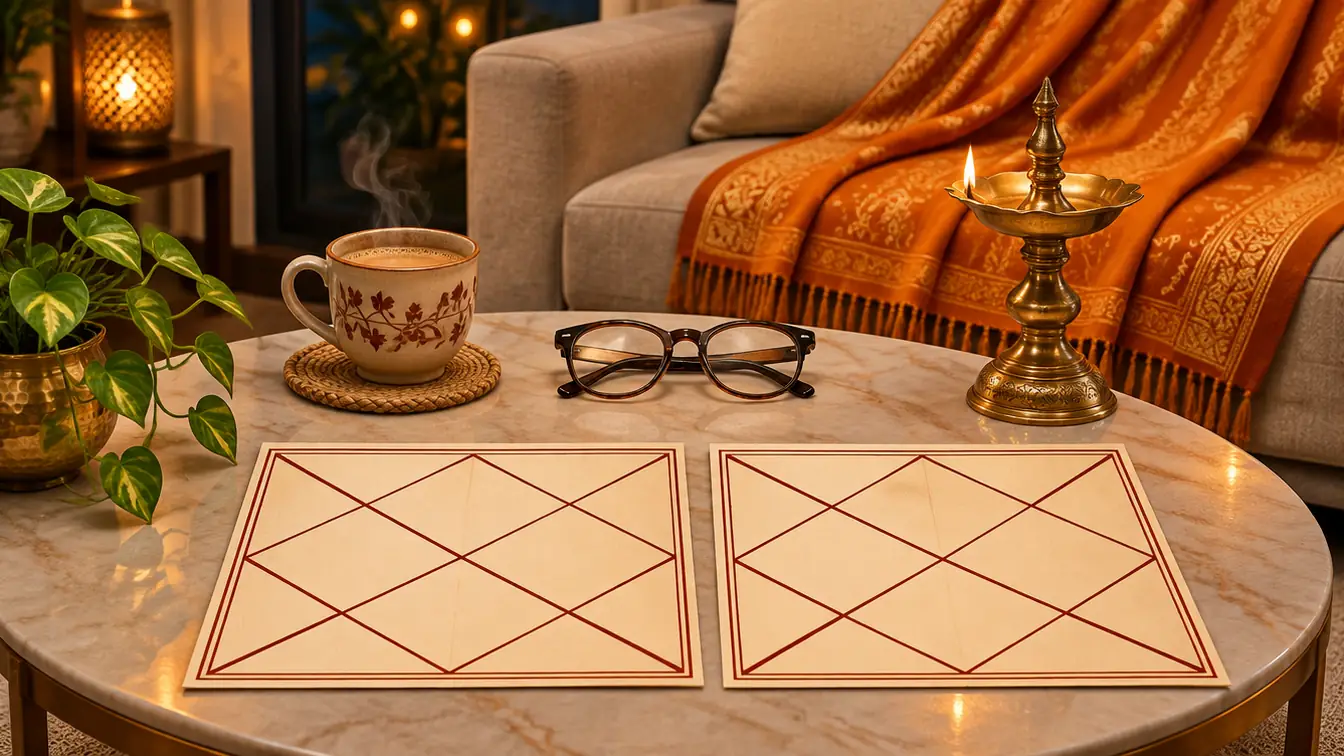
Kundli Matching for Second-Generation Chicago Couples
When parents want kundli matching and a Chicago-raised couple is unsure, a middle path works well: agree beforehand that the matching informs a conversation rather than deciding the marriage, sit in on the session together, and ask what any concern means in practice. A score describes traditional compatibility themes; it cannot judge two people's commitment.
Key takeaways
- For many parents, matching is not about control.
- Guna Milan totals eight factors to a maximum of 36 points, and 18 is the usual threshold families mention.
- Do not panic, and do not let anyone else panic on your behalf.
- Matching should never be used to force a marriage or to forbid one by threat.
- Whatever the score, the most useful preparation for marriage is talking honestly with each other, and many couples find premarital counseling worthwhile.
It is one of the most common conversations in Chicago's South Asian families. A couple meets at university, at work in the Loop or through friends. They are serious about each other. Then a parent in Naperville, Skokie or Hyderabad asks, gently or not so gently, whether the kundlis have been matched. The couple, raised largely in the US, feels a knot form: what if the score is low? Will it be used against us?
Chicago has the second-largest Indian American population of any US metro, about 255,000 people as of 2023 according to the overview of Indians in Chicago, and roughly two-thirds were born abroad. Many households hold two generations with different expectations under one roof. There is a way through that respects both.
Why parents ask
For many parents, matching is not about control. It is care, expressed in the language they grew up with. In the arranged introductions common in their own generation, horoscope matching was a standard step, as the overview of Hindu marriage describes. It offered reassurance, a shared ritual and a way for elders to give their blessing. Some parents also feel the eyes of relatives and community, and want to be able to say it was done properly.
Why couples hesitate
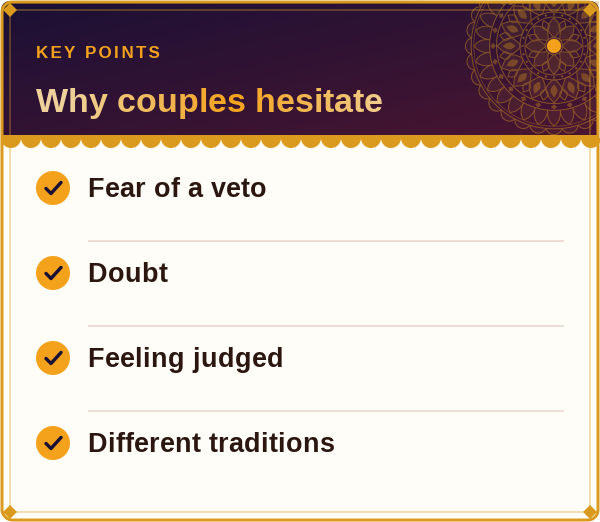
- Fear of a veto. The biggest worry is that a number will be used to stop a relationship that is otherwise good.
- Doubt. Some partners simply do not believe a chart can say much about a person they know well.
- Feeling judged. Matching can feel like an exam you did not sign up for.
- Different traditions. One partner may be from another faith or region, where matching means nothing or works differently.
All of these are reasonable. None of them has to end the conversation.
A middle path in five steps
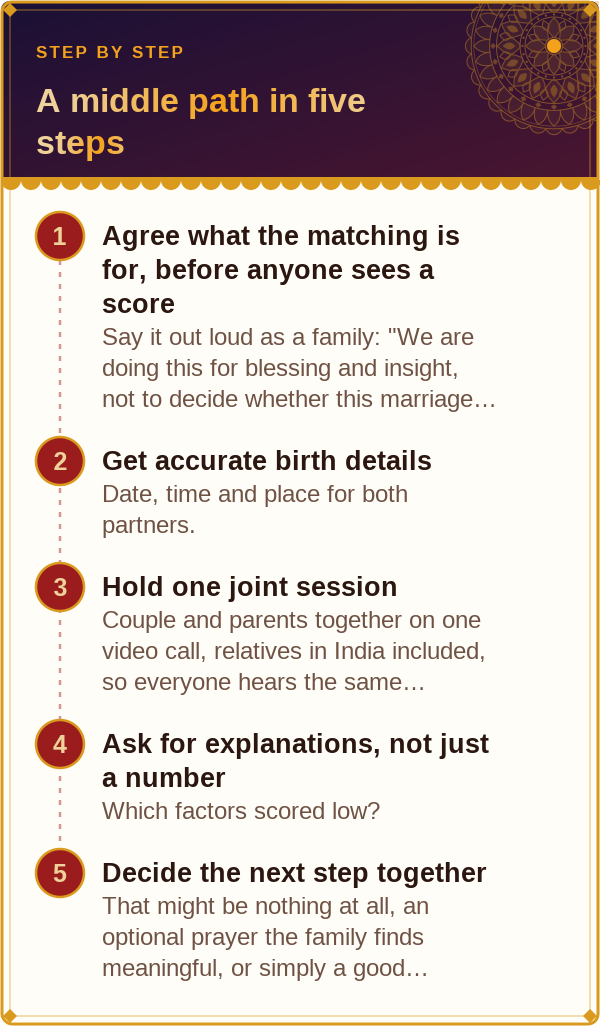
- Agree what the matching is for, before anyone sees a score. Say it out loud as a family: "We are doing this for blessing and insight, not to decide whether this marriage happens." That one sentence removes most of the fear.
- Get accurate birth details. Date, time and place for both partners. If a time is uncertain, say so; guessing makes the result less meaningful.
- Hold one joint session. Couple and parents together on one video call, relatives in India included, so everyone hears the same explanation instead of a secondhand summary.
- Ask for explanations, not just a number. Which factors scored low? What does each one traditionally describe? What would it mean in daily life? A good astrologer explains concerns such as Nadi or Bhakoot calmly, including the traditional exceptions that soften them.
- Decide the next step together. That might be nothing at all, an optional prayer the family finds meaningful, or simply a good conversation about the themes that came up.
What a score can and cannot tell you
Guna Milan totals eight factors to a maximum of 36 points, and 18 is the usual threshold families mention. The factors are drawn mainly from the two Moon positions and describe traditional themes: temperament, attraction, mental harmony, and health and children as the tradition reads them. The post on how the eight kootas are weighed explains each one, and South Indian families may use Porutham instead, covered in Porutham or Guna Milan for Chicago families.
What a score cannot measure: whether you share values, how you handle money, whether you want children, where you will live, how you fight and make up, how you will care for aging parents. It is also worth knowing that astrological compatibility is a matter of tradition and faith, not proven forecasting. A large study of Swedish population records, published in the journal Genus in 2020, tested common astrological claims about which signs marry and divorce one another and found no support for them. It did not test Vedic matching, but it is a fair reminder of what any chart can and cannot do.
If the score comes back low
Do not panic, and do not let anyone else panic on your behalf. Many couples with modest scores have long, happy marriages. The post on what to do after a low matching score sets out calm next steps, and the short answer on whether 18 out of 36 is enough puts the number in context.
When matching becomes pressure
Matching should never be used to force a marriage or to forbid one by threat. Every adult has the right to choose whether and whom to marry. If family pressure turns into threats, isolation or plans to take someone abroad to marry against their will, organizations such as the Tahirih Justice Center's forced marriage initiative can help, and in immediate danger call emergency services. Where love and family approval are pulling in different directions, the love marriage and family approval guidance session offers a calmer space to talk.
The conversations that matter more
Whatever the score, the most useful preparation for marriage is talking honestly with each other, and many couples find premarital counseling worthwhile. A kundli matching consultation with Astrologer and Psychic Vijayram can be one respectful part of that: held by phone, WhatsApp or video, explained in plain language, and offered as traditional guidance. It cannot decide your marriage for you, and it will never be presented as a verdict.
Common questions
We do not know one partner's birth time. Can matching still be done?
Guna Milan works mainly from the Moon's nakshatra, which can often be found from the date alone, unless the Moon changed nakshatra that day. Some finer checks need the time. The reader will explain what can and cannot be said.
Our parents are in India. Can they join the session?
Yes. A video or WhatsApp group call lets parents in India, the suburbs and the city join together. Allow for the time difference and agree beforehand who will ask questions.
Does a high score mean we will be happy?
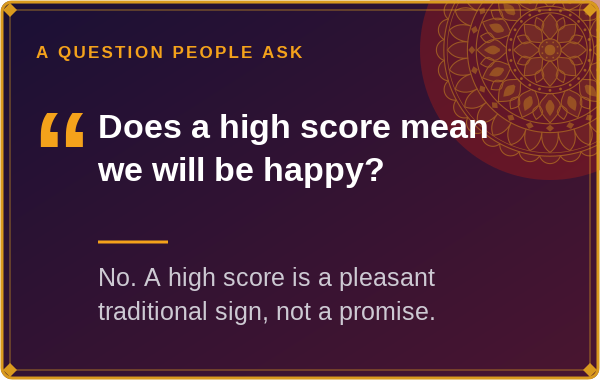
No. A high score is a pleasant traditional sign, not a promise. Happiness depends on how you treat each other, communicate and handle hard seasons, which no chart can measure.
One of us is not Hindu. Does matching still make sense?
It can, if both partners are comfortable and the family values it, but it should never be imposed. Some intercultural couples choose a blessing ceremony or a conversation with elders instead of a score.
Related service
Keep reading

Two Traditions, One Wedding Date: Intercultural Couples in Chicago
Intercultural marriage astrology for Chicago couples: fitting a Hindu muhurta around a church, gurdwara or civil date so both families feel honored.
Read article →
Finding a Match in Chicagoland: Where Kundli Fits Today
Indian matrimony in Chicago today: apps, family introductions and temple circles across Chicagoland, and where kundli matching fits among other inputs.
Read article →
Kundli Matching by Video With Family in India: Running the Session From Chicago
Kundli matching across different countries: how Chicago families run one video session with elders in India, handle the time gap and share both charts.
Read article →Quick answers
What is Guna Milan?
What is Guna Milan? The eight kootas behind the 36-point kundli matching score, what each one compares, and what the number cannot tell a couple or family.
Read answer →Is 18 out of 36 enough for marriage?
Is 18 out of 36 a good kundli matching score? Why 18 is the usual threshold, how doshas and cancellations change it, and why the full charts matter more.
Read answer →Talk to Astrologer and Psychic Vijayram
Tell us what you are facing. If a reading is unlikely to help, you will be told that plainly.