

Kundli Matching by Video With Family in India: Running the Session From Chicago
For kundli matching across different countries, each chart is calculated for its own birthplace and local clock time, then compared. From Chicago, India is 10.5 hours ahead during daylight saving and 11.5 hours ahead in winter, so early-morning or late-evening Central Time calls usually suit both households. Send both charts beforehand.
Key takeaways
- Charts born in different countries are never moved onto one clock before they are drawn.
- The US moves its clocks on the second Sunday of March and the first Sunday of November, as the NIST daylight saving time page sets out.
- Families from the south may be used to the square South Indian layout while northern families know the diamond; the reader can show both or explain one in terms of the other.
- Tension usually comes from surprise, not from the result.
- Ask for a short written summary and give each family a few days to talk privately.
The grandparents want to hear it directly. The couple is in Chicago, one set of parents is in Pune, the other is in Hyderabad, and an aunt who keeps the old horoscopes lives in Edison. Kundli matching that once happened around one dining table now happens across three or four screens. It works well, but only if the time zones, the charts and the conversation are prepared before anyone joins.
This is a common setup for Chicago families. The region has one of the largest Indian American communities in the country, second only to the New York metro according to the overview of Indians in Chicago, and most of those households have close family on the other side of the world.
Which clock each chart uses
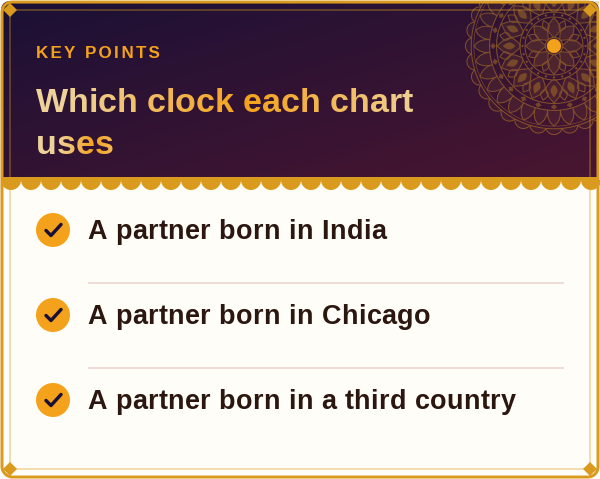
Charts born in different countries are never moved onto one clock before they are drawn. Each is calculated for the birthplace and the local time recorded there:
- A partner born in India uses Indian Standard Time, five and a half hours ahead of universal time, with no daylight saving for modern births. The background on Indian Standard Time explains the older exceptions for some pre-1950s city births.
- A partner born in Chicago uses Central Time, with daylight saving checked for the birth date.
- A partner born in a third country, such as the Gulf states or the UK, uses that place's local time and its own daylight saving history.
Once each chart is correct, the comparison itself is the same as for any couple. The details of why mixed-country charts trip people up are covered in reading a chart across two countries.
Finding an hour both houses can manage
The US moves its clocks on the second Sunday of March and the first Sunday of November, as the NIST daylight saving time page sets out. India does not change its clocks. So the gap is 10.5 hours for most of the year and 11.5 hours in winter. Useful windows:
| Chicago (Central Time) | India, mid-March to early November | India, early November to mid-March |
|---|---|---|
| 7:00 a.m. | 5:30 p.m. | 6:30 p.m. |
| 8:30 a.m. | 7:00 p.m. | 8:00 p.m. |
| 9:00 p.m. | 7:30 a.m. next day | 8:30 a.m. next day |
| 10:00 p.m. | 8:30 a.m. next day | 9:30 a.m. next day |
Early Chicago mornings reach India in the evening, after work and before dinner. Late Chicago evenings reach India the next morning, which elders often prefer. Weekend mornings in Chicago are popular because nobody has a commute. In the week after either clock change, confirm the time again: that is when calendar invitations go wrong.
Before anyone joins
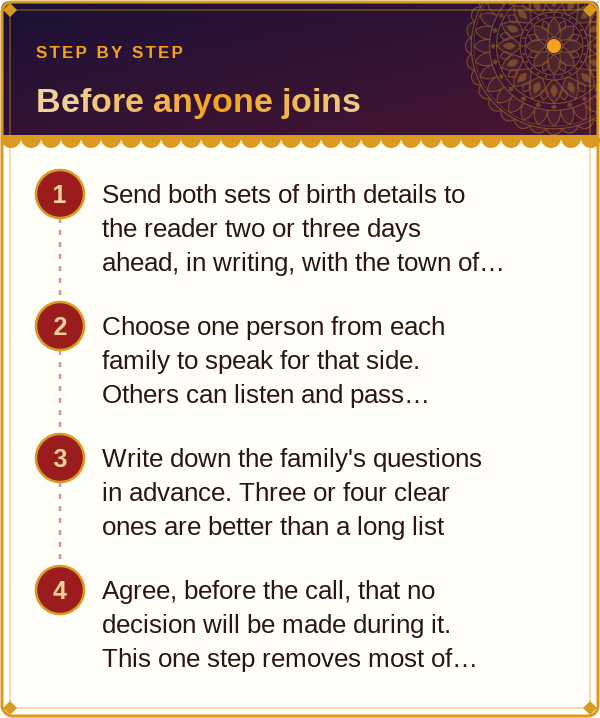
- Send both sets of birth details to the reader two or three days ahead, in writing, with the town of birth for each.
- Choose one person from each family to speak for that side. Others can listen and pass questions to them.
- Write down the family's questions in advance. Three or four clear ones are better than a long list.
- Agree, before the call, that no decision will be made during it. This one step removes most of the tension.
Sharing both charts on screen
On video, the reader can share the two charts side by side and walk through each part of the comparison: the eight kootas and their points, then the deeper factors such as the seventh house, Venus and each person's current planetary period. Families from the south may be used to the square South Indian layout while northern families know the diamond; the reader can show both or explain one in terms of the other. The guide to how the 36 points are weighted is useful reading for relatives beforehand, so the numbers are not a surprise.
If an elder is more comfortable in a family language, a younger relative can sit beside them and explain as the call goes. Build in pauses for that.
Keeping two continents calm in one conversation
Tension usually comes from surprise, not from the result. A few habits help:
- Mute everyone except the person speaking.
- Let the reader finish an explanation before questions begin.
- If a koota scores zero, ask what exceptions apply before reacting.
- Keep the couple in the conversation; they are not an item on the agenda.
The full kundli matching consultation is designed to run this way by phone, WhatsApp or video, with times set in Central Time and confirmed for India in the booking note.
After the call
Ask for a short written summary and give each family a few days to talk privately. If the match goes ahead and relatives will fly in for a roka or ring ceremony, the planning note on engagement dates around flights and visas is the natural next step.
What a matching session cannot settle
A comparison of two charts offers traditional insight into temperament and timing. It cannot settle disagreements between families, and it should never be used to overrule two adults who have made a careful choice. Astrologer and Psychic Vijayram keeps the reading to what the charts suggest and leaves the decision with the people it belongs to.
Common questions
Should I convert my Indian birth time to Central Time before sending it?
No. Send the time exactly as it was recorded where you were born, with the town. The conversion to universal time is part of drawing the chart, and doing it twice is one of the most common causes of a wrong ascendant.
My grandparents prefer the printed patri from India. Can it be used?
Yes. Photograph every page before the call, and have someone hold the original up to the camera if a detail needs checking. The reader confirms the patri against a freshly calculated chart before comparing.
Can the session be recorded for relatives who cannot join?
Ask at booking. Many families prefer a short written summary instead, which travels better on a family chat than a long video and keeps the main points in one place.
What if the call drops halfway through?
It happens with international video. Agree on a backup in advance, such as switching to a WhatsApp audio call, and keep each chart open on a second device so nobody has to search for files mid-session.
Related service

Keep reading

Civil Paperwork and a Hindu Ceremony in Illinois: Which Comes First?
Planning a Hindu wedding in Illinois from Chicago? How couples order the county license, a civil ceremony and the muhurta, and where to check legal steps.
Read article →
Wedding Shopping on Devon Avenue: Dates Families Like to Start
Devon Avenue wedding shopping and the custom of starting purchases on a chosen day: saris, jewelry and gold, with simple muhurta checks for Chicago families.
Read article →
Winter Weddings in Chicago: Muhurta Dates From December to February
Winter wedding muhurta for Chicago couples: which weeks from December to February tradition sets aside, which it allows, and indoor planning for the cold.
Read article →Quick answers
What is Guna Milan?
What is Guna Milan? The eight kootas behind the 36-point kundli matching score, what each one compares, and what the number cannot tell a couple or family.
Read answer →Is 18 out of 36 enough for marriage?
Is 18 out of 36 a good kundli matching score? Why 18 is the usual threshold, how doshas and cancellations change it, and why the full charts matter more.
Read answer →Talk to Astrologer and Psychic Vijayram
Tell us what you are facing. If a reading is unlikely to help, you will be told that plainly.