
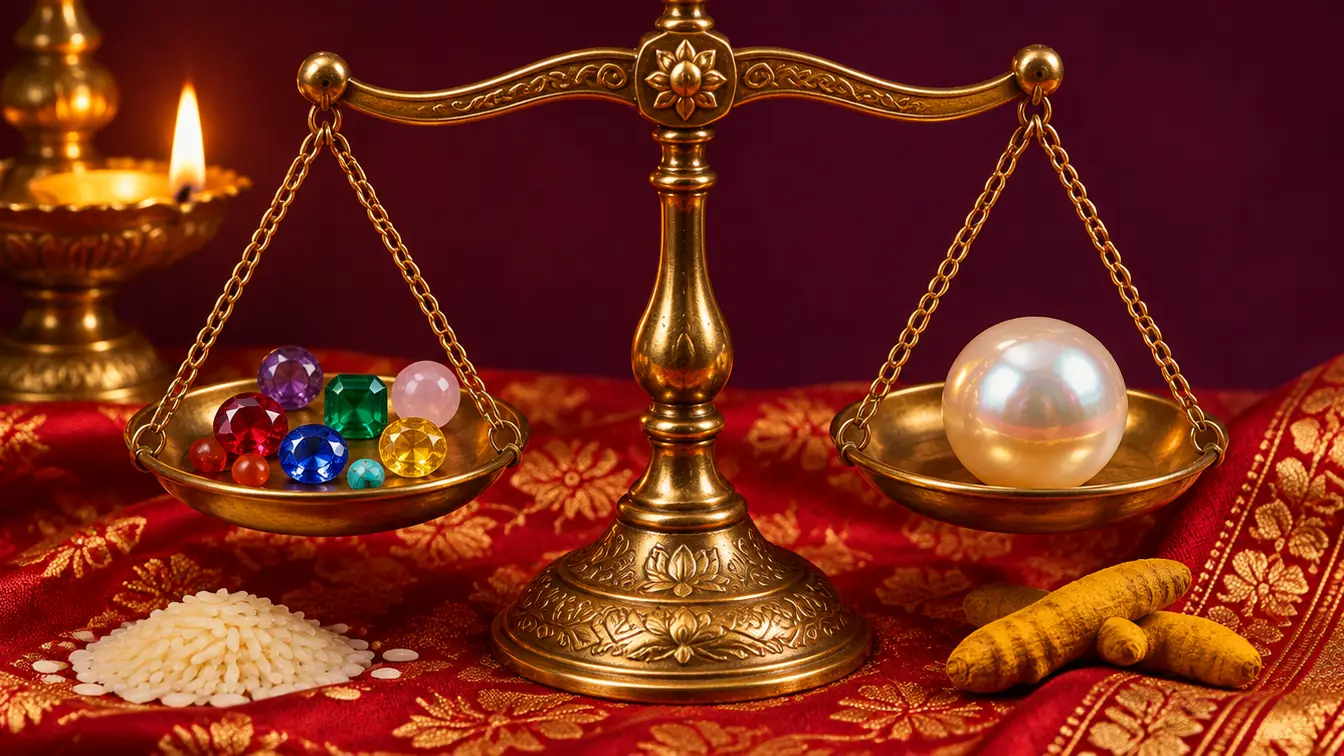
The Eight Kootas Weighed: Why Nadi Counts Eight and Varna Counts One
Guna Milan scores two Moon nakshatras across eight kootas worth 1 to 8 points, for 36 in all. Nadi (8), Bhakoot (7) and Gana (6) carry 21 of those points, so two couples with the same total can have very different profiles. Families look at which kootas scored, not only the sum.
Key takeaways
- Ashtakoota matching compares the two partners' Moons.
- The old rule gives the point when the groom's class is equal to or above the bride's.
- Every nakshatra is assigned an animal symbol, fourteen in all.
- Nakshatras are divided into three temperaments: deva (gentle), manushya (human, mixed) and rakshasa (intense).
- One mismatch in Nadi alone drops a perfect 36 to 28; a mismatch in Nadi and Bhakoot together drops it to 21.
Two couples sit down with the same printout: 24 out of 36. In the first, Nadi scored zero and nearly everything else scored full marks. In the second, Nadi and Bhakoot both scored full, while Yoni and Gana scored almost nothing. Same total, very different conversations. That is the core idea behind Guna Milan explained properly: the points are weighted, and the weighting tells you more than the sum.
Where the 36 come from
Ashtakoota matching compares the two partners' Moons. Each Moon sits in one of the 27 nakshatras, or lunar mansions, and each nakshatra falls in a Moon sign. Eight comparisons, the kootas, are scored with maximums that climb neatly from one to eight. Add 1 through 8 and you get 36.
It helps to think of them in three tiers.
The light tier: Varna, Vashya and Tara (6 points)
Varna, 1 point
Each Moon sign belongs to one of four traditional classes, grouped by element: water signs first, then fire, earth and air. The old rule gives the point when the groom's class is equal to or above the bride's. Many readers today treat Varna as outlook on work and duty and give it little weight. It is worth one point for a reason.
Vashya, 2 points
Moon signs are sorted into groups such as human, four-footed, water, wild and insect. The score reflects how easily each partner's temperament accommodates the other's. Same group scores full; some pairs score partially.
Tara, 3 points
Count the nakshatras from one partner's star to the other's, divide by nine and look at the remainder. Remainders of 3, 5 and 7 are traditionally unfavorable. The count is done in both directions, each worth one and a half points, and it is read for general wellbeing.
The middle tier: Yoni and Graha Maitri (9 points)
Yoni, 4 points
Every nakshatra is assigned an animal symbol, fourteen in all. The same animal scores full, friendly animals score well, and traditional enemy pairs such as cat and rat or snake and mongoose score zero. Families read Yoni for physical and instinctive compatibility.
Graha Maitri, 5 points
The planets ruling the two Moon signs are compared using the classical friendship table. When the rulers are the same planet or friends, the score is full; mutual enemies score zero. Many astrologers treat this as the best single indicator of whether two minds work on the same wavelength.
The heavy tier: Gana, Bhakoot and Nadi (21 points)
Gana, 6 points
Nakshatras are divided into three temperaments: deva (gentle), manushya (human, mixed) and rakshasa (intense). The same gana scores full. Deva with rakshasa scores at or near zero. Tables differ on the mixed cases, which is one reason calculators disagree.
Bhakoot, 7 points
This koota looks at how far apart the two Moon signs are. Pairs that fall 2 and 12, 5 and 9, or 6 and 8 signs from each other score zero; the rest score full. The term has a long technical history, collected in the dictionary entries for bhakuta, and the details are in the guide to the 6-8, 9-5 and 2-12 Moon pairs.
Nadi, 8 points
Each nakshatra belongs to one of three nadis: adi, madhya or antya. Different nadis score all eight points; the same nadi scores none. Tradition links this koota with health and children, which is why families react strongly to a zero. Next steps after a Nadi result walks through the recognized exceptions.
Why the weighting matters more than the total
The heavy tier holds 21 of 36 points. One mismatch in Nadi alone drops a perfect 36 to 28; a mismatch in Nadi and Bhakoot together drops it to 21. Meanwhile, a couple could lose Varna, Vashya and Tara entirely and still score 30.
So when a score comes in, the useful questions are:
- Which kootas scored zero, and which scored full?
- Do any traditional exceptions apply to the zeros?
- Does the overall pattern match what the couple already knows about themselves?
A total under 18 is conventionally treated as low, but a low matching score is a prompt for a fuller look, not a verdict.
What the points leave out
Guna Milan uses only the two Moon nakshatras. It ignores the ascendant, the seventh house and its lord, Venus, Mars, the navamsa and each person's planetary periods, all of which are part of the full kundali. That is why a full kundli matching consultation treats the score as the opening page, not the whole book. Families from the south may use the Porutham system instead, compared in Porutham or Guna Milan.
The limit of any score
No number can describe how two people treat each other on an ordinary Tuesday. Guna Milan is a traditional framework for reflection, and Astrologer and Psychic Vijayram reads it that way: useful for raising good questions, never a substitute for the couple's own judgment.
Common questions
Why do two apps give us different Guna Milan totals?
Usually because one applies traditional exceptions automatically and the other does not, or because the tables for Gana, Yoni and Vashya differ slightly between schools. A birth time close to a nakshatra boundary can also move one Moon into the next star.
Is a score of 30 or more always good?
It is a pleasant result, not a verdict. A high total can still hide a Manglik concern or a difficult seventh house, which the points do not measure at all.
Does Varna mean caste?
The labels are traditional, and many modern astrologers read Varna as a person's approach to work and duty rather than social status. With one point out of 36, it rarely decides anything.
Which kootas should we ask about first?
Nadi and Bhakoot, because together they hold fifteen points and the strongest traditional concerns. If either scored zero, ask which exceptions were checked before drawing any conclusion.
Related service
Keep reading

Nadi Dosha Came Up in Matching: Next Steps for a Chicago Family
Nadi dosha came up in your kundli matching? What the eight-point Nadi koota measures, the exceptions astrologers check, and how a family can talk it through.
Read article →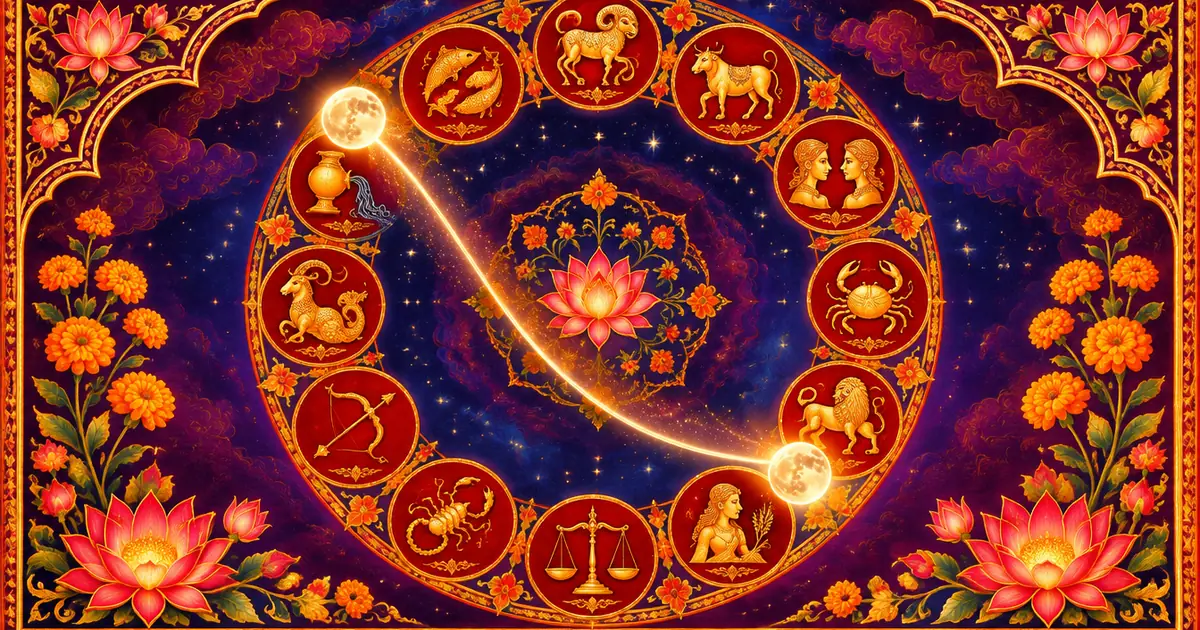
Bhakoot Dosha and the 6-8, 9-5 and 2-12 Moon Pairs
Bhakoot dosha explained: which Moon-sign distances score zero in kundli matching, the usual exceptions, and why it is weighed with both full charts.
Read article →
A Low Matching Score: What Now?
A low kundli matching score under 18 is a prompt for a fuller look, not a verdict. What to check first, which questions to ask and how families decide.
Read article →Quick answers
What is Guna Milan?
What is Guna Milan? The eight kootas behind the 36-point kundli matching score, what each one compares, and what the number cannot tell a couple or family.
Read answer →Is 18 out of 36 enough for marriage?
Is 18 out of 36 a good kundli matching score? Why 18 is the usual threshold, how doshas and cancellations change it, and why the full charts matter more.
Read answer →Talk to Astrologer and Psychic Vijayram
Tell us what you are facing. If a reading is unlikely to help, you will be told that plainly.