
Nadi Dosha Came Up in Matching: Next Steps for a Chicago Family
Nadi dosha means both partners' Moon nakshatras fall in the same nadi, so the Nadi koota scores 0 of 8. Astrologers then check traditional exceptions, such as the same Moon sign with different nakshatras, and look at the full charts. Health worries belong with a doctor. It is a reason to look closer, not to panic.
Key takeaways
- The assignment follows a zigzag through the zodiac, so each nadi holds nine nakshatras spread around the circle.
- The Moon moves fast, changing nakshatra about once a day.
- Astrologers recognize several situations in which a same-nadi result is treated as canceled or greatly softened.
- Tradition ties Nadi to health and to children, and that is usually the real source of worry.
- The eight kootas compare only the two Moons.
It often arrives as a forwarded screenshot. An aunt ran the two charts through an app, the total looked fine, and then one line stood out in red: Nadi, 0 out of 8. By dinner the whole family has heard, and someone has already said the word "dosha" in a worried voice. If that is where your household is right now, the most useful thing to know is that this result is common, has well-known exceptions, and is the start of a closer look rather than the end of a match.
What the Nadi koota actually measures
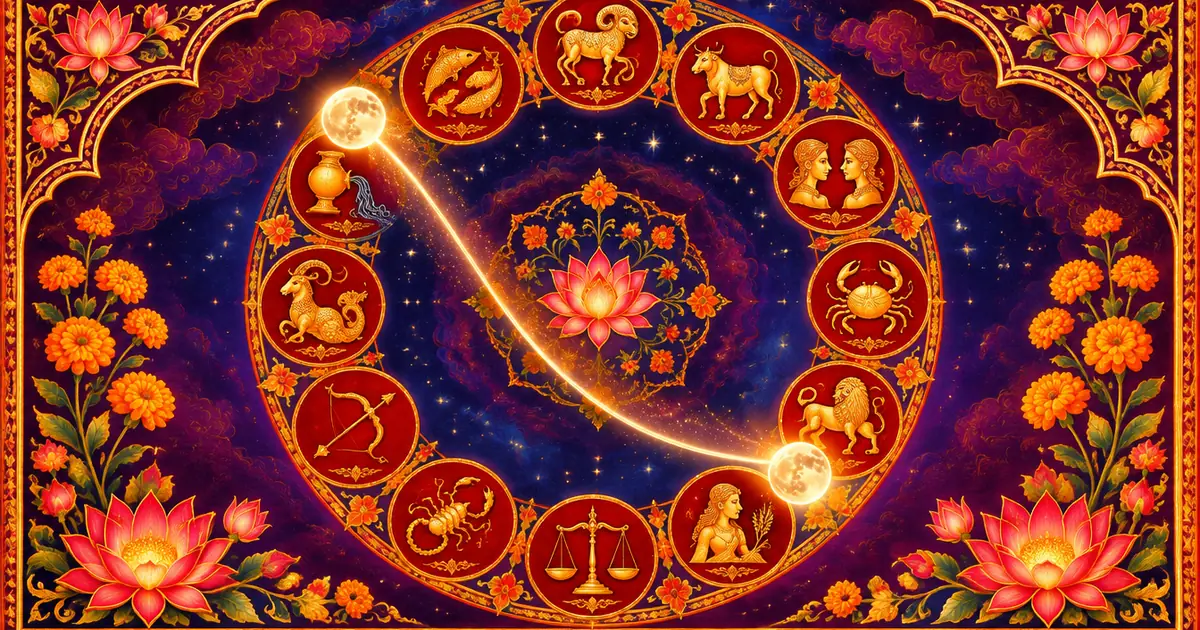
Each of the 27 nakshatras is assigned to one of three nadis: adi, madhya or antya. They are often linked to the three Ayurvedic constitutions, vata, pitta and kapha. The assignment follows a zigzag through the zodiac, so each nadi holds nine nakshatras spread around the circle.
In matching, the rule is simple. If the two partners' Moon nakshatras belong to different nadis, the koota scores all eight points. If they belong to the same one, it scores zero, and that zero is what people call Nadi dosha. Because each nadi holds a third of the stars, roughly one pair in three would share a nadi by chance. Many happy marriages carry this exact result.
Step one: check the data before the interpretation
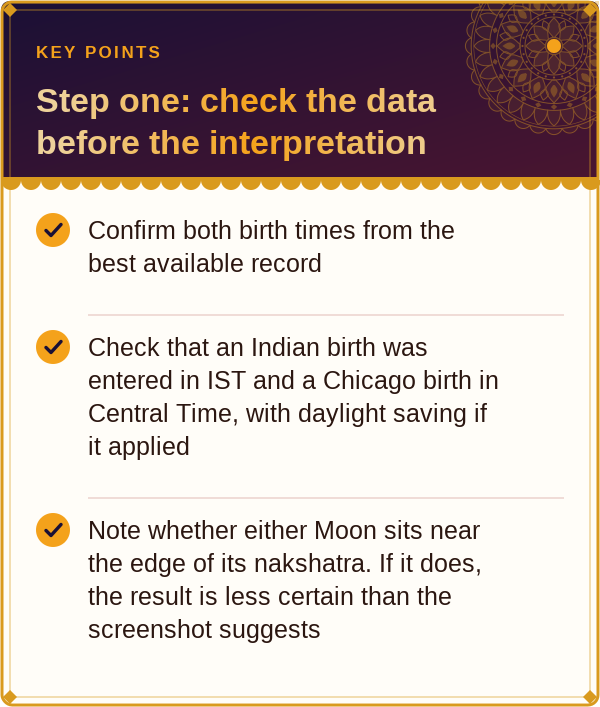
The Moon moves fast, changing nakshatra about once a day. A birth time that is off by a few hours, or a time entered with the wrong time zone, can shift a Moon into the neighboring star and change the nadi. Before anyone discusses meaning:
- Confirm both birth times from the best available record.
- Check that an Indian birth was entered in IST and a Chicago birth in Central Time, with daylight saving if it applied.
- Note whether either Moon sits near the edge of its nakshatra. If it does, the result is less certain than the screenshot suggests.
Step two: the traditional exceptions
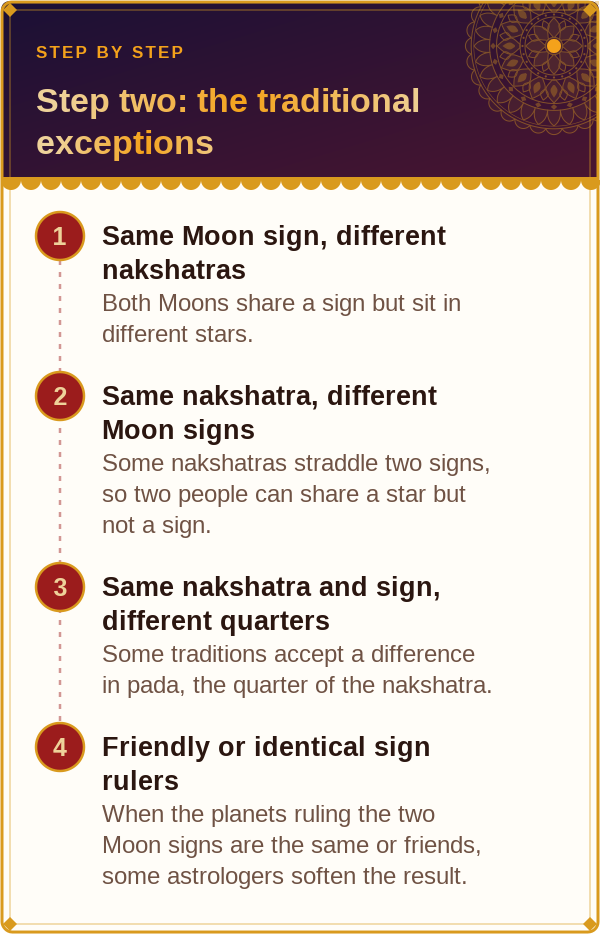
Astrologers recognize several situations in which a same-nadi result is treated as canceled or greatly softened. Schools differ on which ones they accept, but the commonly cited ones are:
- Same Moon sign, different nakshatras. Both Moons share a sign but sit in different stars.
- Same nakshatra, different Moon signs. Some nakshatras straddle two signs, so two people can share a star but not a sign.
- Same nakshatra and sign, different quarters. Some traditions accept a difference in pada, the quarter of the nakshatra.
- Friendly or identical sign rulers. When the planets ruling the two Moon signs are the same or friends, some astrologers soften the result.
A good reader will tell you which, if any, applied to your charts and why. If someone simply says "it is canceled" or "this match can never work" without explaining, ask for the reasoning.
Step three: separate the health question
Tradition ties Nadi to health and to children, and that is usually the real source of worry. A horoscope cannot test anyone's genes. If either family has a history of inherited illness, or simply wants reassurance, the right step is a conversation with a doctor about carrier screening or a referral to a genetic counselor. MedlinePlus explains what genetic counseling involves. That is practical help, and it answers the question far better than any koota can.
Step four: look at the whole of both charts
The eight kootas compare only the two Moons. A full kundli matching consultation also looks at the seventh house and its lord, Venus, Jupiter, the fifth house that tradition reads for children, the navamsa chart, and each partner's current planetary periods. A Nadi zero in two otherwise well-matched charts reads very differently from a Nadi zero alongside several other concerns, such as a Bhakoot zero, which is explained in the Moon-sign distance guide. For how the eight kootas are weighted against each other, see how the 36 points are weighted.
Step five: talk it through as a family
The conversation matters as much as the chart. A few suggestions that help Chicago families keep it calm:
- Agree on who makes the decision. In most families today, the couple decides with their parents' blessing, not the other way round.
- Let the astrologer explain the result to everyone at once, ideally on a single video call, so nobody hears a garbled version later.
- Ask what the full charts suggest, not only what the Nadi line says.
- Give it a few days. Decisions made on the evening of a red screenshot are rarely the best ones.
If a remedy is suggested
Some families find comfort in a prayer, a donation to charity or a recitation for wellbeing before the wedding. These can be meaningful if you choose them. They should be explained first, never presented as compulsory, and never sold through fear. If anyone insists a match can only go ahead after an expensive ritual, treat that as a warning sign. The note on questions to ask before paying for a dosha puja applies here too.
The honest limit
Nadi is one traditional factor among many. It cannot predict the health of a future child, and it cannot tell you whether two people will care for each other well. Astrologer and Psychic Vijayram reads it as part of a fuller picture and leaves the decision where it belongs. If the overall score is also low, what to do with a low matching score is the next useful read.
Common questions
How common is a same-nadi result?
Fairly common. Each of the three nadis holds nine of the 27 nakshatras, so if two Moons were placed at random, roughly one pair in three would share a nadi. It is not a rare or alarming finding.
Does the same nadi mean we cannot have healthy children?
No chart can say that. Tradition links Nadi with health and children, but questions about inherited conditions are answered by doctors, carrier screening and genetic counseling, not by a horoscope.
Is a Nadi puja required before the wedding?
No. Some families choose prayers, charity or a recitation such as the Mahamrityunjaya mantra for peace of mind. Any such step is optional, should be explained before you agree to it, and is never a condition for marrying.
Our app shows the dosha but our family astrologer says it is canceled. Who is right?
Possibly both. Many apps show the raw score and do not apply exceptions. Ask the astrologer which exception applies and why, so the family understands the reasoning rather than just the conclusion.
Related service
Keep reading
Bhakoot Dosha and the 6-8, 9-5 and 2-12 Moon Pairs
Bhakoot dosha explained: which Moon-sign distances score zero in kundli matching, the usual exceptions, and why it is weighed with both full charts.
Read article →
A Low Matching Score: What Now?
A low kundli matching score under 18 is a prompt for a fuller look, not a verdict. What to check first, which questions to ask and how families decide.
Read article →
Manglik Worries in Chicago Families: Five Things Parents Often Hear
Manglik dosha myths heard at Chicago family gatherings, checked against what astrologers actually say about cancellations, frequency and remedies.
Read article →Quick answers
What is Guna Milan?
What is Guna Milan? The eight kootas behind the 36-point kundli matching score, what each one compares, and what the number cannot tell a couple or family.
Read answer →Is 18 out of 36 enough for marriage?
Is 18 out of 36 a good kundli matching score? Why 18 is the usual threshold, how doshas and cancellations change it, and why the full charts matter more.
Read answer →Talk to Astrologer and Psychic Vijayram
Tell us what you are facing. If a reading is unlikely to help, you will be told that plainly.