
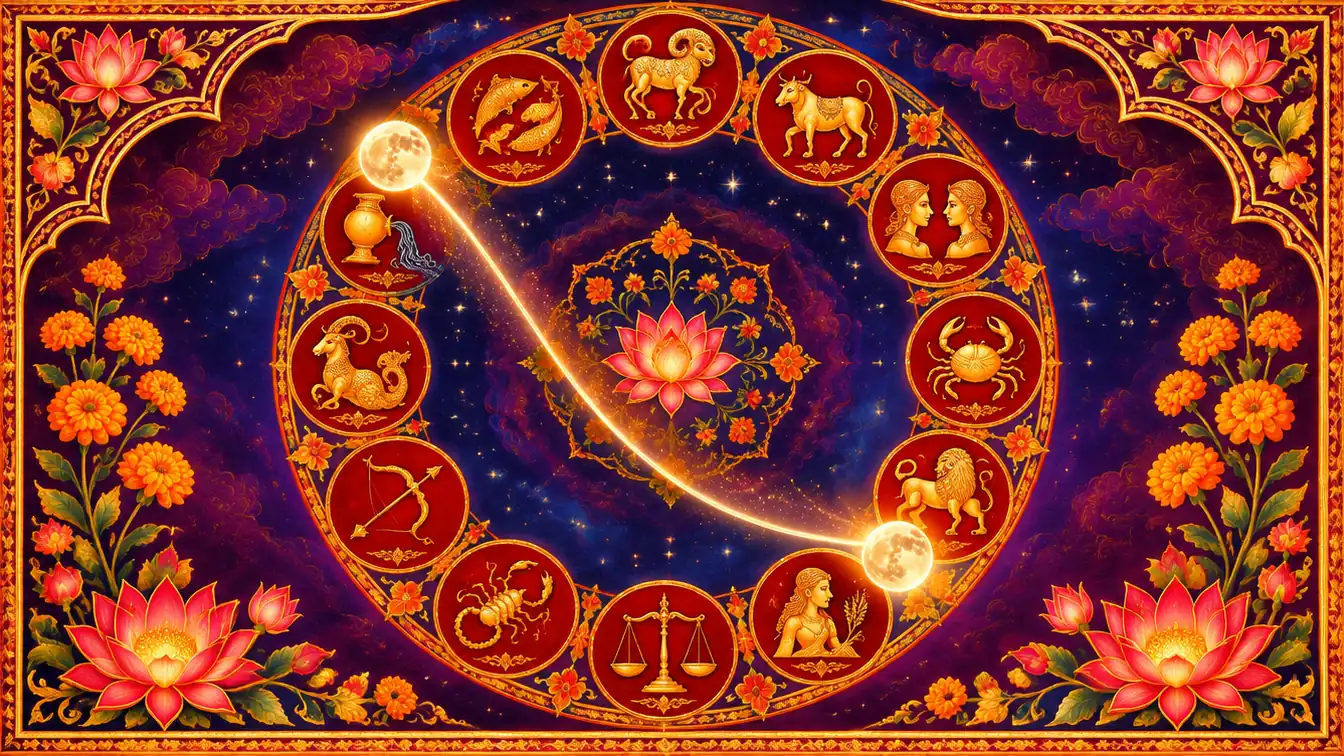
Bhakoot Dosha and the 6-8, 9-5 and 2-12 Moon Pairs
Bhakoot dosha occurs when two Moon signs sit 2 and 12, 5 and 9, or 6 and 8 signs apart, so the Bhakoot koota scores 0 of 7. It is commonly set aside when both signs share a ruling planet or the rulers are friends, and it is always weighed alongside both full charts.
Key takeaways
- Take the two partners' Moon signs from the sidereal zodiac used in Vedic astrology, the same twelve signs described in the overview of the zodiac , but measured against the fixed stars.
- Every other distance, the same sign, 3-11, 4-10 and 7-7, scores the full seven points.
- Some dosha pairs are ruled by the same planet, so the two Moons are seen as working for one master:
- Bhakoot compares two Moons, and the Moon describes emotional rhythm.
- A Bhakoot result describes two Moon positions.
The Bhakoot line on a matching report is easy to misread because it looks like a single yes or no. In fact it measures one simple thing, the distance between two Moon signs, and the result depends on counting correctly and then on reading context. This guide shows how the count works, why three particular distances score zero, and which exceptions astrologers check before treating the result as a concern.
How the count works
Take the two partners' Moon signs from the sidereal zodiac used in Vedic astrology, the same twelve signs described in the overview of the zodiac, but measured against the fixed stars. Count from one Moon sign to the other, including the starting sign as one. Then count back the other way.
Three short examples, with one partner's Moon in Aries:
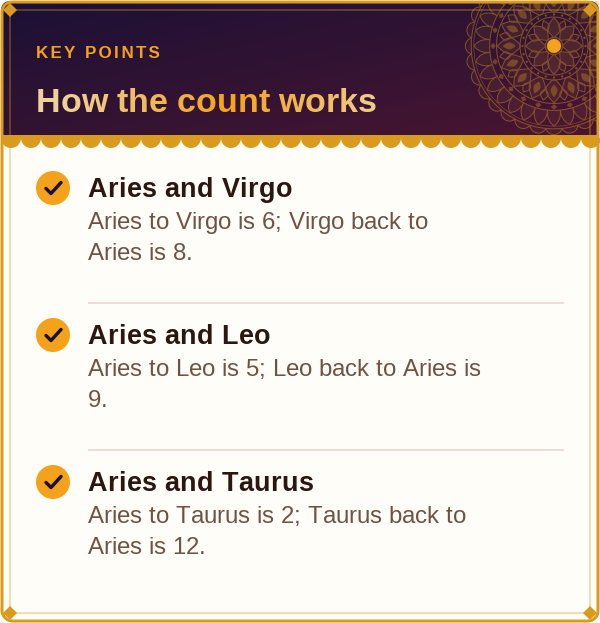
- Aries and Virgo. Aries to Virgo is 6; Virgo back to Aries is 8. A 6-8 pair.
- Aries and Leo. Aries to Leo is 5; Leo back to Aries is 9. A 9-5 pair.
- Aries and Taurus. Aries to Taurus is 2; Taurus back to Aries is 12. A 2-12 pair.
For two different signs, the two counts always add up to 14, which is a quick way to check your arithmetic.
The three pairs that score zero
| Pair | Traditional name | What tradition associates with it |
|---|---|---|
| 6-8 | Shadashtak | Friction, differing routines, and in older texts concerns about health and longevity |
| 9-5 | Nav-pancham | Differing outlooks, and in some texts matters of children; often treated as the mildest |
| 2-12 | Dwi-dwadash | Money, spending and the household budget |
Every other distance, the same sign, 3-11, 4-10 and 7-7, scores the full seven points. The term itself has a long history in Sanskrit and Marathi usage, gathered in the dictionary entries for bhakuta.
It is worth reading the right-hand column calmly. These are traditional associations about tendencies in daily life, not predictions. A 2-12 couple is not destined to argue about money; tradition simply suggests that budgeting deserves a clear conversation.
The exceptions astrologers check
Both signs share a ruling planet
The most widely accepted exception. Some dosha pairs are ruled by the same planet, so the two Moons are seen as working for one master:
- Aries and Scorpio, both ruled by Mars, form a 6-8 pair.
- Taurus and Libra, both ruled by Venus, form a 6-8 pair.
- Capricorn and Aquarius, both ruled by Saturn, form a 2-12 pair.
In all three, many astrologers treat the zero as canceled in spirit, even if a basic calculator still shows it.
The rulers are natural friends
When the two sign rulers are friends in the classical table, the result is often softened. Cancer, ruled by the Moon, and Sagittarius, ruled by Jupiter, form a 6-8 pair, but the Moon and Jupiter are friends. Leo and Pisces, ruled by the Sun and Jupiter, form another such pair.
Other supporting factors
Some readers also look at the Moons in the navamsa chart, or give weight to strong Graha Maitri and Nadi scores in the same match. Schools vary here, and a careful astrologer will tell you which rules were applied rather than just the final word.
Questions worth asking about a Bhakoot zero
When the report comes back with this line at zero, a few plain questions turn a worrying label into useful information:
- Which of the three pairs is it: 6-8, 9-5 or 2-12?
- Do the two Moon signs share a ruler, or are the rulers friends?
- Were both birth times checked, especially if either Moon sits near the start or end of a sign?
- Which school of exceptions did the astrologer follow, and would another school read it differently?
- What does the traditional association suggest the couple talk about, in practical terms?
That last question is often the most valuable. A 2-12 pair might lead to an honest talk about saving, spending and supporting parents. A 6-8 pair might lead to a talk about how each person handles stress and conflict. Those are good conversations for any engaged couple, whatever the chart says.
Why the full charts matter
Bhakoot compares two Moons, and the Moon describes emotional rhythm. Two people whose Moons sit 6-8 may simply process stress on different schedules: one wants to talk right away, the other needs a day. That is useful to know, and it is also something two attentive people can handle. The seventh house, Venus, the navamsa and each partner's planetary periods often say far more about a marriage. This is why the kundli matching consultation never stops at the eight kootas.
For how Bhakoot fits beside the other seven kootas, see how the 36 Guna Milan points are weighted. For the wider topic of Moon pairs that clash, Moon sign pairs that clash, and why they can still work goes further, and the guide to the navamsa (D9) chart explains the chart readers use to judge planet strength.
What the koota cannot tell you
A Bhakoot result describes two Moon positions. It cannot tell you whether two people respect each other, share values or will work through hard seasons together. Astrologer and Psychic Vijayram reads it as one traditional signal among many, and the decision always stays with the couple and their families.
Common questions
Is Bhakoot the same as Rashi koota?
Yes. Different regions and books use either name for the koota that compares the distance between the two Moon signs. Some South Indian systems use a related check called Rasi porutham.
Which of the three pairs is considered most serious?
Many astrologers treat the 6-8 pair as the most demanding and the 9-5 pair as the mildest, but schools disagree. All three score zero in the standard table, so the exceptions and the rest of the charts decide how much weight it gets.
Our Moons are in the same sign. Is that a problem?
Not for Bhakoot. The same sign scores full points. Other kootas, such as Nadi, are checked separately, and a shared Moon sign has its own nuances that a reader will explain.
Can a remedy remove the dosha?
Some families choose prayers or charity for peace of mind, and that is their choice to make. The dosha itself is a description of two Moon positions, which no ritual changes. What changes is how the family understands it.
Related service
Keep reading
A Low Matching Score: What Now?
A low kundli matching score under 18 is a prompt for a fuller look, not a verdict. What to check first, which questions to ask and how families decide.
Read article →
Manglik Worries in Chicago Families: Five Things Parents Often Hear
Manglik dosha myths heard at Chicago family gatherings, checked against what astrologers actually say about cancellations, frequency and remedies.
Read article →
One Partner Manglik: Why Mars' House and Sign Change the Picture
Manglik and non-Manglik marriage: how astrologers weigh Mars by house and sign, what partial (anshik) Mangal dosha means, and why the full chart decides.
Read article →Quick answers
What is Guna Milan?
What is Guna Milan? The eight kootas behind the 36-point kundli matching score, what each one compares, and what the number cannot tell a couple or family.
Read answer →Is 18 out of 36 enough for marriage?
Is 18 out of 36 a good kundli matching score? Why 18 is the usual threshold, how doshas and cancellations change it, and why the full charts matter more.
Read answer →Talk to Astrologer and Psychic Vijayram
Tell us what you are facing. If a reading is unlikely to help, you will be told that plainly.