
Porutham or Guna Milan? Matching for Chicago's South and North Indian Families
Both systems start from the Moon's nakshatra in each chart. Guna Milan, common in North Indian families, adds eight factors into a score out of 36. Porutham, used by many South Indian families, checks ten factors as pass or fail and gives special weight to Rajju. In Chicago, mixed couples often run both and compare.
Key takeaways
- Guna Milan has two kootas with no porutham twin: Varna (1 point) and Nadi (8 points).
- Guna Milan adds weighted points: Nadi alone is worth eight, Varna only one, and families often look for at least 18 of 36.
- The worst way to handle a split result is to let each family wave its own number.
- Her Moon is in Rohini, in Taurus; his is in Shatabhisha, in Aquarius.
- Sessions are by phone, WhatsApp or video in Central Time, which makes it practical for a grandparent in Chennai or Ludhiana to listen in.
Picture a couple who met through work in the Loop. Her parents are Telugu and drive out to the Balaji temple in Aurora on festival days; his family is Punjabi and lives near Devon Avenue. Both mothers want the horoscopes matched. One asks how many of the ten poruthams agree. The other asks for the score out of 36. They are asking the same question in two dialects.
Chicagoland has a long history of South and North Indian families building institutions side by side, from the Tirupati-style temple in Aurora to the Hindu Temple of Greater Chicago in Lemont, as the UCLA overview of Hindus in Chicago describes. Marriages across those lines are now common, and so is the matching puzzle.
One starting point
Both methods begin with the Moon. Each partner's birth chart places the Moon in one of the 27 lunar mansions, explained in the background on nakshatras, and most of the comparison is a set of rules about how those two stars relate. That shared root is why the systems overlap more than people expect.
Side by side
| Porutham (South Indian) | Closest Guna Milan koota | What it is said to look at |
|---|---|---|
| Dinam | Tara (3 points) | Day-to-day wellbeing, counted from one star to the other |
| Ganam | Gana (6 points) | Temperament: deva, manushya or rakshasa |
| Yoni | Yoni (4 points) | Physical and instinctive compatibility, by animal symbol |
| Rasi | Bhakoot (7 points) | How the two Moon signs sit from each other |
| Rasi Athipathi | Graha Maitri (5 points) | Friendship between the lords of the Moon signs |
| Vasya | Vashya (2 points) | Mutual attraction and influence |
| Mahendram | none | Prosperity and family growth |
| Stree Deergham | none | The bride's wellbeing, from the distance between stars |
| Rajju | none | Stars grouped by body part; the same group is avoided |
| Vedhai | none | Specific star pairs said to obstruct each other |
Guna Milan has two kootas with no porutham twin: Varna (1 point) and Nadi (8 points). The Rasi and Bhakoot rows deserve a note. Both flag certain sign distances, such as the six-eight relationship, and the definition of bhakuta gives the traditional sense of the term.
Scoring versus passing
The biggest difference is arithmetic. Guna Milan adds weighted points: Nadi alone is worth eight, Varna only one, and families often look for at least 18 of 36. Porutham usually treats each factor as matched or not matched, then looks at how many agree and, crucially, which ones. In many South Indian households a match with Rajju failing is not accepted however many others pass, and Vedhai is treated almost as seriously.
That means the two systems can disagree. A couple can score 27 of 36 and still share a Rajju. Another can score 17 and pass eight poruthams. Neither result is wrong. They weigh different things.
When the results do not agree
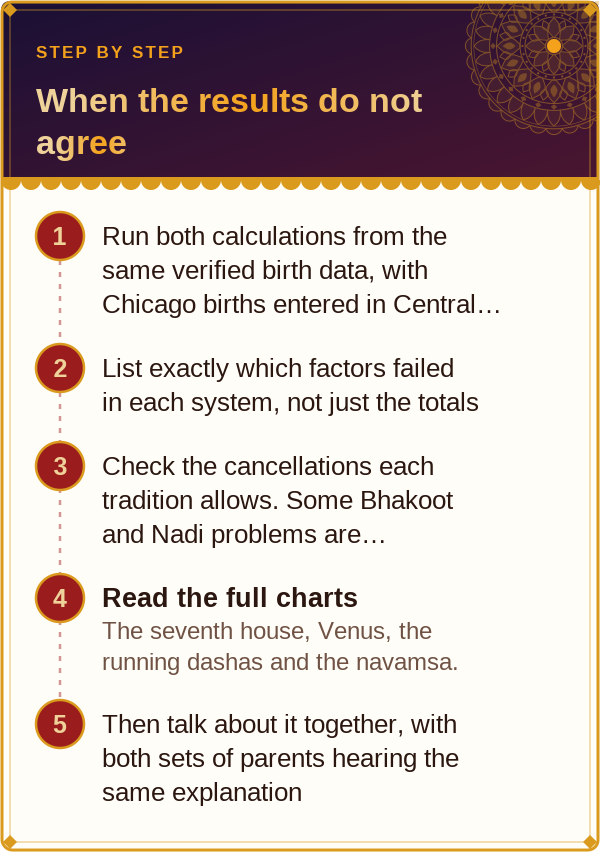
The worst way to handle a split result is to let each family wave its own number. A better order:
- Run both calculations from the same verified birth data, with Chicago births entered in Central Time.
- List exactly which factors failed in each system, not just the totals.
- Check the cancellations each tradition allows. Some Bhakoot and Nadi problems are traditionally considered canceled when the Moon-sign lords are the same or friendly.
- Read the full charts: the seventh house, Venus, the running dashas and the navamsa.
- Then talk about it together, with both sets of parents hearing the same explanation.
The service page for kundli matching for marriage explains how Astrologer and Psychic Vijayram reads Guna Milan in full and adds porutham for South Indian families. For the eight kootas in detail, see the 36 Guna Milan points explained.
A worked example
Take a hypothetical pair. Her Moon is in Rohini, in Taurus; his is in Shatabhisha, in Aquarius. Taurus and Aquarius sit four and ten signs from each other, a distance Bhakoot accepts and most South Indian practice accepts for Rasi as well. The two Moon-sign lords, Venus and Saturn, are traditionally friends, which helps Graha Maitri and Rasi Athipathi. A North Indian astrologer might report a comfortable total and move on. A South Indian astrologer would also ask which Rajju group each star falls in and whether the pair appears on the Vedhai list. If those checks pass too, both families hear the same reassurance in their own terms. If Rajju fails, the conversation shifts to what else the charts show, and what each family is prepared to weigh.
What to bring
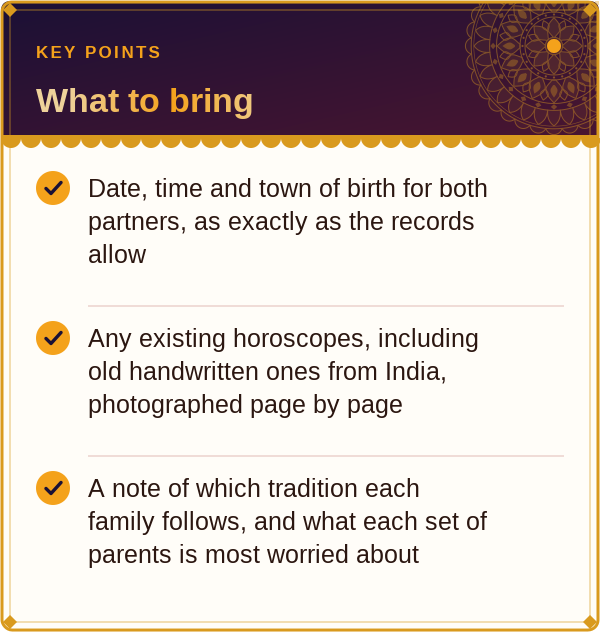
- Date, time and town of birth for both partners, as exactly as the records allow.
- Any existing horoscopes, including old handwritten ones from India, photographed page by page.
- A note of which tradition each family follows, and what each set of parents is most worried about.
Sessions are by phone, WhatsApp or video in Central Time, which makes it practical for a grandparent in Chennai or Ludhiana to listen in. If the couple was born in different countries, the post on matching a chart born in India with one born in Chicago covers the time-zone checks first.
What neither system can tell you
Ten poruthams and 36 points are traditional tools for reflection. They cannot measure whether two people communicate well, share values or will care for each other through hard years. A strong match is not a promise and a weak one is not a verdict; the couple and their families still make the decision.
Common questions
Which system is more accurate?
Neither is more accurate in any measurable sense. They are two regional traditions built on the same nakshatra framework. The useful question is which one each family trusts, and whether the two results tell a consistent story when read together.
Can the bride's and groom's charts be in different styles?
Yes. A square South Indian chart and a diamond North Indian chart show the same positions in different layouts. They only need the same birth data converted correctly. The post on redrawing a South Indian chart in the North Indian layout shows how.
Our Guna Milan score is high but Rajju does not match. What now?
Many South Indian families treat Rajju as decisive, while many North Indian families have never heard of it. Ask for the whole charts to be read, including any cancellations tradition recognizes, before anyone decides. A single factor should start a conversation, not end it.
Do we need both families on the call?
It often helps. When each side hears its own method explained in plain terms, there is less room for one set of parents to feel their tradition was ignored.
Related service
Keep reading

Kumbh Vivah and Other Manglik Customs, Explained Without Fear
Kumbh vivah for manglik dosha: what the symbolic marriage to a pot, tree or idol is meant to express, how it is done, and why it is optional, not required.
Read article →
Clouds Over the Lake on Karwa Chauth: When the Moon Hides in Chicago
Karwa Chauth moonrise time in Chicago is a local calculation, but autumn clouds often hide the Moon. What families do then, and keeping the fast safely.
Read article →
Chicago Wedding Season and Muhurta Dates: Making Both Work
Hindu wedding dates in Chicago: venues fill May to October weekends, while Chaturmas closes much of that window. Finding muhurta dates that fit both.
Read article →Quick answers
What is Guna Milan?
What is Guna Milan? The eight kootas behind the 36-point kundli matching score, what each one compares, and what the number cannot tell a couple or family.
Read answer →Is 18 out of 36 enough for marriage?
Is 18 out of 36 a good kundli matching score? Why 18 is the usual threshold, how doshas and cancellations change it, and why the full charts matter more.
Read answer →Talk to Astrologer and Psychic Vijayram
Tell us what you are facing. If a reading is unlikely to help, you will be told that plainly.