
Chicago Wedding Season and Muhurta Dates: Making Both Work
Chicago venues book fastest for May to October weekends, but many North and West Indian families avoid weddings during Chaturmas, roughly July to November. The usual overlap is late April to June, plus late November indoors. Ask for several Chicago-calculated muhurtas, then match them to venue availability, or split ceremony and reception.
Key takeaways
- Chicago's weather makes May through October the natural season for outdoor photos, baraat processions and guests flying in.
- Families who do not observe Chaturmas, or whose priest permits particular dates within it, have more summer options.
- A muhurta is a window of time judged favorable for an undertaking.
- Many Chicago couples resolve the squeeze by separating the religious ceremony from the big celebration:
- Couples planning for 2027 should start this process now, since spring weekends fill early.
Plan an Indian wedding in Chicago and you meet two calendars that do not care about each other. One belongs to banquet halls, hotels and the lakefront: the warm months fill first, and summer Saturdays go a year or more ahead. The other belongs to the tradition: auspicious dates, months many families avoid and planetary conditions that narrow the choice. With about 255,000 Indian Americans in the metro area, the second-largest such community in the US according to the overview of Indians in Chicago, plenty of couples are chasing the same few weekends.
The good news: with a little planning, the two calendars do overlap.
The squeeze
Chicago's weather makes May through October the natural season for outdoor photos, baraat processions and guests flying in. But many North and West Indian families avoid weddings during Chaturmas, the four months that begin with Shayani Ekadashi, around late June or July, and end with Prabodhini Ekadashi, usually in November. Performing lifecycle rites such as weddings in that period is traditionally considered inauspicious. That removes much of the city's best weather from the list.
Other periods many families avoid as well:
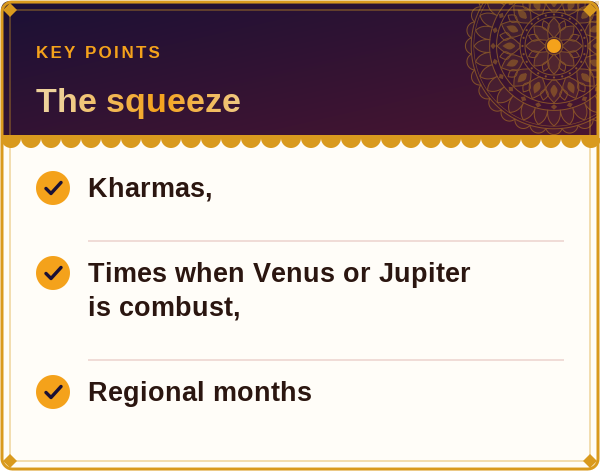
- Kharmas, when the Sun is in Sagittarius (roughly mid-December to mid-January) and in Pisces (roughly mid-March to mid-April).
- Times when Venus or Jupiter is combust, too close to the Sun to be seen. In some years this blocks several weeks or more.
- Regional months. Many Tamil families avoid Aadi, and many Telugu and Kannada families avoid Ashada, both in midsummer.
Customs differ by community, so ask your family priest which of these your family observes before you start looking.
Windows that usually work
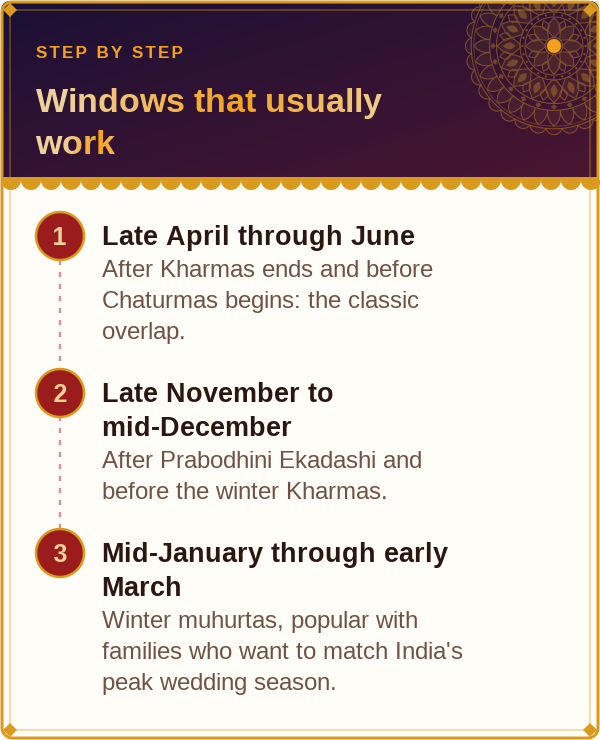
- Late April through June. After Kharmas ends and before Chaturmas begins: the classic overlap. Expect competition for venues, and book early.
- Late November to mid-December. After Prabodhini Ekadashi and before the winter Kharmas. Cold, but banquet halls are indoors anyway, and venue demand often eases after the summer rush.
- Mid-January through early March. Winter muhurtas, popular with families who want to match India's peak wedding season. The post on winter weddings in Chicago from December to February covers snow, travel and guests.
Families who do not observe Chaturmas, or whose priest permits particular dates within it, have more summer options. Ask rather than assume.
What makes a date auspicious
A muhurta is a window of time judged favorable for an undertaking. For a wedding, an astrologer looks at the tithi, the nakshatra, the weekday, the yoga, the ascendant rising at the ceremony time and the condition of Venus and Jupiter, and checks the date against both partners' charts. The post on what makes a wedding date auspicious goes through each factor.
The calculation must be made for Chicago. Sunrise, the rising sign and the hour of the Moon's change all depend on location and time zone, so a date from an Indian almanac cannot be copied across.
Splitting the ceremony and the party
Many Chicago couples resolve the squeeze by separating the religious ceremony from the big celebration:
- A smaller ceremony at the exact muhurta, perhaps on a weekday morning at a temple or a home, with close family.
- A reception on the nearest available weekend, at the venue of your choice.
- The civil paperwork on its own timeline; the post on civil paperwork and a Hindu ceremony in Illinois explains the order.
Muhurtas also do not always fall at convenient hours. Some fall in the early morning, some late at night. A good astrologer will tell you the full window, so you can choose the most practical part of it.
From shortlist to venue deposit
- Agree as families which months and customs you observe.
- Gather both partners' birth details: date, time and place.
- Ask for four to six ranked muhurta options, with the ceremony window for each.
- Take the list to venues and see which dates are open.
- Check travel for relatives from India: visa appointments, school holidays, flight prices.
- Only then sign and pay a deposit.
Couples planning for 2027 should start this process now, since spring weekends fill early. If relatives are holding the wedding in India and you live in Chicago, the post on whose time zone sets the muhurta untangles that situation.
The limits
A muhurta is a traditional way of beginning well. It is not a promise about the marriage, and a less-than-ideal date does not doom anyone. Plenty of happy couples married on the day the hall happened to be open. The wedding muhurta selection service with Astrologer and Psychic Vijayram calculates options for your Chicago venue by phone, WhatsApp or video, explains the reasoning and leaves the final choice with you and your families.
Common questions
Can we hold a Hindu wedding during Chaturmas if we have to?
Some families and communities do, especially when travel or visas leave no other choice, and some priests will help with a suitable date. Others feel strongly against it. Discuss it openly with both families and your priest before booking anything.
Should the muhurta be calculated for Chicago or for India?
For where the ceremony takes place. A muhurta depends on local sunrise, the ascendant at that moment and the Moon's position, all of which change with location and time zone. A date that works in India may fall at a different time, or not work at all, in Chicago.
Are Friday or Sunday weddings acceptable?
Yes. The weekday matters far less than the muhurta itself, and many Chicago couples choose a Friday or Sunday to find both an auspicious date and an open venue at a better rate.
How many muhurta options should we ask for?
Ask for at least four to six in your preferred months, ranked, with the reasoning for each. That gives you room to negotiate with venues without going back to the astrologer every time a date is taken.
Related service
Keep reading
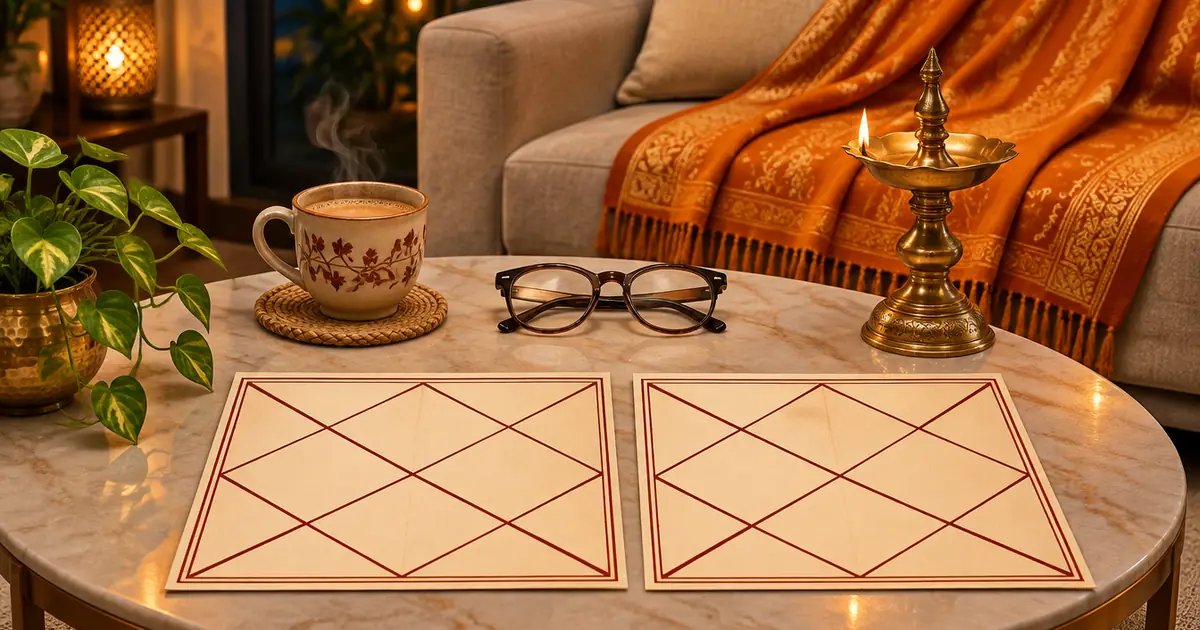
Kundli Matching for Second-Generation Chicago Couples
Kundli matching in Chicago when parents want it and the couple is unsure: a respectful middle path, what a score can and cannot say, and what to agree first.
Read article →
Two Traditions, One Wedding Date: Intercultural Couples in Chicago
Intercultural marriage astrology for Chicago couples: fitting a Hindu muhurta around a church, gurdwara or civil date so both families feel honored.
Read article →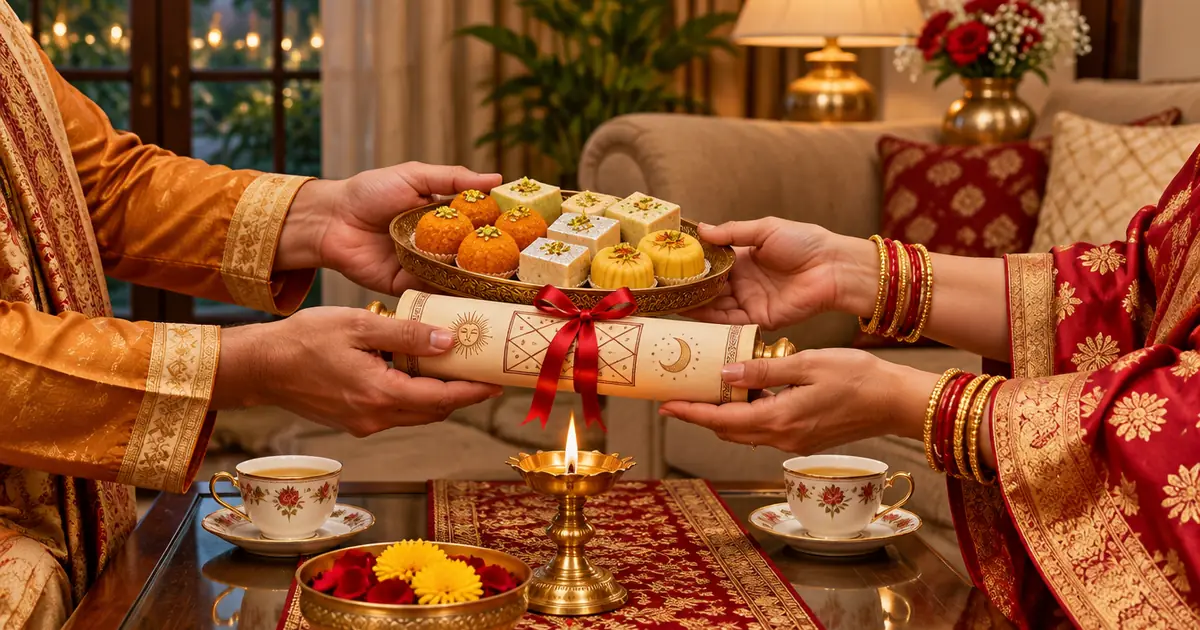
Finding a Match in Chicagoland: Where Kundli Fits Today
Indian matrimony in Chicago today: apps, family introductions and temple circles across Chicagoland, and where kundli matching fits among other inputs.
Read article →Quick answers
Can a wedding muhurta fall late at night or before dawn?
How to choose a Hindu wedding date when the muhurta falls late at night or before dawn: why the lagna sets the hour, and how couples plan the day around it.
Read answer →What is Guna Milan?
What is Guna Milan? The eight kootas behind the 36-point kundli matching score, what each one compares, and what the number cannot tell a couple or family.
Read answer →Talk to Astrologer and Psychic Vijayram
Tell us what you are facing. If a reading is unlikely to help, you will be told that plainly.