

A Wedding in India, a Home in Chicago: Whose Time Zone Sets the Muhurta?
The wedding muhurta is calculated for the city where the ceremony takes place, in that city's local time. A couple living in Chicago who marry in Jaipur or Hyderabad use a Jaipur or Hyderabad muhurta. Chicago time only matters for relatives watching by video and for planning flights, rest days and paperwork around that fixed moment.
Key takeaways
- Before anyone argues over minutes, settle the legal side with a qualified professional.
- A muhurta is a window chosen from the traditional calendar for a specific act in a specific place.
- India keeps one time zone with no daylight saving.
- Once the window is fixed, everything else can be planned around it.
- Many families avoid weddings during the monsoon months of Chaturmas, and some North Indian families also skip the weeks known as Kharmas around mid-December to mid-January.
The family group chat has two clocks in it. Aunties in Jaipur post the priest's suggested time at breakfast; cousins in Naperville read it after dinner. Someone asks the obvious question: if the bride and groom live in Chicago, should the muhurta be worked out for Chicago? The answer is no, and knowing why makes the rest of the planning much easier.
This comes up often in a metro where so many households have roots in India. The overview of Indians in Chicago describes one of the largest Indian American communities in the country, and plenty of its weddings still happen in a parent's hometown.
Paperwork comes first
Before anyone argues over minutes, settle the legal side with a qualified professional. A Hindu ceremony in India and a legally recognized marriage are not automatically the same thing. Registration rules differ by state and by the law the marriage falls under, and a couple who will sponsor a spouse or change status in the United States needs to know what documents immigration officers expect. The official U.S. Citizenship and Immigration Services site explains the family-based routes, but an immigration attorney should confirm what your own case requires. Nothing in a muhurta changes these answers.
The rule: the muhurta belongs to the mandap
A muhurta is a window chosen from the traditional calendar for a specific act in a specific place. The account of muhurta in Hindu timekeeping shows how it draws on the day's tithi, nakshatra and other elements. Some of those change at the same instant all over the world. Others do not:
- The lagna. The rising sign moves through the whole zodiac each day, roughly two hours per sign, and which sign is rising depends on where you stand. A lagna chosen for Chicago would be wrong in Jaipur.
- Sunrise. Many daily periods, including Rahu Kalam and the midday Abhijit window, are counted from local sunrise.
- The calendar date. A nakshatra running on a Saturday morning in India may be in effect on Friday evening by Chicago clocks.
So the muhurta is calculated for the city where the pheras happen, in that city's local time. Where the couple lives afterward does not enter the calculation.
What the clock says back home
India keeps one time zone with no daylight saving. Chicago runs on Central Time and changes its clocks twice a year, which means the gap moves:
| Ceremony time in India | Chicago, winter (standard time) | Chicago, summer (daylight time) |
|---|---|---|
| 7:30 a.m. | 8:00 p.m. the day before | 9:00 p.m. the day before |
| 10:15 a.m. | 10:45 p.m. the day before | 11:45 p.m. the day before |
| 8:00 p.m. | 8:30 a.m. the same day | 9:30 a.m. the same day |
Most Indian wedding seasons fall in Chicago's standard-time months, so the 11.5-hour column is the one to print for grandparents who will watch the livestream from Skokie or Schaumburg.
Working backward from the window
Once the window is fixed, everything else can be planned around it. A sequence that keeps surprises low:
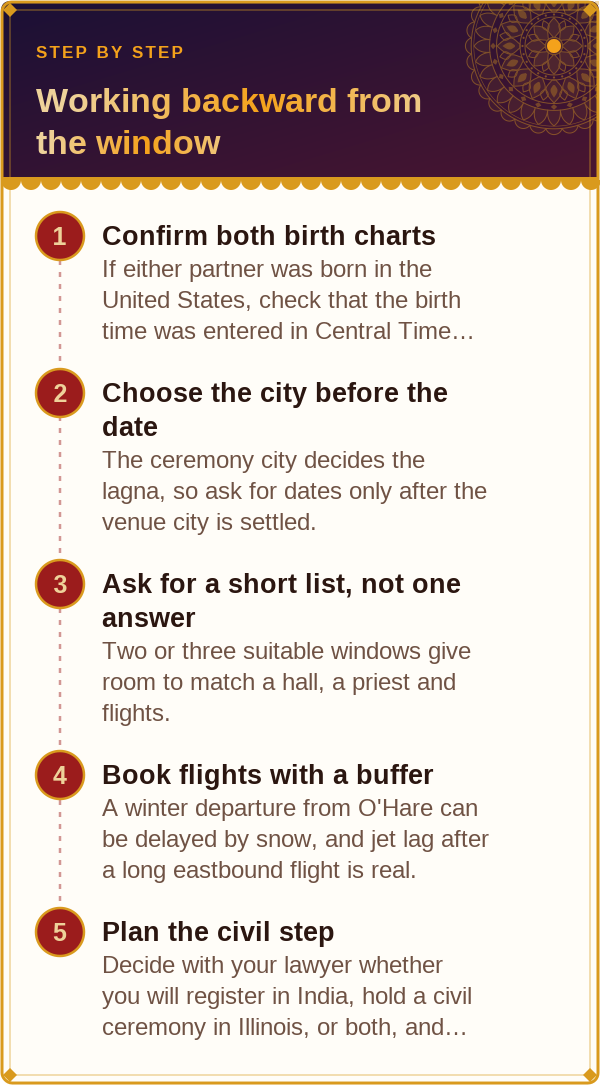
- Confirm both birth charts. If either partner was born in the United States, check that the birth time was entered in Central Time with the right daylight setting. A kundli matching session usually happens before this stage anyway.
- Choose the city before the date. The ceremony city decides the lagna, so ask for dates only after the venue city is settled.
- Ask for a short list, not one answer. Two or three suitable windows give room to match a hall, a priest and flights.
- Book flights with a buffer. A winter departure from O'Hare can be delayed by snow, and jet lag after a long eastbound flight is real. Arriving several days early protects the day itself.
- Plan the civil step. Decide with your lawyer whether you will register in India, hold a civil ceremony in Illinois, or both, and in what order. The post on ordering a civil ceremony and a Hindu wedding in Illinois looks at the choices from the Chicago side.
Two calendars, two seasons
Many families avoid weddings during the monsoon months of Chaturmas, and some North Indian families also skip the weeks known as Kharmas around mid-December to mid-January. That leaves a busy run of dates in late autumn and again in late winter, when halls in Indian cities book early. On the Chicago side, those same months bring holiday fares and winter weather. Starting the conversation a year ahead is common for that reason.
If the couple also plans a Chicago reception, it does not need to share the ceremony's timing. The guide to Chicago wedding season and muhurta dates covers choosing local dates when venue availability and the calendar pull in different directions.
Where a consultation helps
A wedding muhurta selection with Astrologer and Psychic Vijayram starts from both birth charts and the ceremony city, then works through suitable windows and explains why each one was chosen. Sessions run by phone, WhatsApp or video, scheduled in Central Time, so parents in India can join the same call at a reasonable hour on their side. You leave with times stated in the ceremony city's local time and converted to Chicago time for the relatives at home.
What a muhurta cannot do
A muhurta is a traditional way of starting something important at a considered moment. It cannot make a marriage happy, settle a visa case or replace the legal registration that protects both partners. Treat it as one careful part of the planning, not the thing everything else depends on.
Common questions
Can we use one muhurta for the wedding in India and the reception in Chicago?
No, they are separate events in separate places. The ceremony muhurta is fixed for the Indian city. A reception in the suburbs weeks later can be scheduled for convenience, and families who want an auspicious evening for it can ask for a short list of suitable Chicago dates.
Our priest in India already chose a time. Should we check it again?
A second look is reasonable if the birth details given to the priest were converted from American time zones. Births in Chicago are recorded in Central Time, and a slip there can move the Moon's nakshatra. If the inputs were right, there is usually no reason to second-guess a local priest's choice.
The best time falls before dawn. Is that normal?
Yes. Many traditional wedding windows fall late at night or in the early hours, depending on the lagna. The short answer on whether a wedding muhurta can fall late at night covers how families handle it.
Does the muhurta affect whether our marriage is legally valid?
No. Legal validity depends on registration and the law of the place where you marry, not on the time of the pheras. Ask a qualified lawyer how to register the marriage and what proof you will need back in the United States.
Related service
Keep reading
Porutham or Guna Milan? Matching for Chicago's South and North Indian Families
Porutham vs Guna Milan: how the ten South Indian matches compare with the 36-point North Indian score, and how Chicago couples from both sides can use them.
Read article →
Kumbh Vivah and Other Manglik Customs, Explained Without Fear
Kumbh vivah for manglik dosha: what the symbolic marriage to a pot, tree or idol is meant to express, how it is done, and why it is optional, not required.
Read article →
Clouds Over the Lake on Karwa Chauth: When the Moon Hides in Chicago
Karwa Chauth moonrise time in Chicago is a local calculation, but autumn clouds often hide the Moon. What families do then, and keeping the fast safely.
Read article →Quick answers
Can a wedding muhurta fall late at night or before dawn?
How to choose a Hindu wedding date when the muhurta falls late at night or before dawn: why the lagna sets the hour, and how couples plan the day around it.
Read answer →What is Guna Milan?
What is Guna Milan? The eight kootas behind the 36-point kundli matching score, what each one compares, and what the number cannot tell a couple or family.
Read answer →Talk to Astrologer and Psychic Vijayram
Tell us what you are facing. If a reading is unlikely to help, you will be told that plainly.