
Kumbh Vivah and Other Manglik Customs, Explained Without Fear
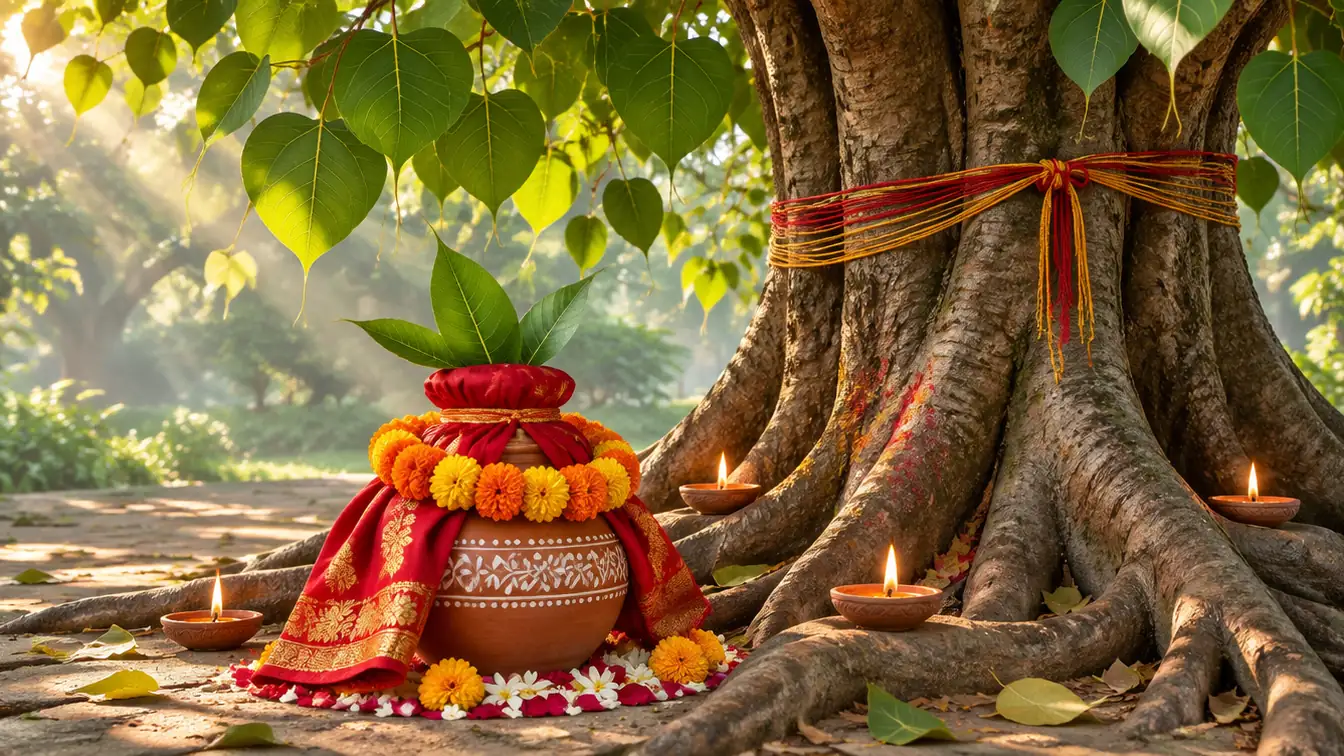
Kumbh vivah is a symbolic ritual some families perform for a person with Mangal dosha: a short ceremony in which the person is first married to a clay pot, a tree or an image of Vishnu. It expresses prayer and reassurance. It has no legal effect, and many manglik charts have cancellations that make it unnecessary.
Key takeaways
- The summary of Manglik in Vedic tradition notes how widely the condition is defined, which is why so many charts qualify.
- The details differ by region, family and priest.
- Read generously, kumbh vivah is less about Mars than about parents.
- Some families will choose the ritual anyway, out of devotion or to set a grandparent's mind at rest.
- A symbolic marriage is a prayer, not a mechanism.
Kumbh vivah sounds stranger to outsiders than it feels to the families who practice it. A young woman, usually with a parent and a priest present, is married in a short ceremony to a clay pot. Afterward the pot is set aside or immersed, and she goes on to marry the person she has chosen. The custom exists for one reason: worry about Mangal dosha.
This post explains what the ritual is meant to say, the related customs you may hear about, and why it belongs in the category of optional prayer rather than obligation.
Mangal dosha in brief
A chart is called manglik when Mars sits in certain houses, most often listed as the first, second, fourth, seventh, eighth or twelfth, counted from the ascendant and sometimes also from the Moon or Venus. The summary of Manglik in Vedic tradition notes how widely the condition is defined, which is why so many charts qualify. Mars itself, Mangala, is associated with energy, courage and heat, as the background on Mangala describes; the worry is that this heat may unsettle a marriage.
Tradition also lists many cancellations. Mars in its own sign or exaltation, certain aspects from Jupiter, and both partners being manglik are among the commonly cited ones. Some traditions also hold that the effect softens with age. A careful reading checks all of this before talking about remedies at all.
The customs you may hear about
- Kumbh vivah. A symbolic marriage to a clay pot (kumbh), often filled with water and treated as a sacred vessel.
- Vishnu vivah. A symbolic marriage to a small image of Vishnu, sometimes of silver or gold, chosen by families who prefer a devotional framing.
- Tree marriages. Some regions use a peepal or banana tree instead. The tree is honored with thread, water and prayer.
- Arka vivah. In some communities a man with the dosha is married first to the arka plant.
The details differ by region, family and priest. What they share is the idea of a first, symbolic union that takes on the feared effect, so the human marriage that follows begins with that worry addressed.
What the ritual is meant to express
Read generously, kumbh vivah is less about Mars than about parents. It gives a family a concrete act when they feel anxious about a child's future. It turns an abstract astrological warning into a prayer said aloud, with a beginning and an end. For some people that is genuinely calming, and there is nothing wrong with wanting it.
Read critically, it can also carry fear that was never necessary. Many people who were told they must perform the ritual later learn their dosha was canceled all along. That is why the order matters: understand the chart first, then decide whether a custom adds anything for you.
Why it is optional
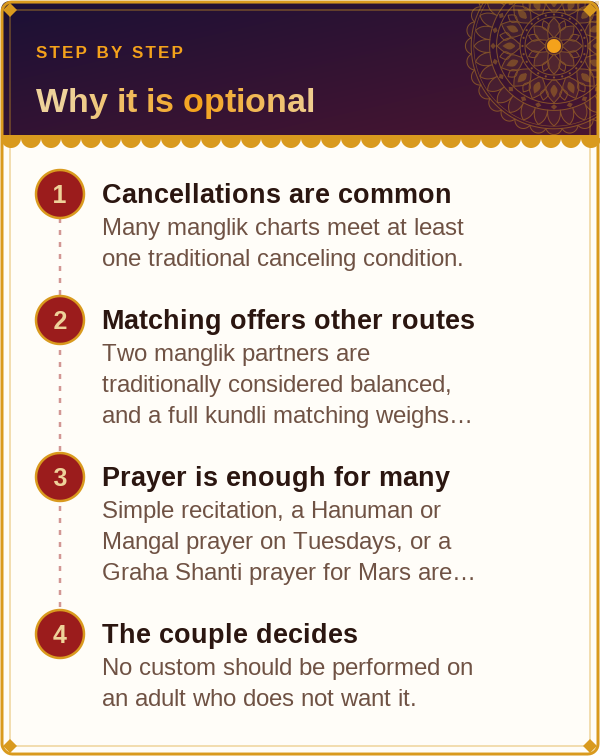
- Cancellations are common. Many manglik charts meet at least one traditional canceling condition.
- Matching offers other routes. Two manglik partners are traditionally considered balanced, and a full kundli matching weighs Mars alongside everything else.
- Prayer is enough for many. Simple recitation, a Hanuman or Mangal prayer on Tuesdays, or a Graha Shanti prayer for Mars are gentler choices some families prefer.
- The couple decides. No custom should be performed on an adult who does not want it.
If your family wants to do it
Some families will choose the ritual anyway, out of devotion or to set a grandparent's mind at rest. Reasonable conditions:
- It involves only the person, a priest and family, plus the pot, plant or image. No other person, child or animal is ever part of it.
- Its meaning and any costs are explained in advance, in plain words.
- It is not kept secret from the future spouse if that would trouble them later.
- Nobody frames it as the only thing standing between the couple and disaster.
The Manglik consultation with Astrologer and Psychic Vijayram starts with the chart, walks through cancellations, and explains customs like this one so the family can make an informed choice. For common misunderstandings, see Manglik dosha myths and facts, and for couples where only one partner is manglik, marrying across a manglik match.
Questions to ask before deciding
If a relative or priest has suggested the ritual, a few calm questions usually clarify things quickly:
- Which houses were used to call the chart manglik, and from which reference point: the ascendant, the Moon or Venus?
- Were any cancellations checked, and which ones?
- Is the partner's chart also manglik, which tradition treats as balancing the matter?
- What would the ritual involve, who would perform it, and how long would it take?
- Would a simpler prayer meet the same wish, if the family's real need is reassurance?
If the answers are vague, or the suggestion arrives with dire warnings, take time before agreeing to anything.
What kumbh vivah cannot do
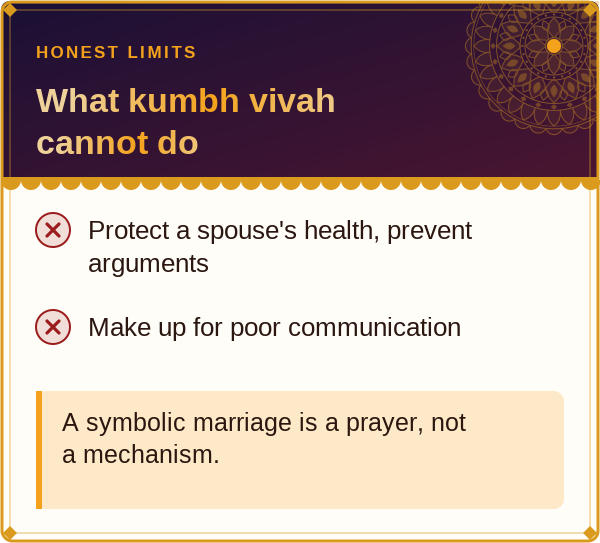
A symbolic marriage is a prayer, not a mechanism. It cannot protect a spouse's health, prevent arguments or make up for poor communication. The things that sustain a marriage are still respect, honesty and patience, and those need no ritual to begin.
Common questions
Is kumbh vivah required before marrying a non-manglik partner?
No. It is one optional custom among several. Many astrologers first check whether the dosha is canceled in the chart, which happens often, and many families simply match a manglik person with another manglik person or proceed with prayer alone.
Does the symbolic marriage count as a first marriage legally?
No. A ritual with a pot, tree or idol creates no legal marriage in Illinois or anywhere else, and it does not need to be declared on a marriage license.
Can it be done in Chicago?
Families who choose it usually arrange it with a priest they trust, privately and simply. The astrologer's role is to explain the chart and the custom, not to require or sell the ritual.
Someone told me my spouse will die unless I pay for this. Is that true?
No reading can say that, and no ethical practitioner would. Fear and payment demands together are a warning sign. The post on signs a reader is pressuring you explains how to step away.
Related service
Keep reading
Clouds Over the Lake on Karwa Chauth: When the Moon Hides in Chicago
Karwa Chauth moonrise time in Chicago is a local calculation, but autumn clouds often hide the Moon. What families do then, and keeping the fast safely.
Read article →
Chicago Wedding Season and Muhurta Dates: Making Both Work
Hindu wedding dates in Chicago: venues fill May to October weekends, while Chaturmas closes much of that window. Finding muhurta dates that fit both.
Read article →
Kundli Matching for Second-Generation Chicago Couples
Kundli matching in Chicago when parents want it and the couple is unsure: a respectful middle path, what a score can and cannot say, and what to agree first.
Read article →Quick answers
How do I check if I am Manglik?
What is Manglik dosha, and are you Manglik? Which houses Mars is checked from, the common cancellations, and a calm way to think about the result.
Read answer →What is Guna Milan?
What is Guna Milan? The eight kootas behind the 36-point kundli matching score, what each one compares, and what the number cannot tell a couple or family.
Read answer →Talk to Astrologer and Psychic Vijayram
Tell us what you are facing. If a reading is unlikely to help, you will be told that plainly.