
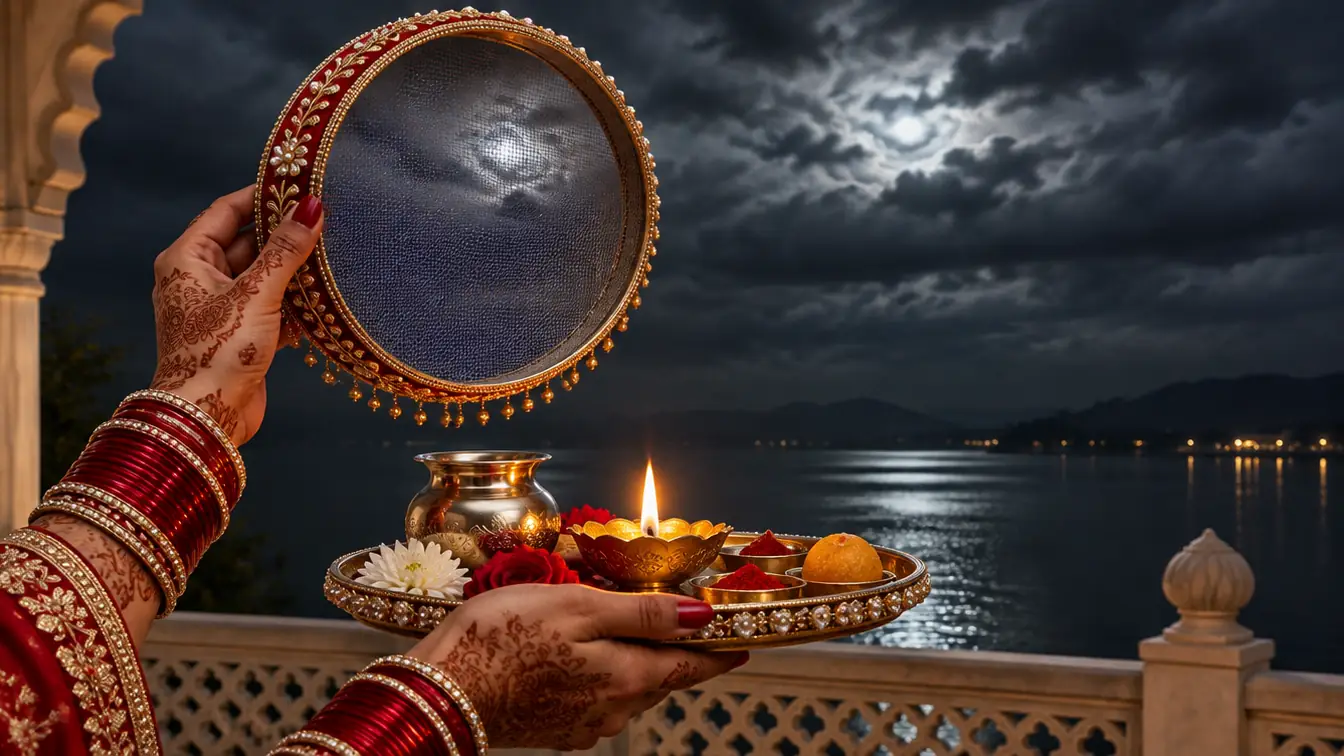
Clouds Over the Lake on Karwa Chauth: When the Moon Hides in Chicago
Karwa Chauth moonrise time in Chicago must be calculated for the city itself, using Central Time and minding daylight saving, not copied from an Indian calendar. When clouds hide the Moon, many families break the fast at the calculated moonrise, offering water toward the east, while others wait for a gap in the clouds or follow their elders' custom.
Key takeaways
- Karwa Chauth falls on the fourth day of the waning Moon in the month of Kartika, by the North Indian reckoning, usually in October or early November.
- The Moon rises at a different clock time in every city.
- Chicago's weather is shaped by Lake Michigan, as the overview of Chicago and its climate describes, and autumn evenings here can bring thick cloud that settles for hours.
- Families handle a hidden Moon in different ways.
- A full day without food or water is demanding.
By evening on Karwa Chauth, a fasting wife in Naperville or Rogers Park has usually been without food since before dawn, often without water too. The puja thali is ready, the sieve is waiting by the door, and everyone keeps checking the sky over the rooftops. Then the forecast shows a low grey ceiling rolling in off the lake. It happens often enough in Chicago that families have learned to plan for it.
What the fast is
Karwa Chauth falls on the fourth day of the waning Moon in the month of Kartika, by the North Indian reckoning, usually in October or early November. Married women fast from sunrise to moonrise for the wellbeing and long life of their husbands, then break the fast after sighting the Moon, traditionally through a sieve, and offering water. The overview of Karva Chauth notes that it is observed most widely in Punjab, Haryana, Rajasthan, Delhi, Uttar Pradesh and neighboring regions, and in Nepal. In 2026 it fell on Thursday, October 29, a working day for most of Chicagoland.
Many families begin with sargi, a meal before dawn often prepared by the mother-in-law, and gather in the evening for the katha and puja with other women. Customs differ from one community to the next.
Moonrise is a local calculation
The Moon rises at a different clock time in every city. Your relatives' time in Delhi or Ludhiana is no use in Chicago, and even a time printed for "USA" may be set for New Jersey or Texas. For the exact local moonrise, the U.S. Naval Observatory's Sun and Moon data tool gives rise and set times for any US location; enter Chicago or your suburb and the date. A panchang calculated for Chicago will give the same moment, plus the tithi.
Two details catch people out:
- Daylight saving time. Central Time switches from CDT to CST on the first Sunday of November. Karwa Chauth sometimes falls before the change and sometimes after, so check that your source uses the right offset for that date.
- Moonrise is not moon sighting. The listed time is when the Moon crosses the horizon. With buildings, trees and haze, you may not see it for a while even on a clear night.
The post on daily time windows on a Chicago panchang explains why every calculation should start from local sunrise and local coordinates.
Autumn skies over the lake
Chicago's weather is shaped by Lake Michigan, as the overview of Chicago and its climate describes, and autumn evenings here can bring thick cloud that settles for hours. Some years the Moon slips between clouds; some years it never shows at all. None of this is a sign about anyone's marriage. It is weather.
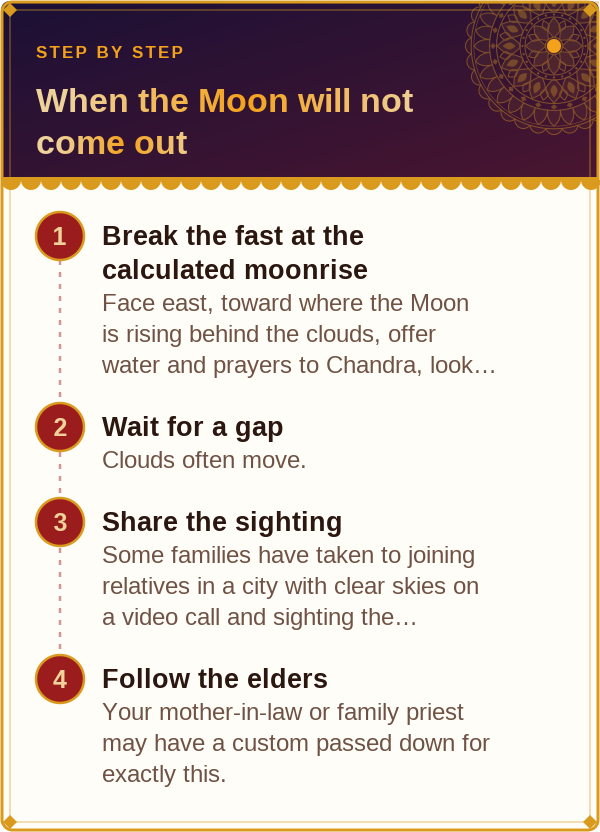
When the Moon will not come out
Families handle a hidden Moon in different ways. Common choices include:
- Break the fast at the calculated moonrise. Face east, toward where the Moon is rising behind the clouds, offer water and prayers to Chandra, look through the sieve toward that part of the sky, then at your husband. Many priests and elders consider this fully valid.
- Wait for a gap. Clouds often move. Some families agree to wait a set time after moonrise, perhaps an hour, then proceed either way.
- Share the sighting. Some families have taken to joining relatives in a city with clear skies on a video call and sighting the Moon together through the screen.
- Follow the elders. Your mother-in-law or family priest may have a custom passed down for exactly this. Ask before the day, not at nine at night.
What matters most is agreeing the plan in the morning, so nobody is anxious or hungry for longer than needed.
Keeping the fast safely
A full day without food or water is demanding. If you are pregnant, nursing, diabetic, on regular medication or have any health condition, talk to your doctor first; many women in those situations keep a modified fast with water, fruit or milk, and that is a sincere observance. Never skip prescribed medicine for a fast. During the day, avoid long drives and heavy exertion, sit down if you feel dizzy, and break the fast early if you feel unwell. Faith asks devotion, not harm.
Couples keeping it together
Chicago couples have found many ways to share the day. Some husbands fast alongside their wives. Some couples work from home that day if they can, or keep the evening clear for the puja. Newly married women far from family may join a community gathering or a friend's puja, or bring in their mother over video for the katha. The post on the first year of marriage far from both families speaks to that particular loneliness.
Where a reading fits
Karwa Chauth is a prayer for a marriage, and sometimes it brings deeper questions to the surface: about the relationship, about family expectations, about living far from home. A marriage and family harmony reading with Astrologer and Psychic Vijayram can be a calm space for those, by phone, WhatsApp or video. For exact local timings for this or any observance, a muhurta consultation calculates them for your Chicago address. A reading offers reflection and traditional guidance. It cannot guarantee anything about a marriage, and it never replaces honest conversation or, where needed, counseling.
Common questions
Is it bad luck if I never see the Moon on Karwa Chauth?
No. Weather has nothing to do with the strength of a marriage. Families have long had customs for cloudy nights, and breaking the fast at the calculated moonrise with prayer is widely accepted. No one should frighten you otherwise.
Can I use the moonrise time my relatives in India send me?
No. Their time is for their city, in India Standard Time. Chicago's moonrise has to be worked out for Chicago's own position, in Central Time, with daylight saving taken into account.
Can unmarried women keep the Karwa Chauth fast?
In some families and regions, yes, often for a future spouse. Customs vary, so follow your family's practice or ask an elder or priest you trust.
My husband wants to fast too. Is that allowed?
Many husbands now fast alongside their wives, and many couples find it meaningful. Tradition centers on the wife's fast, but nothing stops a couple from sharing it.
Related service

Keep reading

Chicago Wedding Season and Muhurta Dates: Making Both Work
Hindu wedding dates in Chicago: venues fill May to October weekends, while Chaturmas closes much of that window. Finding muhurta dates that fit both.
Read article →
Kundli Matching for Second-Generation Chicago Couples
Kundli matching in Chicago when parents want it and the couple is unsure: a respectful middle path, what a score can and cannot say, and what to agree first.
Read article →
Two Traditions, One Wedding Date: Intercultural Couples in Chicago
Intercultural marriage astrology for Chicago couples: fitting a Hindu muhurta around a church, gurdwara or civil date so both families feel honored.
Read article →Quick answers
When should a couple see a counselor instead of an astrologer?
Can astrology fix marriage problems? Signs that a licensed counselor or a safety plan should come first, and where a reading can still support reflection.
Read answer →What is Guna Milan?
What is Guna Milan? The eight kootas behind the 36-point kundli matching score, what each one compares, and what the number cannot tell a couple or family.
Read answer →Talk to Astrologer and Psychic Vijayram
Tell us what you are facing. If a reading is unlikely to help, you will be told that plainly.