
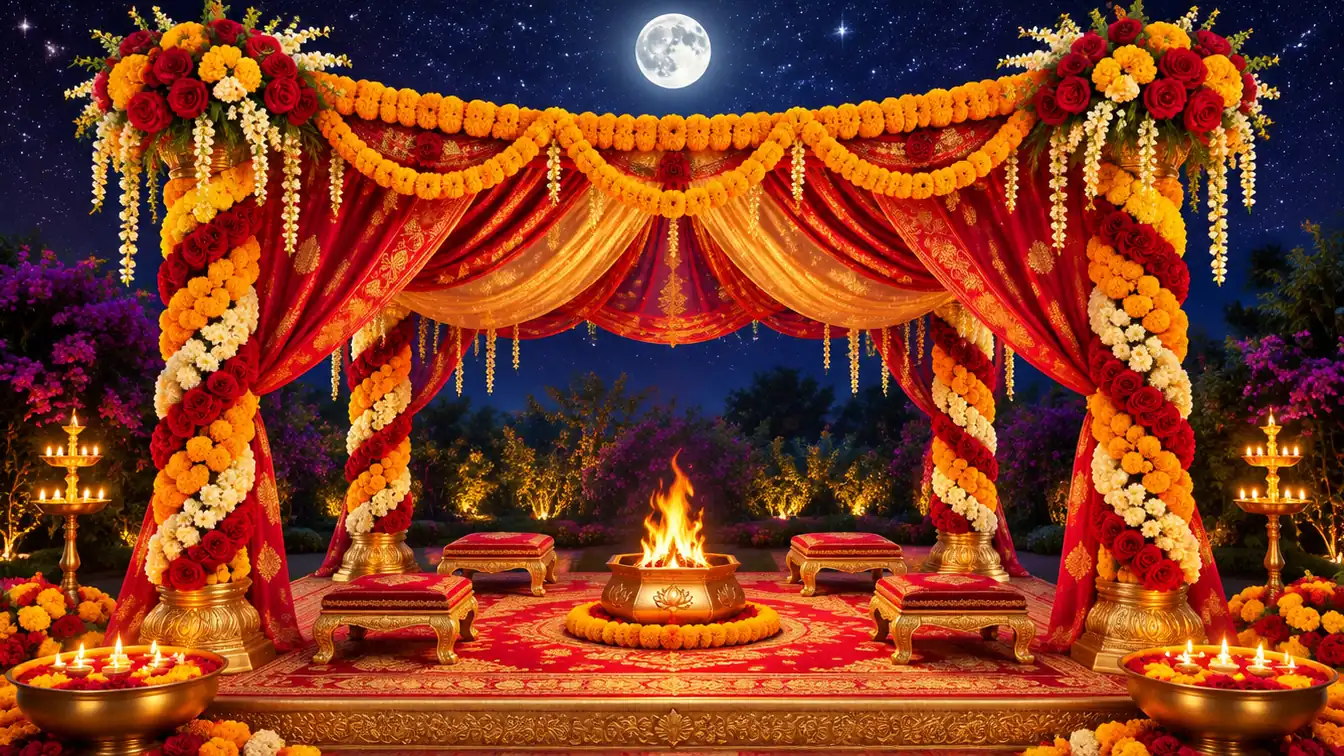
Vivah Muhurta: What Makes a Wedding Date Auspicious
A vivah muhurat combines several checks: a favorable tithi and weekday, one of the traditional wedding nakshatras, a good Moon position for both partners, and a strong rising sign (lagna) at the moment of the main ritual. Months such as Chaturmas and the Sun's passage through Sagittarius are traditionally set aside.
Key takeaways
- Before any single day is considered, whole periods are filtered out.
- Many traditions prefer the waxing half of the lunar month and avoid the fourth, ninth and fourteenth tithis, called rikta or "empty", as well as the new Moon.
- A date that is good in general must also suit the two people marrying.
- The finest layer is the lagna, the sign rising on the eastern horizon at the moment of the main ritual.
- For whether a muhurta can fall late at night or before dawn, the short answer on late-night and pre-dawn wedding muhurtas covers it.
Ask three relatives what makes a wedding date auspicious and you may hear three answers: the right nakshatra, a Thursday, a time before sunset. Each is part of the truth. A vivah muhurat is built in layers, from broad filters that rule out whole months down to the minute when the main ritual begins. Knowing those layers makes it easier to understand why an astrologer offers some dates and not others, and why the shortlist is often shorter than families expect.
Layer one: the months tradition sets aside
Before any single day is considered, whole periods are filtered out. The most familiar is Chaturmas, the four months of the monsoon season when lifecycle rites such as weddings are considered inauspicious, as the overview of Chaturmasya notes. Many families also avoid the solar months when the Sun is in Sagittarius or Pisces, often called Kharmas in the north, and the extra month that the lunisolar calendar inserts every few years. Weddings are also commonly avoided while Venus or Jupiter is combust, too close to the Sun to be seen. These conditions move from year to year, which is why last year's calendar cannot be reused.
Winter couples will find the December to February picture in winter wedding muhurta dates, and the combustion rule in combust planets close to the Sun.
Layer two: the day
Tithi
The lunar day matters. Many traditions prefer the waxing half of the lunar month and avoid the fourth, ninth and fourteenth tithis, called rikta or "empty", as well as the new Moon.
Weekday
Monday, Wednesday, Thursday and Friday are widely preferred. Many families avoid Tuesday. The weekday usually carries less weight than the other factors.
Nakshatra
Classical muhurta manuals list a set of wedding nakshatras. The list most often quoted has eleven: Rohini, Mrigashira, Magha, Uttara Phalguni, Hasta, Swati, Anuradha, Mula, Uttara Ashadha, Uttara Bhadrapada and Revati. A day whose Moon sits in one of them is a strong candidate.
Yoga and karana
Two further divisions of the day are checked. Certain yogas, such as Vyatipata and Vaidhriti, and the karana called Vishti or Bhadra, are traditionally avoided for celebrations.
Layer three: the couple
A date that is good in general must also suit the two people marrying. The reader checks the day's Moon against each partner's birth Moon, a test called chandrabala, and the day's nakshatra against each birth star, called tarabala. Older practice also looked at Jupiter's transit for the bride and the Sun's for the groom; many astrologers now look at both for both partners. A date that troubles one partner's Moon is usually set aside, however good it looks otherwise.
Layer four: the moment
The finest layer is the lagna, the sign rising on the eastern horizon at the moment of the main ritual. The general idea of muhurta is to begin important acts under favorable conditions, and for a wedding that means choosing a lagna with benefic planets in strong houses, the seventh house of the muhurta chart clear of afflicting planets, and the eighth house unoccupied by malefics. Fixed or dual signs are often preferred for their steadiness.
Which moment is timed depends on the community. The overview of the Hindu wedding describes the many rites involved, and the saptapadi, the seven steps, is central for many families. Others time the kanyadaan or the tying of the mangalsutra. Some North Indian families also value godhuli, the dusk hour, as a traditional wedding time.
Chicago-specific details
- Local calculation. Tithi changes, sunrise-based windows and the rising sign must be calculated for Chicago, not taken from an Indian almanac. The post on why local sunrise matters on a Chicago panchang explains the difference.
- How long a lagna lasts. Rising signs do not all take two hours. At Chicago's latitude some pass in about an hour and others last much longer, so the length of the ceremony needs to fit inside the chosen sign.
- Priest timing. Rituals before the timed moment take a while. Work out with the priest when the ceremony must start for the key rite to fall in the window.
- Venue rules. Halls have curfews and set-up times, which may rule out some evening or late-night muhurtas.
If the wedding is in India and the couple lives here, see whose time zone sets the muhurta. For whether a muhurta can fall late at night or before dawn, the short answer on late-night and pre-dawn wedding muhurtas covers it.
Putting it together
Put through all four layers, a year may yield only a handful of excellent dates and a larger set of good ones. A practical wedding muhurta consultation starts from the dates your venue and priest can offer, then filters them through these layers and explains the reasons for each date on the final list. Astrologer and Psychic Vijayram offers these sessions by phone, WhatsApp or video.
What a muhurta cannot do
An auspicious moment is a traditional blessing on a beginning. It cannot make a marriage happy, and a slightly imperfect date chosen with love and care is far better than a perfect one chosen under strain.
Common questions
Which part of the wedding does the muhurta time?
It depends on the community. Many time the pheras or the saptapadi; others time the kanyadaan or the tying of the mangalsutra. Tell your priest and your astrologer which moment your family treats as central, so both plan for the same minute.
Why do two astrologers give different dates for the same year?
They may follow different regional calendars, apply different month restrictions, or weigh the partners' Moon positions differently. A good astrologer will explain the reasons, which makes comparing advice much easier.
Is a night-time muhurta acceptable?
Yes, in many traditions. Night and pre-dawn muhurtas are common in parts of India. In Chicago, the question is usually whether the venue and guests can manage the hour.
We can only marry on a Saturday. Is that a problem?
Many families prefer other weekdays, but plenty accept a Saturday when the other factors are good. The tithi, nakshatra and lagna usually carry more weight than the weekday alone.
Related service
Keep reading

Upapada Lagna and the Second From It: What Sustains a Marriage
Upapada lagna in simple words: how this Jaimini point is found, why tradition reads the second house from it for a lasting marriage, and how to read it calmly.
Read article →
Reading Two Charts for the Year Ahead: A Married Couple's Annual Forecast
A couples yearly horoscope, done properly: how both partners' dashas and transits are laid side by side for the year ahead, so you can plan rather than worry.
Read article →
Seventh-House Transits: When Saturn or Jupiter Crosses the Marriage House
Saturn or Jupiter transiting the 7th house: what tradition says these long transits bring to a marriage, read as seasons to work with rather than threats.
Read article →Quick answers
Can a wedding muhurta fall late at night or before dawn?
How to choose a Hindu wedding date when the muhurta falls late at night or before dawn: why the lagna sets the hour, and how couples plan the day around it.
Read answer →What is Guna Milan?
What is Guna Milan? The eight kootas behind the 36-point kundli matching score, what each one compares, and what the number cannot tell a couple or family.
Read answer →Talk to Astrologer and Psychic Vijayram
Tell us what you are facing. If a reading is unlikely to help, you will be told that plainly.