

Upapada Lagna and the Second From It: What Sustains a Marriage
The Upapada lagna is the arudha, or reflected image, of the twelfth house, and Jaimini astrology reads it for marriage. The second house from it is traditionally linked with what sustains the marriage over time. Benefic influence there is read as support; heavy influence as a call for care, never as a fixed outcome.
Key takeaways
- In Jaimini astrology, every house has an arudha pada, a reflected image showing how that house's matters appear in the world rather than how they feel from the inside.
- In any chart, the second house relates to sustenance: family, food, savings, the things that keep life going.
- Modern readers who use the UL tend to translate those verses into practical language:
- A careful reading compares it with the seventh house and its lord, described in the seventh lord in each house , with Venus, and with the navamsa chart.
- The UL is an elegant idea: marriage seen through what nourishes it.
Sooner or later, anyone who looks closely at a marriage chart meets two letters: UL. Software prints it, astrologers mention it, and relatives who follow Jaimini astrology ask about it. The technique behind it is old and a little intricate, but the core idea is simple enough to explain in a few paragraphs, and it is a gentle one at heart. It asks what sustains a marriage, not only whether one happens.
Arudha in one paragraph
In Jaimini astrology, every house has an arudha pada, a reflected image showing how that house's matters appear in the world rather than how they feel from the inside. To find it, count from the house to the sign where its ruling planet sits, then count the same number of signs again from that planet. The sign you land on is the arudha. The Upapada is the arudha of the twelfth house. The classical source, chapter 30 of Brihat Parashara Hora Shastra on the Upapada, calls it the secondary pada and opens by tying it to happiness from spouse and children.
Why the twelfth house? Tradition links it with private life, the bed a couple shares, and what one person gives up for another. Its image in the world, the Upapada, becomes a marker for marriage itself.

A worked example
Take a chart with an Aries ascendant.
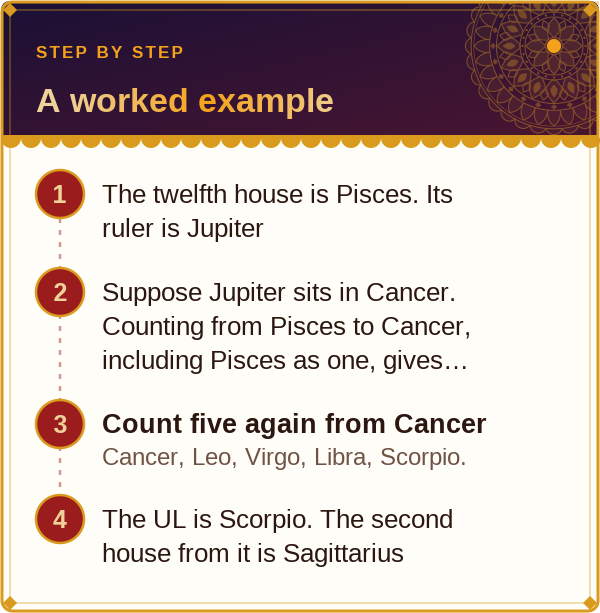
- The twelfth house is Pisces. Its ruler is Jupiter.
- Suppose Jupiter sits in Cancer. Counting from Pisces to Cancer, including Pisces as one, gives five.
- Count five again from Cancer: Cancer, Leo, Virgo, Libra, Scorpio.
- The UL is Scorpio. The second house from it is Sagittarius.
There is a special rule for when the count lands back on the twelfth house itself or on the sign opposite it; a reader applies that adjustment. Jaimini astrology also uses co-rulers for Scorpio and Aquarius, which can change the count in some charts.
Why the second house from the UL matters
In any chart, the second house relates to sustenance: family, food, savings, the things that keep life going. Counted from the UL, the second house is read as what sustains the marriage over time. This is the house tradition watches when asking whether a partnership endures.
The classical verses are direct. When the second from the UL falls in a benefic sign or receives benefic aspects, the text affirms happiness in marriage. When it is heavily afflicted, for example by Saturn and Rahu together, the text links it with strain and separation. Importantly, the same chapter also says that benefic aspect or conjunction prevents the harsher outcomes it describes. The tradition never meant a single placement to be read in isolation.
Reading it calmly today
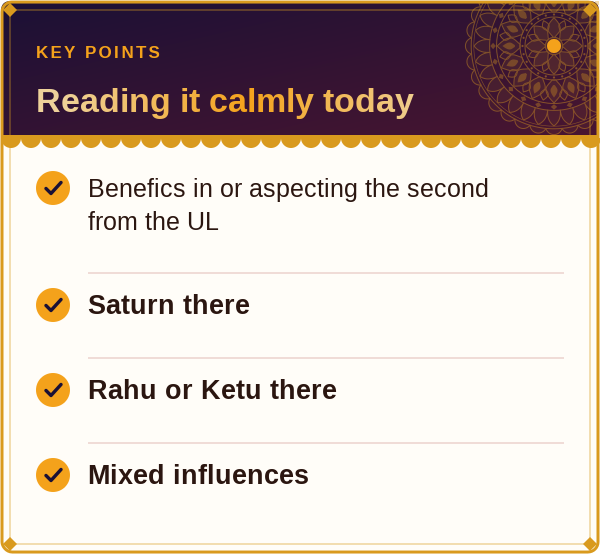
Modern readers who use the UL tend to translate those verses into practical language:
- Benefics in or aspecting the second from the UL suggest natural sources of support: warmth, family backing, shared comforts.
- Saturn there suggests a marriage that is sustained through patience, duty and steady effort, often stronger with time.
- Rahu or Ketu there suggests unconventional supports, distance, or a need to define the marriage on the couple's own terms.
- Mixed influences are the norm, and the reader weighs them.
Some passages in the old text describe illnesses of a spouse and use language from a very different era. Responsible readers do not repeat those as predictions. They are part of the history of the technique, not a guide to anyone's life.
How the UL fits with everything else
The UL is one view among several. A careful reading compares it with the seventh house and its lord, described in the seventh lord in each house, with Venus, and with the navamsa chart. Jaimini astrology adds the chara karakas, a set of variable significators described in the overview of the atmakaraka and chara karakas; one of them, the darakaraka, is read for the spouse, as explained in the planet said to describe a partner. When these views agree, a reader speaks with more confidence. When they disagree, the honest answer is a mixed picture.
The marriage timing consultation brings the Upapada in where it helps, especially when a client asks what will keep a marriage steady rather than when it will begin. Couples comparing two charts can ask for it within a two-chart compatibility reading.
Why it is never a verdict
The UL is an elegant idea: marriage seen through what nourishes it. That is exactly why it should not be used to frighten anyone. Astrologer and Psychic Vijayram reads it, when it is relevant, as a description of supports and pressures, and leaves the shape of the marriage to the two people building it.
The limit
No arudha, house or planet can tell you whether a marriage will last. Endurance comes from how two people treat each other through ordinary and difficult years, which no technique can calculate.
Common questions
Is the Upapada more important than the seventh house?
Neither replaces the other. The seventh house describes partnership in the Parashari approach; the Upapada adds a Jaimini view of how marriage shows up and holds together. Readers who use both look for agreement between them.
My app shows UL in a different sign from my astrologer's chart. Why?
Usually because of the special rule for when the count lands on the twelfth house itself or the sign opposite it, which some software handles differently. Co-rulers of Scorpio and Aquarius used in Jaimini astrology can also change the result.
Saturn sits in the second from my UL. Should I worry?
No. Saturn there is traditionally read as a call for patience and steady effort in what keeps a marriage going. The classical text itself says benefic support modifies such placements, and the rest of the chart matters as much.
Can the Upapada describe my partner?
Tradition reads the sign of the UL and planets connected with it for qualities of the spouse and the marriage. Read as tendency, it can be an interesting reflection; it is not a portrait.
Related service

Keep reading
Reading Two Charts for the Year Ahead: A Married Couple's Annual Forecast
A couples yearly horoscope, done properly: how both partners' dashas and transits are laid side by side for the year ahead, so you can plan rather than worry.
Read article →
Seventh-House Transits: When Saturn or Jupiter Crosses the Marriage House
Saturn or Jupiter transiting the 7th house: what tradition says these long transits bring to a marriage, read as seasons to work with rather than threats.
Read article →
The First Year of Marriage in Chicago, Far From Both Families
First year of marriage advice for Chicago newlyweds far from both families: settling roles, festivals for two, the long winter, and where a reading can help.
Read article →Quick answers
Which planets do astrologers check for marriage timing?
When will I get married? Astrology reads Venus, Jupiter, the seventh lord and their dasha periods, which point to favorable windows rather than fixed dates.
Read answer →What is Guna Milan?
What is Guna Milan? The eight kootas behind the 36-point kundli matching score, what each one compares, and what the number cannot tell a couple or family.
Read answer →Talk to Astrologer and Psychic Vijayram
Tell us what you are facing. If a reading is unlikely to help, you will be told that plainly.