

Darakaraka: The Planet Said to Describe a Partner
The darakaraka is a Jaimini indicator: among the planets in your chart, the one with the lowest degree within its sign. Tradition reads it as describing qualities of a spouse or long-term partner. It is found by comparing degrees only, ignoring signs, and it is one clue among many, not a portrait of a specific person.
Key takeaways
- Vedic astrology uses the word karaka, significator, in two ways.
- Readers also look at the sign and house the DK occupies, its strength, the planets with it, and especially its place in the navamsa, the ninth divisional chart used for marriage.
- Most planets move slowly enough that a few minutes' error in birth time will not change their degrees much.
- A love timing reading with Astrologer and Psychic Vijayram can include the DK alongside the seventh house, Venus, and the dasha periods that tradition associates with partnership.
Most people who learn a little Vedic astrology start with the seventh house for marriage and Venus for love. Then someone mentions the darakaraka, and a new question opens: is there a single planet that describes the person I will marry? The tradition says there is a planet that points toward some of that person's qualities. It is worth understanding both what that means and what it does not.
Two kinds of significator
Vedic astrology uses the word karaka, significator, in two ways. Fixed karakas are the same for everyone: Venus for spouse, Jupiter for children, the Sun for father, and so on. Chara karakas, "movable" significators, change from chart to chart. They come from the Jaimini system and are set out in classical texts, including the chapter on karakas in Brihat Parashara Hora Shastra.
Chara karakas are assigned by degree. The planet with the highest degree becomes the atmakaraka, the significator of the self, described in the overview of the atmakaraka. The planet with the lowest degree becomes the darakaraka, often shortened to DK: dara means wife or spouse.
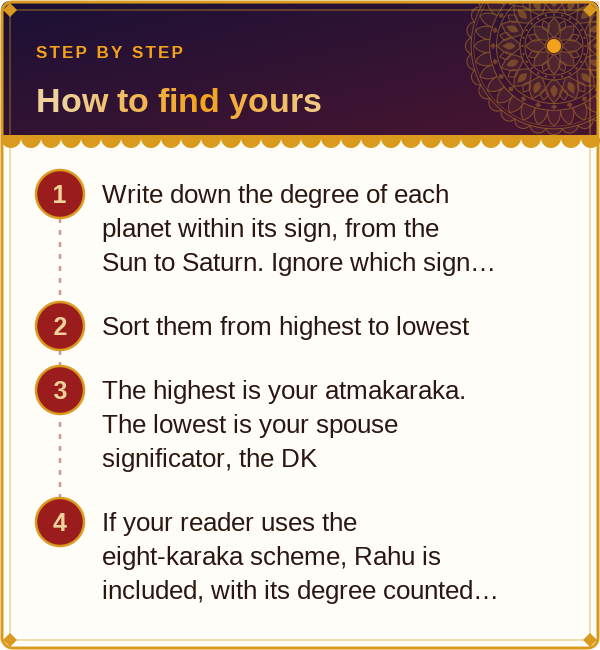
How to find yours
- Write down the degree of each planet within its sign, from the Sun to Saturn. Ignore which sign it is in; only the degree from 0 to 30 matters.
- Sort them from highest to lowest.
- The highest is your atmakaraka. The lowest is your spouse significator, the DK.
- If your reader uses the eight-karaka scheme, Rahu is included, with its degree counted backward from 30 because it moves in reverse.
| Planet (example chart) | Degree in sign | Karaka |
|---|---|---|
| Mercury | 27°40' | Atmakaraka (highest) |
| Moon | 22°15' | Second |
| Jupiter | 18°02' | Third |
| Sun | 14°30' | Fourth |
| Saturn | 11°48' | Fifth |
| Mars | 9°05' | Sixth |
| Venus | 3°21' | Darakaraka (lowest) |
In this example Venus is the DK. That doubles Venus's role, since it is also the fixed significator of spouse, and a reader would pay close attention to its condition.
What each planet is said to describe
These are traditional sketches of a partner's qualities, not predictions about a specific person:
- Sun: dignified, proud, possibly a leader or someone with authority.
- Moon: caring, emotional, attentive to home and family.
- Mars: energetic, direct, courageous, sometimes quick-tempered.
- Mercury: youthful, witty, communicative, curious.
- Jupiter: wise, principled, generous, perhaps a teacher or advisor.
- Venus: artistic, affectionate, refined, fond of comfort.
- Saturn: mature, serious, hardworking, dependable.
Where it sits matters
The planet is only the start. Readers also look at the sign and house the DK occupies, its strength, the planets with it, and especially its place in the navamsa, the ninth divisional chart used for marriage. Some also compare it with the upapada lagna, another Jaimini point for marriage, explained in the post on upapada lagna and the spouse.
A note on birth time
Most planets move slowly enough that a few minutes' error in birth time will not change their degrees much. The Moon is the exception: it moves about 13 degrees a day, roughly half a degree an hour. If the Moon's degree is close to another planet's near the bottom of the list, an inaccurate birth time can change which planet ends up last. If your time is uncertain, the post on rectifying a birth time from life events explains the options.
The self and the partner, side by side
Because the atmakaraka and the DK come from the same list, Jaimini readers often compare them. If the two planets are natural friends, such as the Sun and Jupiter, tradition reads more ease between what you want for yourself and what you seek in a partner. If they are natural enemies, such as the Sun and Saturn, readers may describe a partnership that asks both people to stretch. Neither is good or bad. It simply suggests where effort may go.
Some readers also look at the navamsa sign of the atmakaraka, called the karakamsa, and count from it to see where the DK falls. These refinements belong to a full reading rather than a quick lookup.
Common misunderstandings
- "My DK is Mars, so my partner will be angry." Mars describes energy and directness; temper is only one way that can show.
- "The person I am dating does not match my DK, so they are wrong for me." No single indicator can rule anyone in or out.
- "Online calculators all agree, so it must be right." They agree only if they use the same ayanamsa, the same birth time and the same seven- or eight-planet scheme.
Reading it in context
A love timing reading with Astrologer and Psychic Vijayram can include the DK alongside the seventh house, Venus, and the dasha periods that tradition associates with partnership. Seen together, they give a more balanced picture than any single indicator.
What the darakaraka cannot do
It cannot identify a specific person, tell you whether someone you are dating is "the one," or replace getting to know a real human being. It offers a traditional sketch of qualities that may feature in a partnership, useful for reflection and nothing more.

Common questions
My darakaraka is Saturn. Does that mean my spouse will be much older?
Not necessarily. Saturn as darakaraka is read as describing a mature, serious or responsible partner, which may or may not mean older in years. Other factors in the chart change the picture.
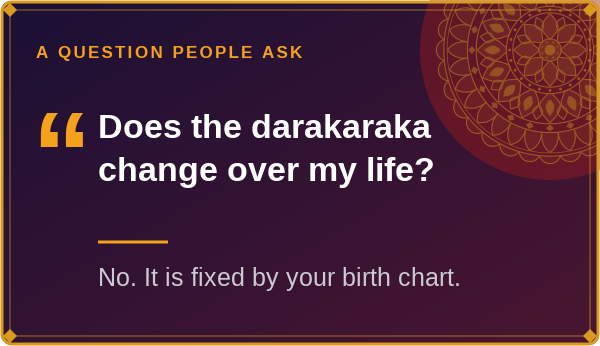
Does the darakaraka change over my life?
No. It is fixed by your birth chart. What changes is which periods activate it, and how you understand it as your life unfolds.
Should Rahu be included when finding the darakaraka?
Practitioners differ. Some use seven planets, Sun through Saturn; others add Rahu for an eight-karaka scheme, measuring its degree backward. A good reader will tell you which method they use and why.
Can the darakaraka tell me when I will meet my partner?
It is mainly descriptive. Timing comes from dashas and transits. The short answer on why readers give a time window rather than a date explains how timing is approached.
Related service

Keep reading

Love Timing: Which Dasha Periods Favor Meeting Someone
When will I find love, in astrology terms? How readers use Venus, seventh-lord and fifth-lord dashas to find windows tradition favors for meeting someone.
Read article →
Family Approval for a Love Marriage: Patience and Prayer
When parents hesitate over a love marriage: what helps family approval grow over months, what makes it harder, and how prayer can fit without manipulation.
Read article →
Intercaste and Interfaith Marriage in the Chart
Intercaste marriage astrology explained: the traditional chart indicators readers cite for interfaith and intercaste unions, read with respect for the couple.
Read article →Quick answers
Why do readers give a time window, not a date, for meeting someone?
Asking when you will meet your partner? Why a reading gives a time window, not a date, how dasha and transit timing works, and what to do in the meantime.
Read answer →Should I keep waiting for my ex while I get readings?
Can a psychic bring your ex back? Get-your-ex-back work is offered as prayer, mantra and puja for reconciliation, with no result promised. Waiting versus healing.
Read answer →Talk to Astrologer and Psychic Vijayram
Tell us what you are facing. If a reading is unlikely to help, you will be told that plainly.