

Where Your Seventh Lord Sits: Twelve Placements and Marriage
In Vedic astrology, the 7th house describes partnership and marriage, and its lord shows where that theme gets carried in your life. A seventh lord in the tenth links marriage with career; in the fourth, with home and family. Venus and Jupiter, the significators, are read alongside. Each placement is a tendency, not a forecast.
Key takeaways
- Start with your ascendant, the sign rising at birth.
- People with this placement often define themselves partly through their relationships and may choose someone who mirrors their own outlook.
- The same house placement reads differently depending on:
- Alongside the house and its lord, tradition names significators.
- Astrologer and Psychic Vijayram reads the seventh lord in that wider frame, by phone, WhatsApp or video.
Most people know the seventh house is the house of marriage. Fewer know that its lord, the planet ruling the seventh sign, carries the theme into another part of the chart, and that this placement often says more about how partnership shows up in daily life than the house itself. Below are twelve short notes, one for each house the seventh lord can occupy, followed by how Venus and Jupiter fit in. Read them as tendencies, the way the tradition intends.
Finding your seventh lord
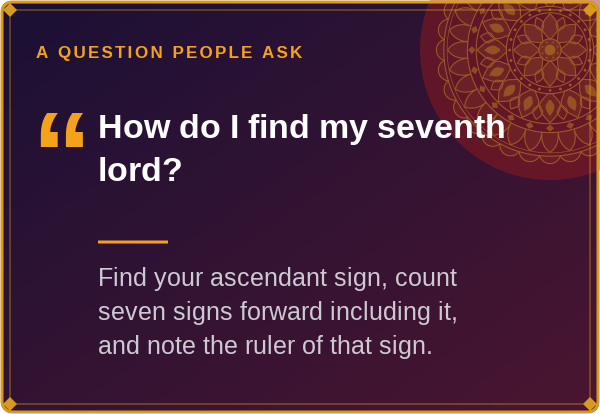
Start with your ascendant, the sign rising at birth. Count seven signs forward, including the ascendant as one. The ruler of that sign is your seventh lord. Classical texts name the twelve houses and their themes in a standard order, as in the verse listing the bhavas in Brihat Parashara Hora Shastra 7.37, and the seventh is the house of the spouse and partnerships of every kind. If you are unsure of your ascendant, the guide to your lagna lord explains how it is found.
The seventh lord, house by house
In the first house
Partnership sits close to identity. People with this placement often define themselves partly through their relationships and may choose someone who mirrors their own outlook. The task is to keep a sense of self inside the couple.
In the second house
Marriage is bound up with family, savings and speech. Families are often closely involved in the match, and money conversations become a central part of married life.
In the third house
Partnership through communication, siblings, neighbors or short trips. A talkative, active partnership, sometimes formed through a brother, sister or local network.
In the fourth house
Marriage linked to home, property and the mother. Many with this placement want a settled household and may live near family after marrying.
In the fifth house
Marriage joined to romance and creativity. This is one of the classic links between love and marriage in a chart, discussed further in what a chart can honestly add to the love-or-arranged question.
In the sixth house
Partnership tied to work, routines and service. It can bring friction that needs active effort, and it sometimes describes meeting through a workplace or a helping profession. Practical teamwork tends to strengthen it.
In the seventh house
The lord in its own house is strong. Partnership is a clear, central theme, and the partner is often a person of definite character.
In the eighth house
Marriage tied to shared resources, in-laws and deep change. Tradition calls this house difficult, and modern readers often see it as a call for trust and openness about joint finances and private matters.
In the ninth house
Marriage linked to faith, fortune, teachers and long distance. Partners from another culture or a far place are a common reading, and the relationship may widen one's beliefs.
In the tenth house
Marriage and career intertwine. Meeting through work is common, and the partnership often supports, or competes with, public ambitions. Chicago professionals with this placement may find scheduling the relationship as demanding as scheduling work.
In the eleventh house
Partnership through friends, networks and community. A marriage that grows out of friendship, and one that brings gains or wider social circles.
In the twelfth house
Marriage tied to distant lands, private life and expenses. Many immigrants, and many who marry someone living abroad, have some twelfth-house theme in their partnership story. It can also describe a strong need for rest and privacy within the marriage.
What changes the reading
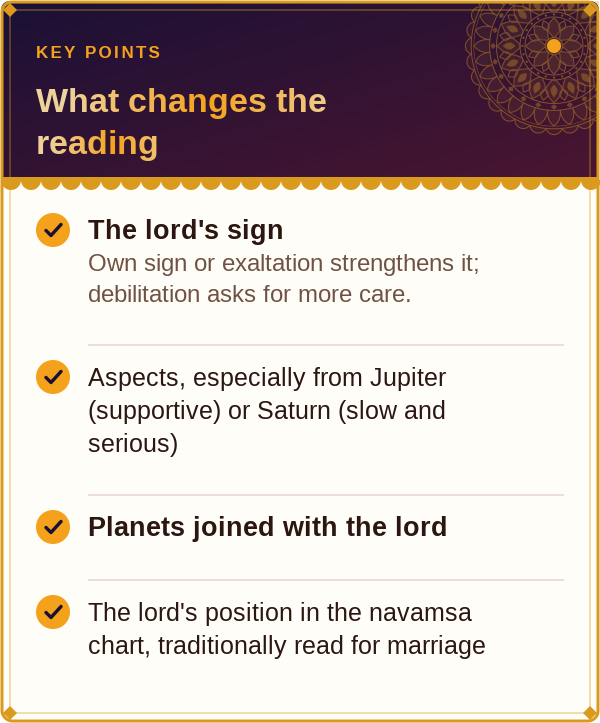
The same house placement reads differently depending on:
- The lord's sign: own sign or exaltation strengthens it; debilitation asks for more care.
- Aspects, especially from Jupiter (supportive) or Saturn (slow and serious).
- Planets joined with the lord.
- The lord's position in the navamsa chart, traditionally read for marriage.
Venus and Jupiter, the significators
Alongside the house and its lord, tradition names significators. Venus, Shukra, represents love, attraction and partnership in every chart; its classical character is set out in the overview of Shukra. Jupiter, Brihaspati, is the teacher among the planets, as the overview of Brihaspati describes, and older astrological texts treat it as the significator of the husband in a woman's chart. Many modern readers look at both planets in every chart regardless of gender. A strong seventh lord with a struggling Venus reads differently from the reverse. For more on Venus specifically, see Venus combust, retrograde or exalted. Jaimini astrology adds a further layer through the Upapada lagna and the second house from it.
People marrying again read the same placements with a few additions, described in second marriage questions about children, elders and timing.
Using these notes well
These are traditional descriptions of style, not predictions of events. They are useful for reflection: noticing what you seek in a partner, where tension tends to appear, and what kind of support helps. When the question is about timing, a marriage timing consultation adds the planetary periods and transits that the placement alone cannot show. Astrologer and Psychic Vijayram reads the seventh lord in that wider frame, by phone, WhatsApp or video.
The limit
A chart describes tendencies. The kind of marriage you build depends on choices you and your partner make, day after day, which no placement can make for you.
Common questions
How do I find my seventh lord?
Find your ascendant sign, count seven signs forward including it, and note the ruler of that sign. For a Leo ascendant, the seventh sign is Aquarius, so Saturn is the seventh lord.
Is a seventh lord in the sixth, eighth or twelfth house bad for marriage?
Those houses are traditionally harder, and they ask for more effort or adjustment in partnership. They are common placements in long, happy marriages, and the lord's sign, aspects and the navamsa can change the picture a great deal.
Does an empty seventh house mean no marriage?
No. An empty house simply has no planets in it. Its lord, its aspects and the significators still describe the area fully. Most houses in most charts are empty.
Can these notes tell me when I will marry?
Not on their own. Timing comes from planetary periods and transits, which a marriage timing reading examines. The placement describes the style of partnership more than the date.
Related service

Keep reading

Marrying After 30 in Chicago: Careers, Family Pressure and the Chart
Delay in marriage astrology for Chicago professionals: Saturn and timing windows set beside the ordinary reasons people marry later, without blame.
Read article →
When Parents Ask 'Love or Arranged?': What a Chart Can Honestly Add
Love or arranged marriage in astrology: how fifth and seventh house links are read as tendency, and why the couple's own choice matters more than any yoga.
Read article →
Second Marriage Questions From Chicago Families: Children, Elders and Timing
Second marriage astrology for Chicago families after divorce or loss: how remarriage is read, and the questions people bring about children, parents and timing.
Read article →Quick answers
Which planets do astrologers check for marriage timing?
When will I get married? Astrology reads Venus, Jupiter, the seventh lord and their dasha periods, which point to favorable windows rather than fixed dates.
Read answer →What is Guna Milan?
What is Guna Milan? The eight kootas behind the 36-point kundli matching score, what each one compares, and what the number cannot tell a couple or family.
Read answer →Talk to Astrologer and Psychic Vijayram
Tell us what you are facing. If a reading is unlikely to help, you will be told that plainly.