
Guna Milan Was Written for Bride and Groom: Adapting It for Same-Sex Couples
LGBTQ astrology compatibility works once you know which parts of Guna Milan assume a bride and groom. Varna, Stree Deergha and some Vashya and Gana tables depend on who is entered as the bride, so readers score both directions or set them aside, then rely on Moon signs, Nadi, the seventh house, Venus and dasha timing.
Key takeaways
- Kundli matching grew up as a tool for families arranging marriages, so its rules were written for one pairing.
- The gendered pieces are small in points but worth handling honestly.
- Whichever route is used, you should be told which one.
- Much of compatibility work was gender-neutral all along:
- Some Chicago couples now want a wedding date chosen the traditional way, and the service for choosing a wedding muhurta works the same for any two people.
Couples sometimes ask, a little warily, whether LGBTQ astrology compatibility is even possible in the Vedic tradition, because the classic matching system speaks of a bride and a groom on every page. The short answer is yes. Most of what a careful reader compares between two charts has nothing to do with gender, and the few parts that do can be adapted openly instead of being ignored or forced.
Where the bride-and-groom wording comes from
Kundli matching grew up as a tool for families arranging marriages, so its rules were written for one pairing. The best-known system, ashtakoota or Guna Milan, compares the two birth stars, the nakshatras occupied by each partner's Moon, across eight factors worth 36 points in all. The overview of astrological compatibility lists those eight and also the longer South Indian list, which includes factors such as Stree Deergha and Mahendra that are counted from the bride's star.
That history matters, because it tells you exactly where an adaptation is needed and where it is not.
Which kootas assume a gender, and which do not
| Koota (points) | What it compares | Does it depend on who is the bride? |
|---|---|---|
| Varna (1) | Temperament ranked in four classes | Yes. The rule is written in terms of the groom's class relative to the bride's. |
| Vashya (2) | Mutual pull or influence between Moon signs | Partly. Some published tables score the pair differently depending on direction. |
| Tara (3) | Distance between the two birth stars | Counted both ways, so it balances out when done fully. |
| Yoni (4) | Animal symbols of the two stars | Mostly no. The score rests on the pair of animals. |
| Graha Maitri (5) | Friendship of the two Moon-sign lords | No. |
| Gana (6) | Three temperament groups | Partly. Some tables give one point more or less depending on who is entered as the bride. |
| Bhakoot (7) | Distance between the two Moon signs | No. It reads the pair as a pair. |
| Nadi (8) | Three constitution types | No. |
So the factors carrying the most weight, Nadi, Bhakoot and Graha Maitri, need no adjustment at all. The gendered pieces are small in points but worth handling honestly.
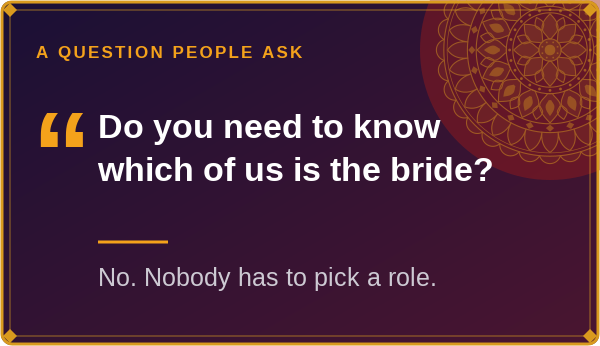
Three ways readers adapt the comparison
- Score it both ways. The reader runs the calculation twice, swapping columns, and shows you both totals. Often they differ by a point or two, which tells you how little the gendered rules change the picture.
- Set the gendered factors aside. Varna is dropped, the directional tables are read as mutual, and the total is treated as being out of a slightly smaller number.
- Let the score become a footnote. Many readers, for all couples, put more weight on the full charts than on the number. For same-sex couples this is often the most natural route.
Whichever route is used, you should be told which one. A reading that quietly assigns one partner the bride's role without asking is not respecting either of you.
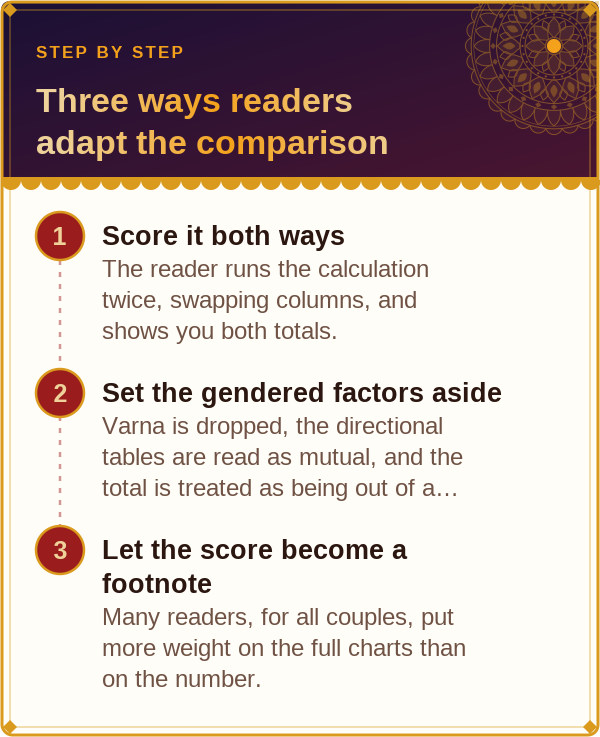
Methods that never assumed a gender
Much of compatibility work was gender-neutral all along:
- The Moon signs and stars, for emotional rhythm and how each of you settles after a hard day.
- The seventh house and its lord in each chart, read as "partner" for anyone.
- Venus and Mars, for affection, desire and how each person handles friction.
- The darakaraka, the planet at the lowest degree in the chart, which is found by arithmetic alone. The post on the darakaraka and what it is said to describe explains it.
- Dasha timing side by side, which often explains more about a difficult year than any score.
- Western synastry aspects, which overlay two charts without roles. The comparison of synastry and kundli matching sets the two methods next to each other.
Classical texts also read Venus as the wife's significator in a man's chart and Jupiter as the husband's in a woman's. Modern readers usually read Venus for love and attraction in every chart, and the seventh house for the partner, which works for any couple.
Families, weddings and Illinois law
Illinois has recognized same-sex marriage since June 1, 2014, and couples in Cook County could marry from February of that year after a federal court ruling, as the history of same-sex marriage in Illinois records. Some Chicago couples now want a wedding date chosen the traditional way, and the service for choosing a wedding muhurta works the same for any two people.
Others are thinking about parents in the suburbs or relatives in India who still speak the language of the kundli. A respectful matching, explained in familiar terms, can give an older relative a way into the conversation. It cannot change anyone's mind for them, and it should never be used to pressure a family.
What to send, and how the session runs
Each partner's date, time and place of birth is enough. If one of you does not know a birth time, say so; Moon-based factors can often still be read. You can join together on one video call or one of you can take it by phone. Sessions with Astrologer and Psychic Vijayram are by phone, WhatsApp or video and set in Central Time, and the full approach is on the page for the two-chart compatibility reading for couples. If a family also wants the traditional score explained, the kundli matching service covers that in detail.
The limit
No score and no chart can say whether a relationship is valid, and none can promise that it will last. Orientation is never treated as a problem to be read in a chart. A compatibility reading offers traditional interpretation for reflection; the daily work of listening, sharing a home and choosing each other stays with the two of you.
Common questions
Is gay couple astrology different from ordinary chart matching?
Mostly it is the same work. Two charts are compared for temperament, emotional rhythm and timing. The only real difference is that a handful of traditional scoring rules were written for a bride and a groom, and an honest reader tells you how those rules are being handled instead of quietly forcing your relationship into them.
Can a queer compatibility reading still use the 36-point score?
It can, with care. Some readers calculate the score twice, once with each partner in the bride's column, and show you both totals. Others drop Varna and rescale. Either way, the number is a starting point for conversation, not a verdict on your relationship.
Our parents care about the kundli. What should we show them?
Show them the parts that carry over without any change: the Moon sign relationship, Nadi, the seventh house of each chart and the timing of both dashas. Many elders are relieved to hear the traditional language applied with respect. A reader can explain it to them on a video call if that helps.
Do you need to know which of us is the bride?
No. Nobody has to pick a role. The comparison is set up so that either partner can sit in either column, and any rule that depends on that choice is named and handled openly.
Related service
Keep reading
Synastry and Kundli Matching: Two Ways to Compare Charts
Synastry vs kundli matching explained: Western aspects between two tropical charts against Vedic kootas, Moon stars and dosha checks, and when each one helps.
Read article →
Two Leases Into One: Choosing a Move-In Date as a Couple
A compatibility reading before moving in together: simple panchang checks for a move-in day, what two charts add, and the money talks that matter more.
Read article →
Twin Flame Reading Requests: What We Look At and What We Will Not Claim
What a twin flame reading is, how a twin flame match or tarot reading works, what a reader actually looks at, and why no honest reader can promise a reunion.
Read article →Quick answers
Does astrology show if two people are compatible?
How accurate is astrology compatibility? What comparing two charts highlights, what research has found, and what couples still have to work out themselves.
Read answer →Should I keep waiting for my ex while I get readings?
Can a psychic bring your ex back? Get-your-ex-back work is offered as prayer, mantra and puja for reconciliation, with no result promised. Waiting versus healing.
Read answer →Talk to Astrologer and Psychic Vijayram
Tell us what you are facing. If a reading is unlikely to help, you will be told that plainly.