
Synastry and Kundli Matching: Two Ways to Compare Charts
Synastry vs kundli matching comes down to method. Western synastry lays two tropical charts over each other and reads the angles, or aspects, between their planets. Kundli matching uses the sidereal zodiac, scores the two Moon stars across eight kootas out of 36, then checks Mangal dosha and timing. One describes dynamics; the other screens for fit.
Key takeaways
- The first difference is the zodiac itself.
- Synastry overlays one person's chart on the other's and looks at the angles between their planets.
- The overview of compatibility systems lists all eight with their weights.
- The couple at the start are a good example.
- Astrologer and Psychic Vijayram works in the Vedic framework, but many clients arrive with a Western report, and it is easy to translate between the two once the zodiac difference is clear.
Picture a Chicago couple with two reports on the table. One came from a family astrologer through a parent in Naperville: a score of 21 out of 36 and a note about Mars. The other came from a Western astrology app one of them has used since college: a page about a Venus trine and a worrying Saturn square. They want to know which one to believe. Synastry vs kundli matching is a fair question, and the honest answer is that each was built to answer something different.
Same sky, two measuring sticks
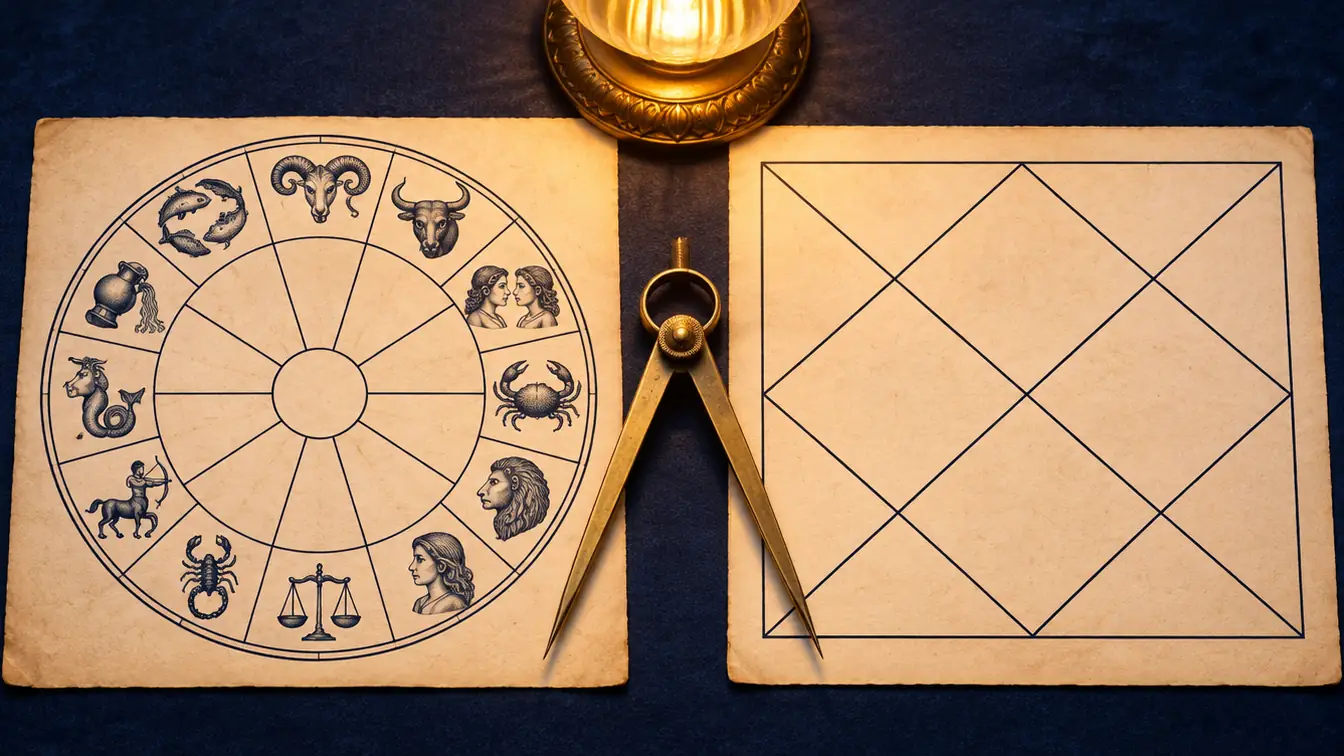
The first difference is the zodiac itself. Western astrology mostly uses the tropical zodiac, tied to the seasons. Vedic astrology uses the sidereal zodiac, tied to the stars. Because of the slow wobble of the Earth's axis, the two have drifted apart by roughly 24 degrees, as the explanation of sidereal and tropical astrology sets out. That is why many people who think of themselves as Leos turn out to have the Sun in Cancer in their kundli. Before comparing any results, it helps to know that the two reports did not even place the planets in the same signs.
How synastry works
Synastry overlays one person's chart on the other's and looks at the angles between their planets. These angles are called aspects: a conjunction when two planets sit together, a sextile at 60 degrees, a square at 90, a trine at 120 and an opposition at 180, as the guide to astrological aspects describes. Each aspect has an allowed margin, or orb.
Readers pay most attention to a few contacts: one partner's Sun or Moon with the other's Moon, Venus with Mars, and anything touching Saturn, which tends to be read as commitment, weight or friction. They also note which house of one chart the other person's planets fall into. Some go further with a composite chart, a single blended chart for the relationship.
There is no pass mark. The output is a description of chemistry and strain points, written in the language of personality.
How kundli matching works
Kundli matching starts from the Moon. Each partner's Moon sits in one of 27 stars, and the eight kootas of Guna Milan compare those stars and signs for temperament, attraction, health and family harmony, totalling 36 points. The overview of compatibility systems lists all eight with their weights. A score above 18 is the common threshold families use.
A good matching does not stop at the number. It checks Mangal dosha in both charts, looks at whether a low Nadi or Bhakoot score is offset by other factors, and then reads the seventh house, Venus and the dasha periods each partner is about to enter. The kundli matching service and the post on how the eight kootas are weighed go into this in detail.
Side by side
| Synastry | Kundli matching | |
|---|---|---|
| Zodiac | Tropical (seasons) | Sidereal (stars) |
| Starting point | Every planet in both charts | The two Moon stars, then the full charts |
| Result | A description of dynamics | A score, dosha checks and a reading |
| Strength | Rich detail on personality and attraction | A consistent, shared framework families understand |
| Blind spot | Says little about timing | A score can be mistaken for a verdict |
| Typical use | Dating couples, curiosity, self-understanding | Marriage decisions involving two families |
Why the two can disagree
The couple at the start are a good example. A score of 21 says their birth stars meet the traditional threshold. The Saturn square says one partner may feel weighed down by the other's caution. Both can be true at once, because one measures broad fit by fixed rules and the other describes a specific pressure point. It is equally common to see a modest kundli score alongside warm Moon and Venus contacts in synastry.
When the two systems point in different directions, the most useful move is not to choose a winner. It is to ask what each one is drawing attention to, and whether that matches what the two of you already notice.
Which one to use
- A family arranging a marriage that expects a score: kundli matching, explained plainly.
- A dating couple curious about how they work together: a two-chart reading that may draw on either method.
- A couple from two traditions: often both, with the differences explained. The post on intercultural couples and chart matching in Chicago covers this.
- A same-sex couple: see the note on adapting Guna Milan for same-sex couples, since synastry never assumed roles.
How a two-chart session uses both
Astrologer and Psychic Vijayram works in the Vedic framework, but many clients arrive with a Western report, and it is easy to translate between the two once the zodiac difference is clear. The two-chart compatibility reading looks at temperament, emotional rhythm, how each of you handles conflict, and the timing of both dashas. Questions about Moon signs specifically are covered in Moon sign pairs that clash and why they can still work. Sessions run by phone, WhatsApp or video, in Central Time.
What neither method can tell you
Neither synastry nor kundli matching can say whether a relationship will last, and neither replaces the knowledge two people gain from time together. Both are traditional ways of looking at two lives side by side. Treat them as prompts for an honest conversation, not as the conversation itself.
Common questions
Which is more accurate, synastry or kundli matching?
Neither has been shown to predict which relationships last, so accuracy is the wrong yardstick. They answer different questions. Kundli matching asks whether two birth stars sit well together by traditional rules; synastry asks how two personalities are likely to meet. Used for reflection, both can be useful.
Can my Western birth chart be used for kundli matching?
The birth data can, but the chart has to be recalculated in the sidereal zodiac, which usually moves planets back by about one sign. The short answer on turning a Western printout into a kundli explains the steps.
What is a composite chart?
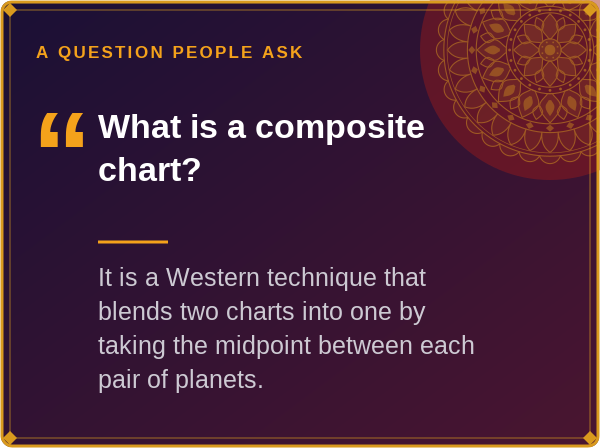
It is a Western technique that blends two charts into one by taking the midpoint between each pair of planets. It is read as a portrait of the relationship itself rather than of either person. Vedic matching has no direct equivalent.
Do we both need exact birth times?
Exact times help both methods, especially for houses and the rising sign. Without them, a kundli match can still use the Moon's star for most days, and synastry can still read planet-to-planet aspects. The reader will tell you which parts become less reliable.
Related service

Keep reading

Two Leases Into One: Choosing a Move-In Date as a Couple
A compatibility reading before moving in together: simple panchang checks for a move-in day, what two charts add, and the money talks that matter more.
Read article →
Twin Flame Reading Requests: What We Look At and What We Will Not Claim
What a twin flame reading is, how a twin flame match or tarot reading works, what a reader actually looks at, and why no honest reader can promise a reunion.
Read article →
Runner and Chaser: When Twin Flame Talk Keeps You Waiting
The twin flame runner and chaser story can keep you tied to someone who left. Signs it is time to step back, where to find support and what a reading can do.
Read article →Quick answers
Does astrology show if two people are compatible?
How accurate is astrology compatibility? What comparing two charts highlights, what research has found, and what couples still have to work out themselves.
Read answer →Should I keep waiting for my ex while I get readings?
Can a psychic bring your ex back? Get-your-ex-back work is offered as prayer, mantra and puja for reconciliation, with no result promised. Waiting versus healing.
Read answer →Talk to Astrologer and Psychic Vijayram
Tell us what you are facing. If a reading is unlikely to help, you will be told that plainly.