
Why Some Readers Combine Intuition and a Birth Chart
A psychic works from intuition and impressions in the moment; an astrologer works from a birth chart calculated from your date, time and place of birth. Intuition tends to suit questions about feelings and situations, while the chart suits timing and long-term patterns. A combined reading uses each to check the other.
Key takeaways
- A psychic works from impressions: what comes to mind while listening to you, sometimes helped by cards or a photo.
- No method, intuitive or calculated, has shown it can forecast specific events.
- The psychic reading offered here works this way by default, by phone, WhatsApp or video.
- Neither a psychic nor an astrologer can see the future with certainty, read another person's mind, diagnose illness or replace a doctor, lawyer, counselor or financial advisor.
People often ask the question as if they were choosing a doctor: "Do I need a psychic or an astrologer?" It is a fair question, and the honest answer is that it depends on what you want to know. The two methods start from different places and are good at different things. That is exactly why some readers, including Astrologer and Psychic Vijayram, put them together.
Two different starting points
A psychic works from impressions: what comes to mind while listening to you, sometimes helped by cards or a photo. The word psychic covers a wide range of claimed abilities, from intuition to clairvoyance, none of which has been demonstrated under scientific testing. In practice, a good psychic reading is an attentive, intuitive conversation.
An astrologer works from a calculation. In Vedic astrology, or jyotish, your date, time and place of birth produce a chart of planetary positions, divided into houses that stand for areas of life, with a sequence of planetary periods, the dashas, that suggest when each theme comes to the fore. Two astrologers using the same method should begin from the same chart, even if they read it differently.
Which questions suit which method?
| Kind of question | Intuitive reading | Birth chart |
|---|---|---|
| "How do I feel about this, really?" | Strong fit | Limited |
| "What is going on in this situation right now?" | Strong fit | Partial, through transits |
| "When is a better time to start, move or marry?" | Weak | Strong fit, through dashas and muhurta |
| "Why do I keep repeating this pattern?" | Good | Good |
| "What are my long-term tendencies in career or relationships?" | Partial | Strong fit |
| "Will this specific event happen on this date?" | Neither can say reliably | Neither can say reliably |
The last row matters most. No method, intuitive or calculated, has shown it can forecast specific events. When astrologers were tested in a double-blind study published in Nature, they could not match birth charts to personality profiles better than chance, as Shawn Carlson's 1985 experiment reported. A responsible reader keeps that in view and offers guidance, not prophecy.
Why combine them?
Each method has a typical weakness, and the other helps correct it.
Intuition can drift
Impressions can slide toward what the client hopes to hear, or toward what the reader picks up from tone of voice. A chart gives a second reference point that does not depend on your mood or your face. If an impression says "big change this year" and the chart shows a quiet period, the reader has reason to soften the impression.
Charts can become mechanical
Chart rules can produce long lists of placements that sound important but miss the person entirely. An intuitive conversation brings the reading back to what you actually came to ask, and to what you are feeling now. A Saturn period described as "hard" means something very different for someone grieving and someone starting a business.
How a combined reading runs
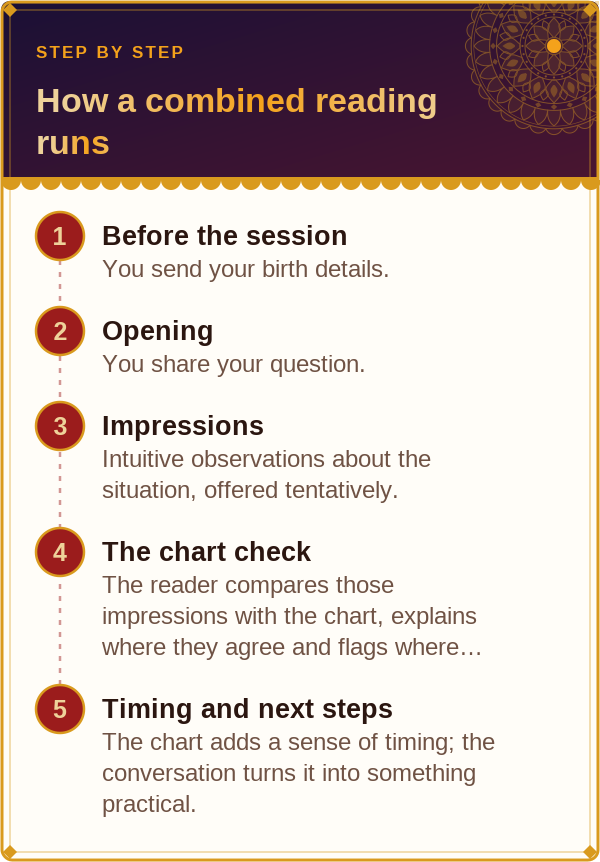
- Before the session: you send your birth details. The reader casts the chart and notes your current dasha and major transits.
- Opening: you share your question. The reader listens first, without leading with the chart.
- Impressions: intuitive observations about the situation, offered tentatively.
- The chart check: the reader compares those impressions with the chart, explains where they agree and flags where they do not.
- Timing and next steps: the chart adds a sense of timing; the conversation turns it into something practical.
The psychic reading offered here works this way by default, by phone, WhatsApp or video.
When one method is enough
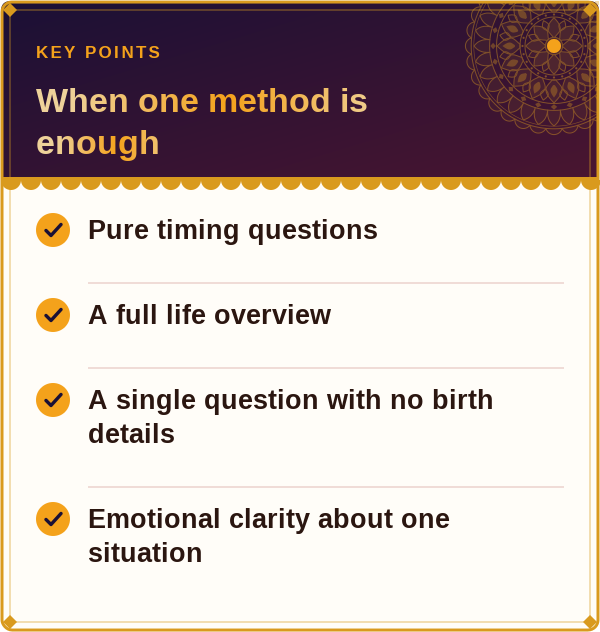
- Pure timing questions, such as a wedding date or a good day to sign, need the chart and nothing else. See Vedic astrologer in Chicago.
- A full life overview from your chart, with its houses, planets and dashas, is a Vedic birth chart (kundli) reading.
- A single question with no birth details can be read intuitively, with cards, or through a Prashna question chart cast for the moment you ask.
- Emotional clarity about one situation often needs only an intuitive or tarot reading.
If you are weighing cards against a chart, the post on tarot or Vedic astrology compares the two directly, and the short answer on Vedic versus Western astrology for timing covers the chart side.
What neither method can do
Neither a psychic nor an astrologer can see the future with certainty, read another person's mind, diagnose illness or replace a doctor, lawyer, counselor or financial advisor. Combined, they offer a more balanced conversation about your life, which is a useful thing, but not a guarantee of anything. Questions are welcome through the contact page.
Common questions
Can I have a combined reading without a birth time?
Yes. Without a birth time, the chart loses the ascendant and house positions, but the Moon sign, planetary periods and many placements are still usable, and the intuitive side of the reading does not need a time at all. A Prashna chart cast for the moment of your question is another option.
Is a psychic astrologer more accurate than either alone?
There is no evidence that combining methods produces accurate predictions. The benefit is a more balanced conversation: the chart keeps intuition from drifting, and intuition keeps the chart from becoming a list of mechanical rules.
Does Vedic astrology itself involve intuition?
Traditional texts give rules for reading a chart, but the rules often point in different directions, and an experienced jyotishi has to weigh them. Many astrologers would say that weighing is where intuition comes in.
Which should I choose for a marriage question?
For a proposed match, kundli matching is the established Vedic method. For questions about how you feel or what you want in a relationship, an intuitive or tarot reading may help more. Many people use both at different stages.
Related service

Keep reading

Mediums and Psychics: Which One for Grief, Which One for Decisions
Psychic vs medium, sorted by the question you bring: a medium for grief and remembrance, a psychic for decisions, and what to do when a question is both.
Read article →
Open Questions or Yes-or-No: Getting More From a Psychic Reading
Questions to ask a psychic that lead somewhere useful: why open questions beat yes-or-no, with ten examples rewritten from closed to open and a simple formula.
Read article →
When a Reader Says No: The Requests We Turn Down and What We Offer Instead
Psychic ethics in practice: death dates, diagnoses, court outcomes and naming culprits are declined. Why, and what a responsible session offers in their place.
Read article →Quick answers
Do I have to tell a psychic anything before the reading starts?
What happens in a psychic reading, and what must you share first? Often just your first name and question; you never need to tell more than you wish.
Read answer →What should I do if a reader keeps asking for more money?
How to spot a psychic scam: what to do if a reader uses fear and keeps asking for more money. Stop paying, keep records, report it, and know the warning signs.
Read answer →Talk to Astrologer and Psychic Vijayram
Tell us what you are facing. If a reading is unlikely to help, you will be told that plainly.