
Kundli Matching in Aurora
Ten Poruthams and 36 gunas, worked out for the same couple and laid side by side.
Kundli matching in Aurora often means two systems at once: the ten Poruthams many South Indian families use and the 36-point Guna Milan common in North India. This practice calculates both for one couple by phone, WhatsApp or video, compares where they agree and disagree, and then reads the full charts.
Services available here: Kundli Matching (Guna Milan) for Marriage.
Key takeaways
- Aurora sits at the western end of the BNSF line, the second-largest city in Illinois , and its South Asian community has grown alongside Naperville's next door.
- The ten Poruthams are Dina, Gana, Mahendra, Stree Deergha, Yoni, Rasi, Rasi Adhipati, Vasya, Rajju and Vedha.
- A couple might score 26 out of 36 in Guna Milan yet fail Rajju, or pass seven of ten Poruthams while carrying a Nadi dosha on the North Indian side.
- Disputes are easier to avoid than to settle.
- Horoscopes written in India sometimes give the star but not the exact time, and a Moon near the edge of a nakshatra can land in different stars on different charts.
Horoscope matching in Aurora: why families ask for both
Aurora sits at the western end of the BNSF line, the second-largest city in Illinois, and its South Asian community has grown alongside Naperville's next door. The history of Hindus in Chicago counts the Balaji temple in Aurora among the area's major places of worship. Families from Tamil Nadu, Andhra Pradesh, Telangana and Karnataka often grew up with Porutham matching, while a partner from Gujarat, Punjab or Uttar Pradesh may come with Guna Milan. When a South Indian family in Aurora meets a North Indian one, or when relatives in two regions each want their own system, the simplest answer is to calculate both.
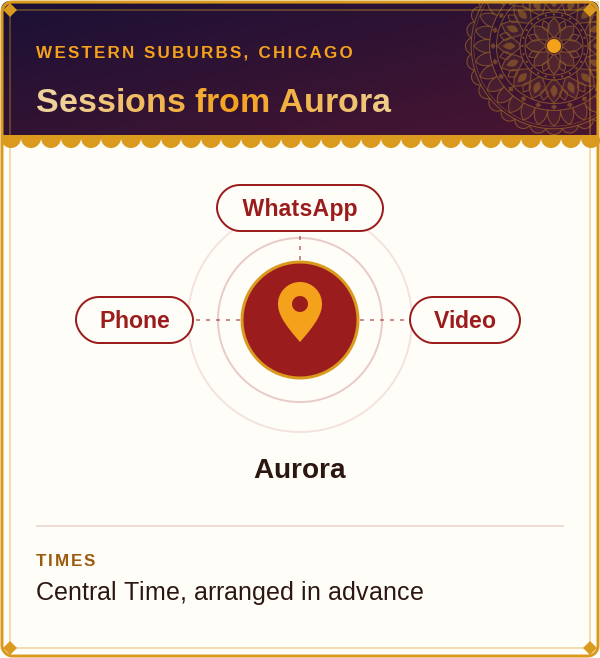
Astrologer and Psychic Vijayram matches charts for Aurora families by phone, WhatsApp or video, with times confirmed in Central Time.
The two systems at a glance
| Porutham (South Indian) | Guna Milan (North Indian) | |
|---|---|---|
| Starts from | The two birth stars and Moon signs | The two birth stars and Moon signs |
| Factors | Ten poruthams, each judged as agreeing or not | Eight kootas worth 36 points in total |
| Usual reading | A count of agreeing poruthams, with some treated as essential | A score, with 18 as the usual threshold |
| Weighted most | Rajju and Vedha | Nadi and Bhakoot |
The ten Poruthams are Dina, Gana, Mahendra, Stree Deergha, Yoni, Rasi, Rasi Adhipati, Vasya, Rajju and Vedha. Both systems start from the 27 nakshatras, so they overlap: Gana, Yoni and Rasi appear in each under similar names.
When the two disagree
It happens more often than families expect. A couple might score 26 out of 36 in Guna Milan yet fail Rajju, or pass seven of ten Poruthams while carrying a Nadi dosha on the North Indian side. In a session, each disagreement is traced to the factor behind it, and the full charts are then read for the seventh house, Venus, Mars and the dasha periods ahead. Tradition also records exceptions for several doshas, and these are checked before any conclusion. The post on Porutham or Guna Milan for Chicago families gives the background, and the 36 points of Guna Milan explained breaks down each koota.
Agree on a method before you start
Disputes are easier to avoid than to settle. Before the session, both families can agree which system they will treat as primary, and that the full chart reading counts as much as either score. Then nobody feels the goalposts moved halfway through.
Getting the birth stars right
Both systems hang on the nakshatra the Moon occupied at each birth, so the data has to be right. Horoscopes written in India sometimes give the star but not the exact time, and a Moon near the edge of a nakshatra can land in different stars on different charts. Send the original birth time and place for both people, plus any jathakam the families already hold. If the Moon sits close to a boundary, the session reads both possibilities rather than quietly choosing one.
Limits
Neither system can show character, kindness or whether two people will keep choosing each other. Matching is faith-based guidance, and the couple's own consent comes before any chart.
Booking from Aurora
Send both sets of birth details through the booking form, and say which systems each family uses. Once a match is agreed, choosing the wedding muhurta is the usual next step. For more on the city, see the Aurora area guide and the western suburbs page. The kundli matching service explains the full method, and the Vedic astrologer page for Aurora covers South Indian chart readings.
Common questions
Which result should we trust if the systems disagree?
Neither score should decide alone. The session explains which factor causes the gap and what the full charts add, then leaves the decision with the couple and their families.
Is Rajju dosha the same as Nadi dosha?
No. Each is treated seriously in its own tradition, but they are calculated differently. Rajju groups the nakshatras into five classes linked to parts of the body, while Nadi uses three. A couple can have one without the other.
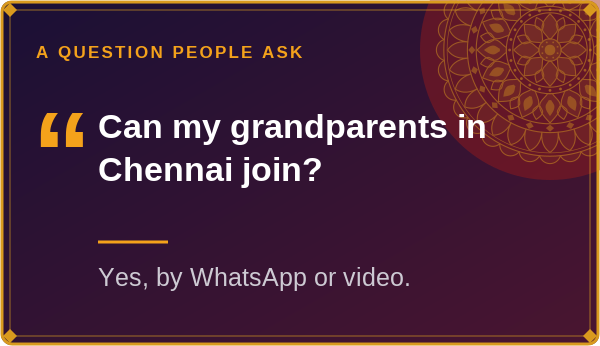
Can my grandparents in Chennai join?
Yes, by WhatsApp or video. Choose a Chicago evening; it will be morning in Chennai, which usually suits older relatives best.
More in Aurora

Indian Astrologer in Aurora
Indian astrologer for Aurora, IL: Vedic chart readings, kundli matching and ceremony dates by phone, WhatsApp or video for families on the Fox River.
View location →
Psychic Reading in Aurora
A psychic reading for Aurora, Illinois families by phone, WhatsApp or video: how a faith-based reading differs from a quick card reading, fee set first.
View location →
Vedic Astrologer in Aurora
A Vedic astrologer for Aurora families who keep South Indian charts and Telugu or Tamil panchangs: readings that work from those formats, by phone or video.
View location →
Love and Relationship Reading in Aurora
A love reading in Aurora, IL for bicultural Latino and South Asian couples: family approval across two cultures, read in a respectful framework.
View location →
Spiritual Cleansing and Evil Eye Removal in Aurora
Spiritual cleansing in Aurora, IL for Latino and South Asian families: mal de ojo and nazar customs, egg and lemon, compared with respect.
View location →Related service
Nearby areas

Astrologer in Oak Brook
Astrologer in Oak Brook, IL for career timing, business launch dates and gemstone questions, by phone, WhatsApp or video, with plain limits explained.
View location →
Psychic Reading and Astrology in Oak Park
Psychic reading in Oak Park, IL by phone, WhatsApp or video: tarot, intuitive and Vedic astrology sessions explained step by step, with no pressure.
View location →
Astrologer in Elmhurst
Astrologer in Elmhurst, IL for birth chart readings, dasha timing and student questions, by phone, WhatsApp or video in Central Time, with clear limits.
View location →Talk to Astrologer and Psychic Vijayram
Tell us what you are facing. If a reading is unlikely to help, you will be told that plainly.