

A 40-Day Hanuman Chalisa Practice for Tuesdays and Saturdays
People recite the Hanuman Chalisa for protection because its forty verses praise Hanuman as the remover of fear and trouble. A forty-day practice usually means one recitation a day at a fixed time, with extra rounds on Tuesdays and Saturdays. It steadies the mind and builds courage; it does not replace practical safety steps.
Key takeaways
- The hymn is attributed to Tulsidas and written in Awadhi, a form of old Hindi.
- Tuesday, Mangalvar, is the day most North Indian families set aside for Hanuman, and many temples hold their busiest Hanuman worship that evening.
- The word chalisa simply means forty, and a forty-day vow is a common way to give a practice shape.
- The hymn can bring real comfort in those weeks.
The Hanuman Chalisa is forty short verses, framed by couplets at the start and end, that most Hindu households know at least in part. When people search for Hanuman Chalisa protection, they usually want two things: a reason to trust the practice, and a plan they can keep up for longer than a week. This post covers both, along with the limits of what a hymn can do.
Why these verses are linked with protection
The hymn is attributed to Tulsidas and written in Awadhi, a form of old Hindi. The overview of the Hanuman Chalisa and its origins notes that it praises Hanuman's strength, courage, wisdom and devotion to Rama. In the Ramayana, Hanuman leaps the ocean, carries a mountain of healing herbs and stands guard for Rama. Devotees picture that loyalty turned toward them.
Several verses make the protective theme explicit. One says that ghosts and troubling spirits do not come near when the name of Mahavir is spoken. Another says that Hanuman frees from difficulty those who keep him in mind, action and speech. Read closely, that second line ties protection to steadiness: your thoughts, deeds and words pointed the same way. That is a useful frame for the whole practice. You are not hiring a guard. You are training your own attention toward courage.
Hanuman is also known as Sankat Mochan, the one who frees from trouble. The general article on Hanuman in Hindu tradition gives the wider background, including his place as Rama's devoted servant.
Why Tuesdays and Saturdays?
Tuesday, Mangalvar, is the day most North Indian families set aside for Hanuman, and many temples hold their busiest Hanuman worship that evening. Saturday belongs to Shani, the planet Saturn, and a popular story says Hanuman once freed Shani from captivity, after which Shani promised to go easy on Hanuman's devotees. For that reason, people in a hard Saturn period often add the Chalisa on Saturdays. The post on Shani remedies that fit a nine-to-five week goes further into that custom.
A plan for the forty days
The word chalisa simply means forty, and a forty-day vow is a common way to give a practice shape. Here is a version that suits a working week.
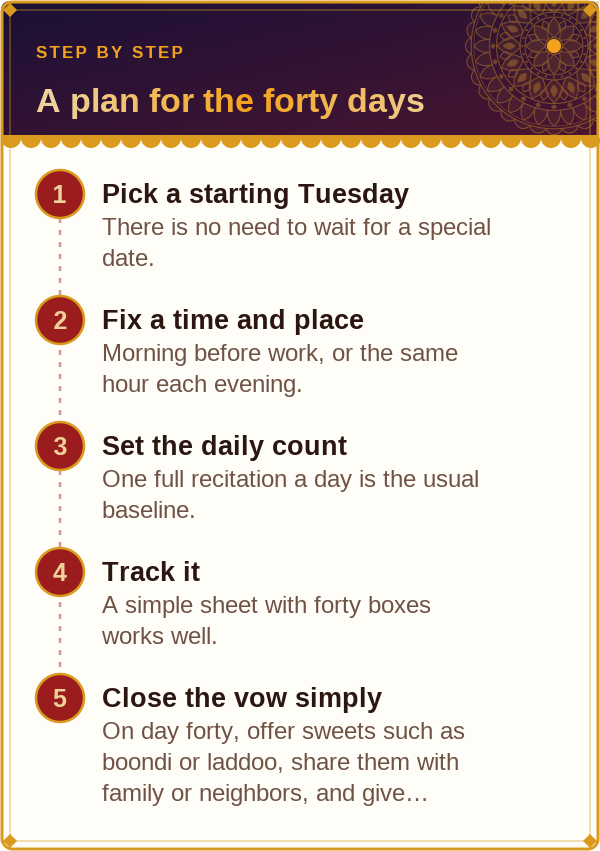
- Pick a starting Tuesday. There is no need to wait for a special date. Write the start and end dates on paper and put them where you will see them.
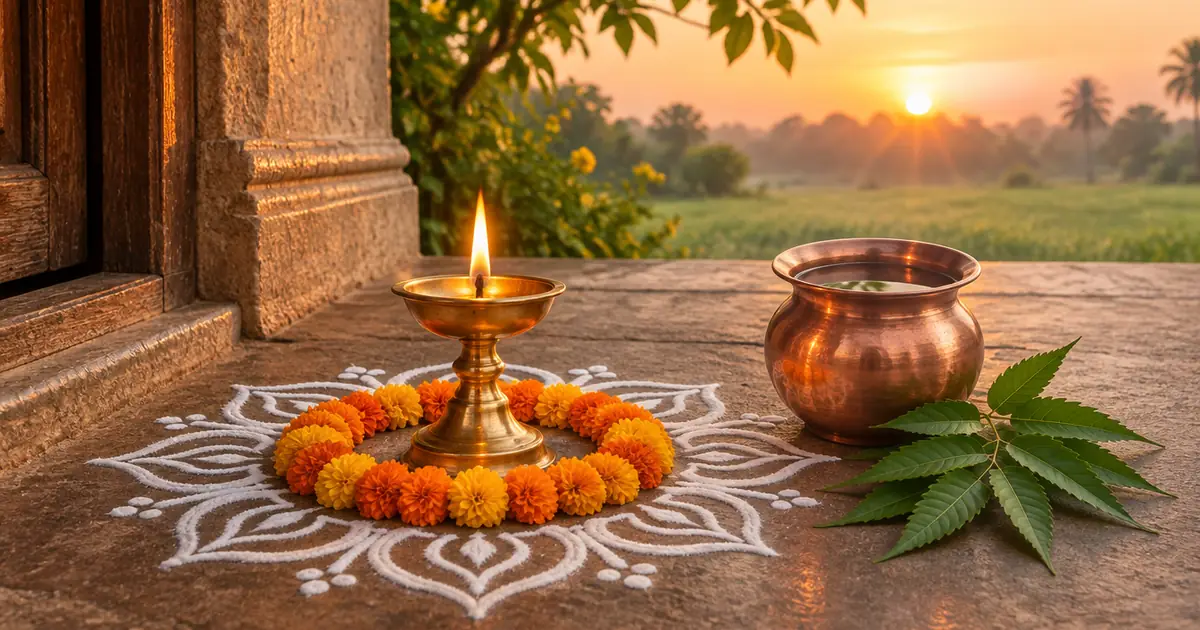
- Fix a time and place. Morning before work, or the same hour each evening. A shelf with a small picture of Hanuman, a lamp or a candle, and a little space to sit is enough.
- Set the daily count. One full recitation a day is the usual baseline. On Tuesdays and Saturdays, many people do three, seven or eleven. Choose a number you can keep on your busiest day, not your easiest.
- Track it. A simple sheet with forty boxes works well. Some people use a mala to count rounds; others tick a box after each recitation.
- Close the vow simply. On day forty, offer sweets such as boondi or laddoo, share them with family or neighbors, and give something to someone in need if you can.
One recitation at a steady pace takes roughly ten minutes. If you are learning, read from a book or a printed sheet with transliteration. Pronunciation improves with repetition, and devotion does not wait for perfection.
Small things that help the practice last
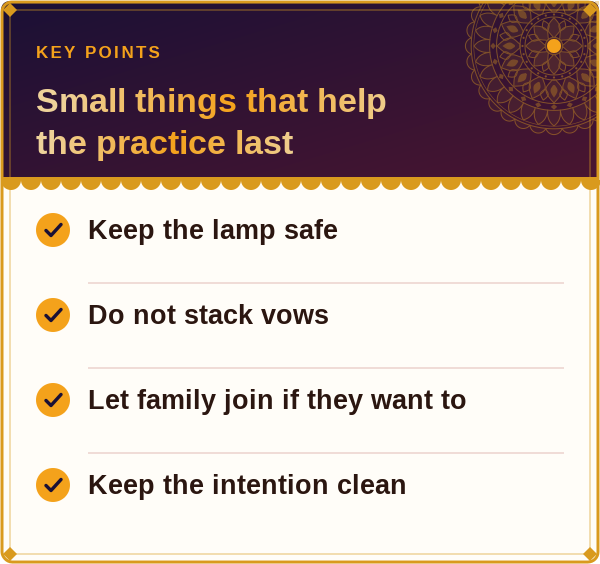
- Keep the lamp safe. Place it on a metal plate, away from curtains, and never leave it burning when you step out. A battery candle is fine in a rental with strict rules.
- Do not stack vows. Starting the Chalisa, a fast and a new mantra in the same week usually ends with all three dropped. One practice done steadily beats three done anxiously.
- Let family join if they want to. Children often learn the Chalisa faster than adults. A shared Tuesday recitation can become a household habit that outlasts the forty days.
- Keep the intention clean. Pray for courage, clarity and protection for your household. Never recite against a person. Using a prayer as a weapon goes against the spirit of Hanuman's own service.
If you want help choosing between the Chalisa and a shorter mantra, the guide to choosing a mantra by deity, planet or need sets out the options, and personal mantra and meditation guidance can build a routine with you by phone or video.
When fear is the reason you started
Many people begin the Chalisa because they feel unsafe, unlucky or afraid that someone has put the evil eye or a spell on them. The hymn can bring real comfort in those weeks. It works best alongside ordinary checks: sleep, health, money stress, conflict at work or at home. The post on black magic fears and how not to be scared into paying explains why anyone who uses fear to demand growing sums should be avoided.
Be plain with yourself about what a recitation cannot do. It cannot stop a real threat from a real person, settle a legal problem or treat anxiety that is stopping you from working or sleeping. If someone is threatening you, call emergency services. If fear or low mood has taken over your days, talk to your doctor, or contact the Suicide and Crisis Lifeline at any hour. Astrologer and Psychic Vijayram offers the Chalisa as faith practice for courage, alongside that help and never in place of it.
If fear of black magic is what brought you to this prayer, the protection prayers session offers removal prayers, puja and protective remedies, explained calmly and with the fee stated first.

Common questions
What if I miss a day in the middle of the forty?
Nothing bad happens. Customs differ: some families simply carry on and add one extra day at the end, others start again from day one. Choose the rule before you begin so a missed evening does not turn into worry. A vow made in devotion is not a contract with penalties.
Can I listen to a recording instead of reciting?
Listening is a valid form of devotion, and many people play the Chalisa while cooking or driving. For a counted practice, reciting along with the recording, even softly, keeps your attention in it. On days when your voice is gone, listening with full attention is fine.
Do I have to be Hindu to recite it?
No. The Chalisa is sung by people of many backgrounds, and nobody checks credentials at the door of a prayer. What matters is approaching it with respect: learning a little about Hanuman and the Ramayana, and not treating the verses as a charm to use against someone.
Is the Hanuman Chalisa a remedy for black magic?
Families often turn to it when they are afraid, and as a prayer for courage it can help you feel steadier. It also forms part of the removal work described on the page about calm black magic removal prayers and puja.
Related service
Keep reading

Graha Shanti at Home or at a Temple: Choosing How to Hold One
What a graha shanti puja is, when an astrologer suggests one, and how Chicago families choose between a home rite, a temple booking or joining online.
Read article →
Shani Remedies That Fit a Nine-to-Five Week
Shani remedies scaled to a working schedule: a Saturday oil lamp, a short mantra, steady charity and Saturn's lesson of discipline, without fear or big costs.
Read article →
Rahu and Ketu Across Your Houses: When Remedies Are Suggested
Rahu ketu remedies explained calmly: how the nodal axis is read across the six house pairs, when observances are suggested and why alarm is rarely called for.
Read article →Quick answers
Why do families tie a black thread against nazar?
What is the evil eye, or nazar, and why do families tie a black thread against it? A belief shared by many cultures, and what the custom is meant to express.
Read answer →Is feeling drained around certain people a sign of negative energy?
Is feeling drained around certain people one of the signs of negative energy? Common feelings, the ordinary causes to rule out first, and healthy boundaries.
Read answer →Talk to Astrologer and Psychic Vijayram
Tell us what you are facing. If a reading is unlikely to help, you will be told that plainly.