

Shani Remedies That Fit a Nine-to-Five Week
Traditional Shani remedies are an oil lamp or temple visit on Saturdays, a short Saturn mantra, charity to workers, elders and people in need, and steady discipline in daily duties. They scale down easily: ten minutes on Saturday and a few minutes on weekdays is a sound practice. They offer steadiness, not a promise of easier events.
Key takeaways
- Shani is the planet Saturn, worshipped as a deity in Hindu tradition.
- At Shani temples, devotees pour mustard oil over the image on Saturdays.
- The short Shani mantra is Om Sham Shanaishcharaya Namah .
- Saturn is associated with laborers, elders, people who are poor or overlooked, and anyone doing hard physical work.
- Saturn rewards steady, unglamorous effort.
Most lists of Shani remedies were written for someone who can spend Saturday morning at a temple. If your Saturdays go to laundry, groceries and a child's swim lesson, and your weekdays start with a Metra train or an expressway, you need a version of the tradition that fits. Here is one, built around the week most working people actually have.
Who Shani is, briefly
Shani is the planet Saturn, worshipped as a deity in Hindu tradition. The overview of Shani in Hindu belief describes him as the slow-moving son of Surya, linked with justice, patience, hard work and the consequences of action. Saturn takes about two and a half years to cross each sign, so its phases are long. The best known is Sade Sati, roughly seven and a half years when Saturn passes over the signs around your Moon; the background on Sade Sati explains the calculation.
The tradition does not see Shani as a villain. Saturn is a strict teacher. Remedies are less about pleading for mercy and more about meeting Saturn's terms: patience, honest effort and respect for people who work hard with little reward.
The week, laid out
| When | Practice | Time needed |
|---|---|---|
| Saturday morning or evening | Light a sesame or mustard oil lamp, recite the Shani mantra 108 times or read a short Shani hymn | 10 to 15 minutes |
| Weekday commute | Silent repetition of the short mantra, eleven or twenty-one times | 2 to 5 minutes |
| Once a week or month | Charity: food, warm clothing or time given to people who labor or struggle | As your schedule allows |
| Every day | Saturn's discipline: keep one commitment you have been avoiding | Built into work |
Saturday: the oil lamp
Oil is Saturn's traditional offering. At Shani temples, devotees pour mustard oil over the image on Saturdays. At home, the usual version is a small lamp of sesame or mustard oil lit at dusk or in the morning, often with a few black sesame seeds placed beside it. Some families also keep the custom of chhaya daan: looking at your reflection in a bowl of oil, then giving that oil away to a temple or someone who needs it.
Lamps and Chicago apartments need some care. Use a heavy metal holder on a stable surface, keep it well away from curtains and radiators, and put it out before you leave for errands. The National Fire Protection Association's guidance on candle safety applies to oil lamps too. A battery lamp is an acceptable substitute where open flames are not allowed.

Weekdays: a mantra small enough to keep
The short Shani mantra is Om Sham Shanaishcharaya Namah. Repeated silently, it fits into the wait on a platform or the first few minutes of a train ride. Eleven or twenty-one repetitions are enough on a busy day. The post on a five-minute mantra for the Metra or the 'L' shows how to turn a commute into a steady practice. If you prefer a devotional text, many people add the Hanuman Chalisa on Saturdays; the guide to a forty-day Hanuman Chalisa practice explains why the two are paired.
Charity that matches Saturn
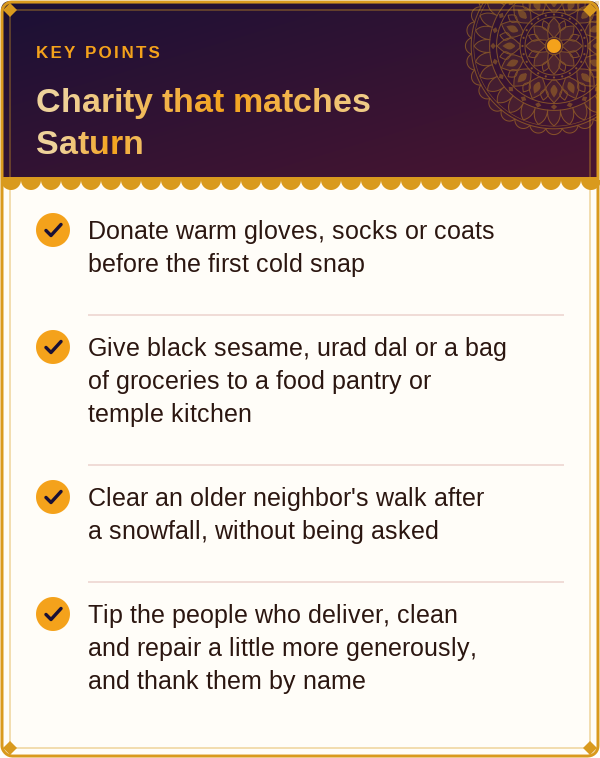
Saturn is associated with laborers, elders, people who are poor or overlooked, and anyone doing hard physical work. Charity aimed at them is the remedy the tradition rates most highly, and it suits a busy life because it can be planned ahead. Ideas that fit a Chicago year:
- Donate warm gloves, socks or coats before the first cold snap.
- Give black sesame, urad dal or a bag of groceries to a food pantry or temple kitchen.
- Clear an older neighbor's walk after a snowfall, without being asked.
- Tip the people who deliver, clean and repair a little more generously, and thank them by name.
For more ways to practice without spending much, see the post on seva, fasting and charity as remedies.
The remedy people skip: discipline
Saturn rewards steady, unglamorous effort. The most traditional Shani remedy of all is to do your duty well: arrive on time, finish what is overdue, keep your word, and treat the people under you fairly. During a hard Saturn period, pick one area where you have been cutting corners and fix it. It asks only for attention, and it is the remedy most directly tied to what Saturn represents.
When to get a chart looked at
If you are not sure whether a Saturn period is running for you, or which phase you are in, a reading can tell you. Graha shanti planetary prayers can be planned from your chart if you want a fuller rite, and the post on routines for each phase of Sade Sati gives phase-by-phase ideas.
A remedy cannot make a layoff, a court date or an illness go away. If Saturn's period lines up with real trouble, take the practical steps first: talk to your manager or HR, a lawyer, a financial counselor or your doctor. Astrologer and Psychic Vijayram offers these practices as faith-based steadiness alongside that help, never as a substitute for it.
Common questions
Should I fast on Saturdays for Shani?
A Saturday fast is a traditional option, often taken as one simple meal without salt or grains. It is optional. Anyone with diabetes, a heart condition, a history of eating disorders, a pregnancy or regular medication should ask a doctor first, and nobody should fast in a way that leaves them unsafe at work or behind the wheel.
Do I need to visit a Shani temple?
No. Many people never do. A lamp at home, the mantra and regular charity form a complete practice. If you like temple visits, a Hanuman or Navagraha shrine at a local temple suits a Saturday morning just as well.
Someone told me to wear a blue sapphire for Saturn. Should I?
Be careful. Blue sapphire is one of the stones the tradition treats with the most caution, and it should only be considered after a full chart check. The post on who should not wear Jyotish gemstones explains why many astrologers suggest prayer and charity first.
How long should I keep these remedies going?
Many people keep them for the length of the Saturn period that prompted them, which can be years for Sade Sati. That is why they need to be small enough to keep. A practice you can sustain on a tired Friday night is worth more than a grand one you drop after a month.
Related service
Keep reading

Rahu and Ketu Across Your Houses: When Remedies Are Suggested
Rahu ketu remedies explained calmly: how the nodal axis is read across the six house pairs, when observances are suggested and why alarm is rarely called for.
Read article →
From Lease to Opening Night: Blessing a New Chicago Restaurant
A restaurant opening puja for Chicago kitchens: timing the blessing between inspection and opening, the doorway and stove rites, and fire-code sense with lamps.
Read article →
Blessing a Home Office: Protection Customs for Remote Workers
A home office blessing for remote workers: small traditional customs for a desk or spare room, the ordinary fixes to try first, and what ritual cannot change.
Read article →Quick answers
Why do families tie a black thread against nazar?
What is the evil eye, or nazar, and why do families tie a black thread against it? A belief shared by many cultures, and what the custom is meant to express.
Read answer →Is feeling drained around certain people a sign of negative energy?
Is feeling drained around certain people one of the signs of negative energy? Common feelings, the ordinary causes to rule out first, and healthy boundaries.
Read answer →Talk to Astrologer and Psychic Vijayram
Tell us what you are facing. If a reading is unlikely to help, you will be told that plainly.