
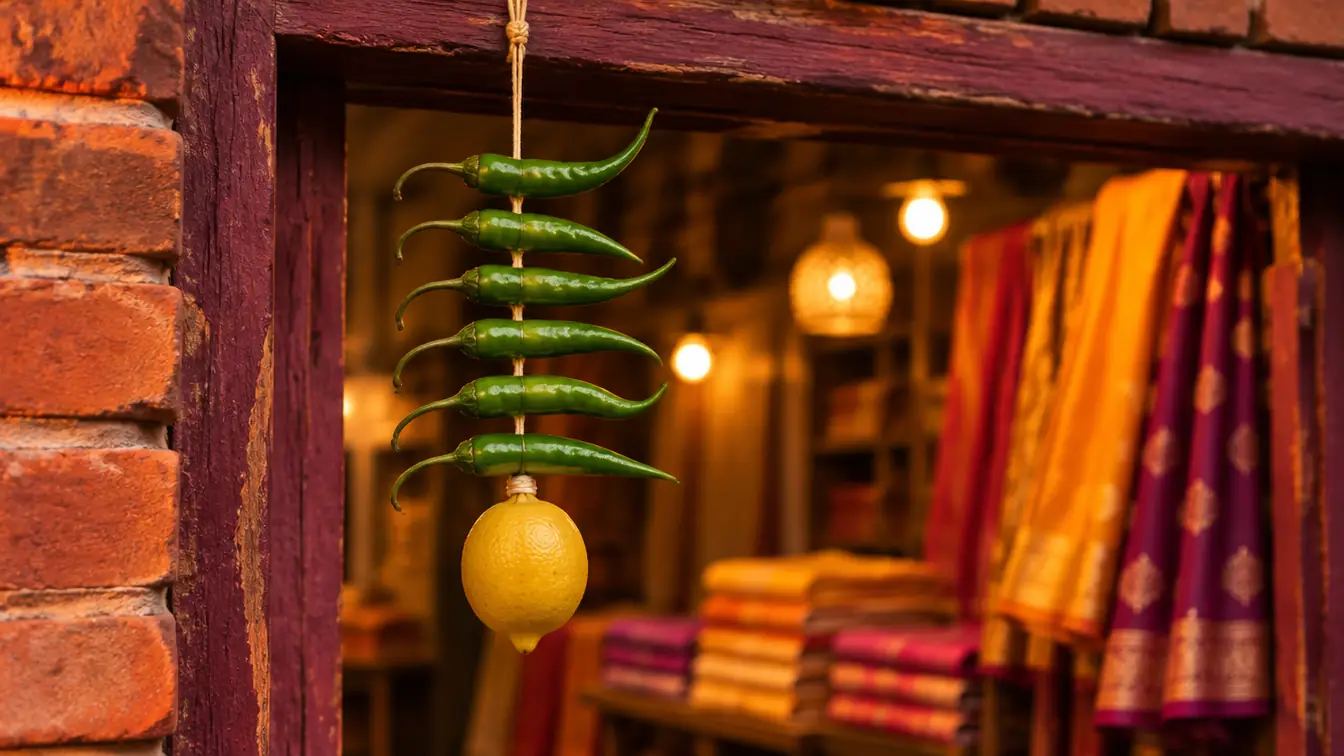
Lemon-and-Chili Charms at Shop Doors: The Nimbu Mirchi Custom
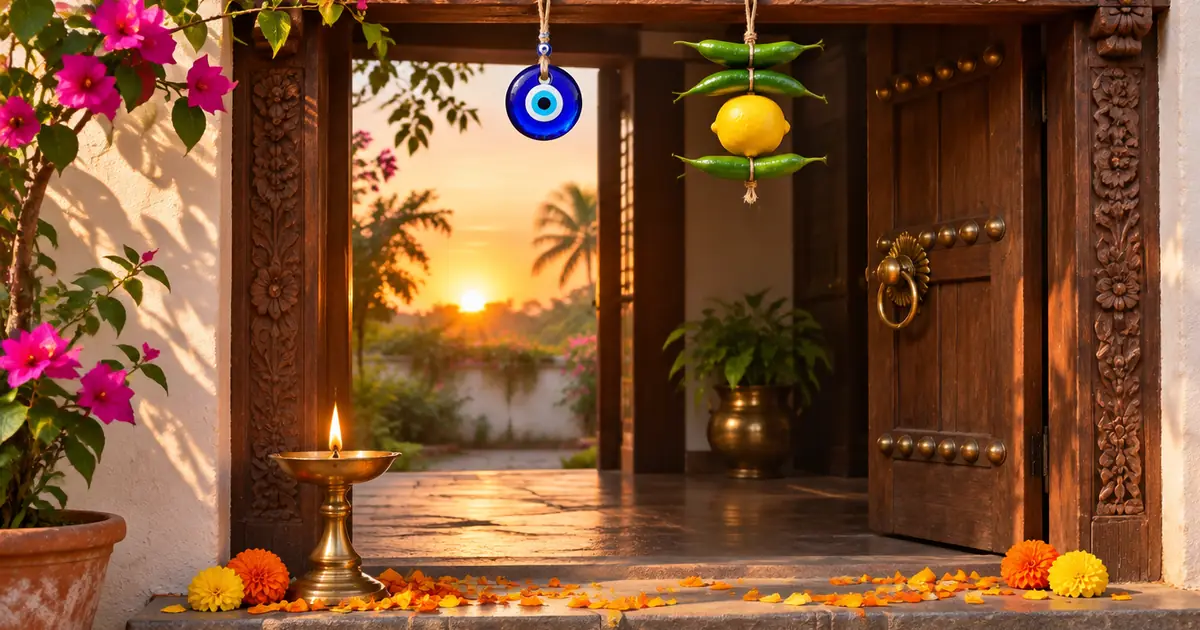
Nimbu mirchi is a string of one lemon and seven green chilies, threaded on cotton and hung at a shop or home door to turn away nazar, the evil eye. It is a familiar sight on South Asian shopping streets like Devon Avenue. Families describe it as protection and good luck; it is a custom of faith, not a guarantee.
Key takeaways
- Nimbu is Hindi and Urdu for lemon; mirchi is chili.
- Families give a few explanations, and they often overlap:
- In many families the string is changed on Saturday, the day linked with Shani, the planet Saturn, who is associated with hardship and its removal.
- The street was earlier a largely Jewish shopping district, and many people feel "Little India" is too narrow a name for it today.
- Business owners sometimes want more than a weekly charm when they open or renovate.
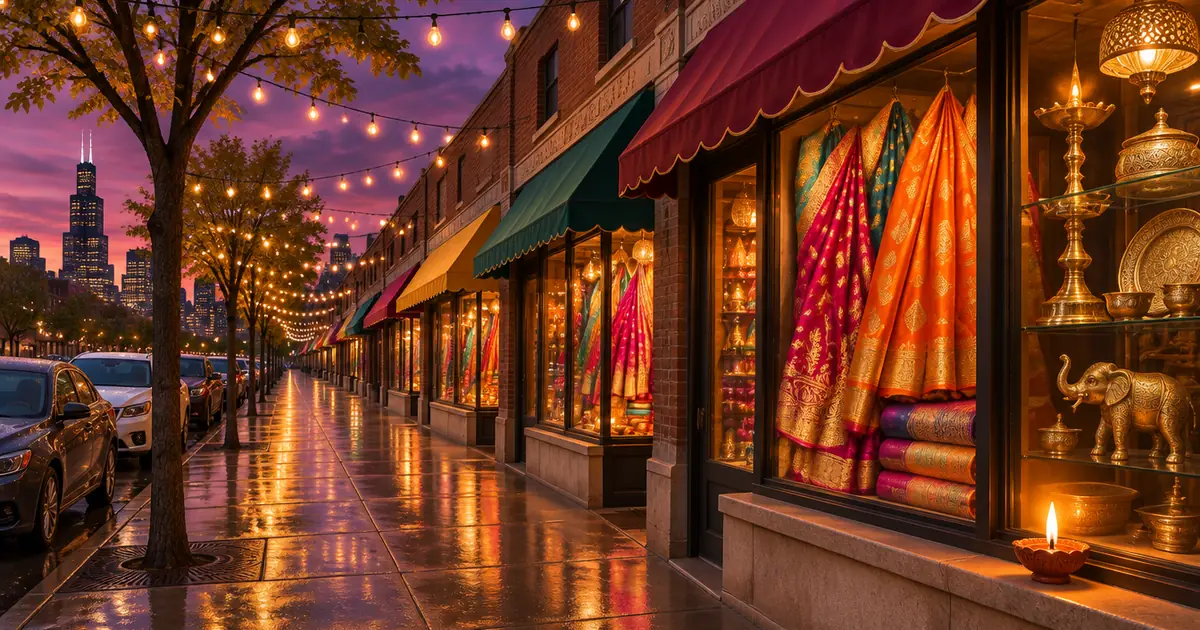
Walk the mile or so of Devon Avenue that makes up its South Asian shopping district, mostly in West Ridge, and you pass sari shops, jewelers, grocers and restaurants run by Indian, Pakistani and Bangladeshi families, along with longtime businesses from older communities. Look up at some doorways in South Asian shopping streets and you may notice a string of one lemon and seven green chilies swinging gently from a cotton thread. People who search for the nimbu mirchi meaning are usually trying to understand exactly that small charm.
What it is
Nimbu is Hindi and Urdu for lemon; mirchi is chili. The charm is simple: a needle and thread pass through a lemon, then through seven fresh green chilies, and sometimes a small piece of charcoal is added at the bottom. The string is hung at the threshold of a shop, home or vehicle, and replaced with a fresh one each week.
It belongs to a wide family of South Asian protections against nazar, the evil eye. The term nazar battu covers any object or mark used for that purpose, from a black dot on a child's face to a deliberate flaw stitched into a sari, as the article on nazar battu explains. The lemon-and-chili string is one of the most visible.
The stories behind the lemon and chilies
Families give a few explanations, and they often overlap:
- Alakshmi at the door. A popular story says that Alakshmi, the goddess of misfortune and elder sister of Lakshmi, likes sour and pungent things. She eats her fill at the door, is satisfied, and leaves without coming inside, so misfortune never enters.
- Absorbing the gaze. Others say the sharp, sour items catch and hold an envious look before it reaches the business or the family.
- A practical reading. Some people suggest the lemon and chilies kept insects away from old shop fronts. That is a modern guess, not something anyone has shown, and most families do not keep the custom for that reason.
Whatever the explanation, the meaning shopkeepers usually give is simple: protection for the business and a wish for steady customers.
Why Saturday
In many families the string is changed on Saturday, the day linked with Shani, the planet Saturn, who is associated with hardship and its removal. Some change it on Tuesday instead. Vendors in Indian cities sell fresh strings to shopkeepers on those mornings. The day matters less than the habit of renewing it before the lemon dries and the chilies wilt.
Seen from Devon Avenue
Devon became Chicago's best-known South Asian street over several decades, as the WBEZ history of how Devon Avenue became Chicago's Little India traces, and its honorary names, Gandhi Marg, Mohammed Ali Jinnah Way and Sheikh Mujib Way, mark three nations on one road, as the Devon Avenue article notes. The street was earlier a largely Jewish shopping district, and many people feel "Little India" is too narrow a name for it today.
That mix matters here. A lemon-and-chili string is one way of saying "protect this place." Other businesses on the same block say it with a framed prayer, a small shrine, a blue glass eye, or nothing at all. None of these is more correct than another; each family follows its own faith. For more on how different Chicago communities guard against the same worry, see how Chicago's communities guard against the evil eye, and for the neighborhood itself, the page on West Ridge and Devon Avenue and the wider North Side.
Hanging one at a Chicago door
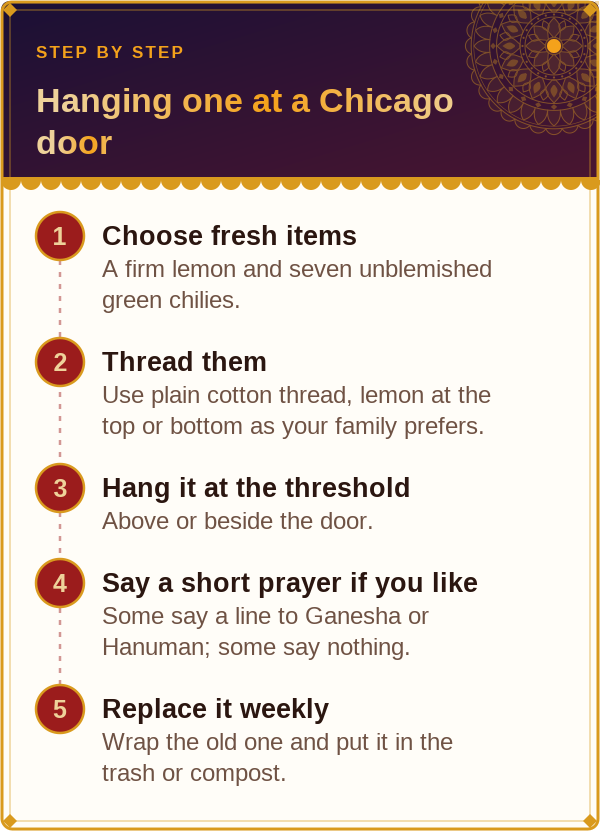
- Choose fresh items. A firm lemon and seven unblemished green chilies.
- Thread them. Use plain cotton thread, lemon at the top or bottom as your family prefers.
- Hang it at the threshold. Above or beside the door. In winter, hang it just inside, since a frozen lemon splits.
- Say a short prayer if you like. Some say a line to Ganesha or Hanuman; some say nothing.
- Replace it weekly. Wrap the old one and put it in the trash or compost. Tradition says not to step on it.
A few modern cautions: check building or condominium rules before hanging anything on a shared hallway door; keep chilies away from curious dogs and toddlers; and wash your hands after threading, before touching your eyes.
For shop owners
Business owners sometimes want more than a weekly charm when they open or renovate. The shop and office blessing for Chicago businesses covers a simple opening prayer and timing, and the post on choosing a business muhurta for a Chicago shop explains how an opening day is picked.
What the charm cannot do
A lemon and seven chilies cannot protect a shop from a slow January, a rent increase or a competitor across the street. It is a sign of faith and care, kept by many families with real affection. Good service, sound accounts and insurance do the practical work. If worry about envy is affecting your sleep or your business decisions, the evil eye prayers and protection session with Astrologer and Psychic Vijayram starts with ordinary causes and offers a calm prayer only if you want one.
Common questions
Why seven chilies?
Seven is a number with many auspicious links in South Asian tradition, from the seven steps of a wedding to the seven days of the week. No single scripture fixes the number for this charm. It is a folk custom, and families repeat what their elders did.
Is nimbu mirchi totka a Hindu or a Muslim custom?
It is best described as a South Asian folk custom. It is especially familiar in Hindu households and businesses, and the wider belief in nazar it answers is shared across Hindu, Muslim, Sikh and Christian families in the region. People keep it, or do not, according to their own faith and family habit.
Can I hang one inside my apartment?
Yes. Many people hang it just inside the front door, which also keeps it from freezing in a Chicago winter. Keep it out of reach of children and pets, since chilies are irritating to eyes and mouths.
What do I do with the old one?
Tradition says not to step on it or bring it back inside. Most families wrap it and put it out with the trash or compost on the day they hang a fresh one, often a Saturday.
Related service
Keep reading

Blessing a New Chicago Apartment
Apartment cleansing in Chicago, done simply: a move-in blessing that respects your lease, the neighbors through the wall and the smoke detector in the hallway.
Read article →
Griha Shanti in a Suburban Subdivision: Havan Smoke, HOA Rules and Neighbors
Planning a house blessing in the Chicago suburbs: griha shanti and havan smoke, smoke alarms, HOA and village rules, parking and a word to the neighbors.
Read article →
A Heavy Atmosphere at Work: A Faith-Based View for Loop Offices
Negative energy at work in a Loop office usually means workload, conflict or burnout. When HR and rest help most, and quiet desk-level practices for the rest.
Read article →More from North Side

Lunar Calendars on Devon Avenue: Hindu, Islamic and Sikh Dates Side by Side
Why festival dates change every year: how Hindu, Islamic and Sikh calendars are set, and where a Chicago panchang fits on Devon Avenue's shared street.
Read article →
Devon Avenue Questions: What Chicago Families Ask an Astrologer
What families around Devon Avenue ask an Indian astrologer: marriage matches, visa waits, shop openings and children's charts, and where a chart's answer stops.
Read article →
Akshaya Tritiya and Gold Shopping on Devon Avenue
Akshaya Tritiya in Chicago: why the day is considered lasting for purchases, how the Devon Avenue gold custom fits it, and how to keep it without overspending.
Read article →Local pages
Indian Astrologer Near Devon Avenue, West Ridge
An Indian astrologer for West Ridge and Devon Avenue, Chicago: Vedic charts, kundli matching and muhurta dates by phone, WhatsApp or video, in Central Time.
View location →
Astrologer in Rogers Park
Astrologer in Rogers Park, Chicago: Vedic birth charts, tarot and psychic readings by phone, WhatsApp or video for Loyola students, families and renters.
View location →
Psychic Reading and Astrology in Edgewater
Psychic reading for Edgewater, Chicago, plus Vedic astrology and tarot by phone, WhatsApp or video, for residents of the Sheridan Road towers and side streets.
View location →Quick answers
Why do families tie a black thread against nazar?
What is the evil eye, or nazar, and why do families tie a black thread against it? A belief shared by many cultures, and what the custom is meant to express.
Read answer →Is feeling drained around certain people a sign of negative energy?
Is feeling drained around certain people one of the signs of negative energy? Common feelings, the ordinary causes to rule out first, and healthy boundaries.
Read answer →Talk to Astrologer and Psychic Vijayram
Tell us what you are facing. If a reading is unlikely to help, you will be told that plainly.