
Lunar Calendars on Devon Avenue: Hindu, Islamic and Sikh Dates Side by Side
Festival dates change every year because many calendars follow the Moon. On Devon Avenue, Eid moves about eleven days earlier each year on the purely lunar Islamic calendar, Diwali shifts within autumn because the Hindu calendar adds a leap month, and some Sikh gurpurabs follow lunar dates while others are fixed to the sun.
Key takeaways
- The Hijri calendar has twelve months that follow the Moon exactly, each 29 or 30 days long.
- The result is a festival that wanders within a window rather than through the whole year.
- In 2003 the Shiromani Gurdwara Parbandhak Committee adopted the Nanakshahi calendar, which fixed gurpurabs to solar dates so they would stay put each year.
- Bangladesh's revised Bengali calendar fixes Pohela Boishakh, the Bengali new year, on April 14.
- Many households and shops on Devon hang a printed panchang from India.
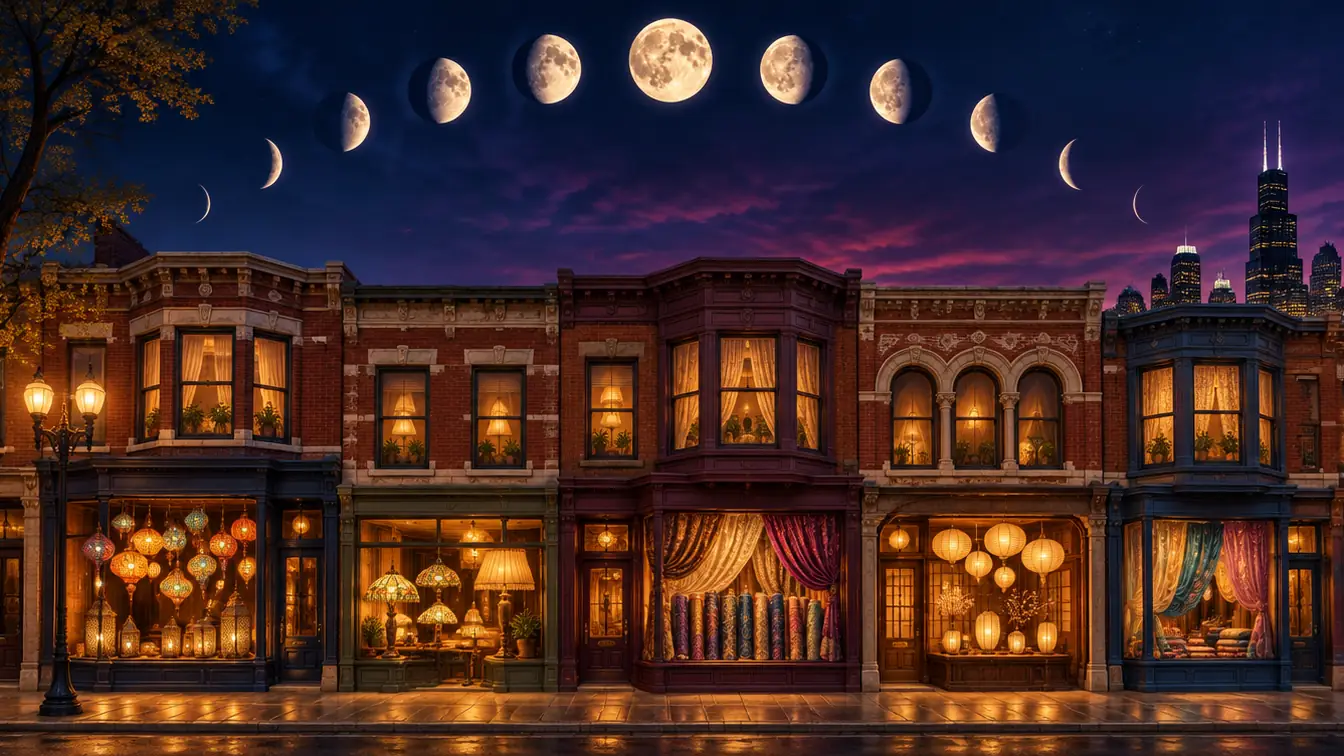
Walk the mile or so of Devon Avenue's South Asian shopping district in West Ridge and you pass under honorary street signs that tell its story: Gandhi Marg, Mohammed Ali Jinnah Way, Sheikh Mujib Way, as the history of Devon Avenue records. Indian, Pakistani and Bangladeshi shops sit side by side, in a neighborhood that WBEZ notes was largely Jewish before South Asian businesses arrived, and where some residents feel "Little India" is too narrow a name. The same street keeps several calendars at once. That is why a sweet shop's busiest week moves around the year, and why a shopkeeper may tell you "Eid is early this year" without looking at a phone.
Here is why festival dates change every year, calendar by calendar.
The Islamic calendar: purely lunar
The Hijri calendar has twelve months that follow the Moon exactly, each 29 or 30 days long. Twelve lunar months come to about 354 days, eleven short of the solar year. Nothing adds the missing days back, so Eid al-Fitr and Eid al-Adha arrive about eleven days earlier on the Gregorian calendar each year and drift through every season over roughly 33 years. Ramadan in a Chicago July means long fasts with sunset after 8:00 p.m.; Ramadan in December means short days and early iftars.
Each month starts with the new crescent. Some communities wait for a local sighting, some use astronomical calculation, and some follow announcements from abroad, which is why mosques in the same city occasionally mark Eid a day apart.
The Hindu calendar: lunar months, solar anchor
The Hindu calendar is lunisolar. Its months follow the Moon, but roughly every 32 to 33 months an extra month, adhika masa, is inserted so that the calendar does not drift away from the seasons. The result is a festival that wanders within a window rather than through the whole year. Diwali always falls in autumn, somewhere from mid-October to mid-November; Holi always falls near the spring full moon.
Two more details explain much of the confusion on festival week:
- Two ways of naming months. North Indian calendars usually end the month at the full moon; many South Indian, Gujarati and Maharashtrian calendars end it at the new moon. The festival falls on the same night, but the month may be named differently.
- The tithi rule. A festival is tied to a tithi, a lunar day defined by the angle between Sun and Moon, and to the time of day when it must be in force: sunrise for many observances, the evening for Diwali's Lakshmi Puja, midnight for Janmashtami. That moment is calculated for the place where you are.
Some Hindu observances are solar instead. Makar Sankranti marks the Sun's entry into sidereal Capricorn, which is why it stays near January 14 or 15. Gujarati families on Devon mark their new year the day after Diwali, following the Vikram Samvat calendar.
The Sikh calendar: a mix of solar and lunar
In 2003 the Shiromani Gurdwara Parbandhak Committee adopted the Nanakshahi calendar, which fixed gurpurabs to solar dates so they would stay put each year. In 2010 the committee amended it and returned several observances, including Guru Nanak's gurpurab, to lunar dates. Different gurdwaras and organizations follow different versions, so dates can differ between congregations. Vaisakhi, tied to the solar year, stays on April 13 or 14; Guru Nanak's gurpurab, on the full moon of Kartik, usually lands in November but moves.
Other calendars on the same street
Bangladesh's revised Bengali calendar fixes Pohela Boishakh, the Bengali new year, on April 14. The Hebrew calendar, part of West Ridge's earlier history, is lunisolar like the Hindu one, adding a leap month seven times in every nineteen years. Christian Easter is set by the first full moon after the spring equinox. Very few streets in the city hold this many ways of counting time.
Where a Chicago panchang fits
Many households and shops on Devon hang a printed panchang from India. It is useful for the month and the festival names, but the times are calculated for an Indian city. Chicago is ten and a half or eleven and a half hours behind India, depending on daylight saving, and that gap is long enough to move a tithi's key moment onto a different civil day. A panchang calculated for Chicago's own sunrise and sunset gives the right date and time here. Our post on why a Chicago panchang uses local sunrise explains the arithmetic, and the note on Lakshmi Puja timing for Diwali in Chicago applies it to the biggest festival of the year.
For anything personal, such as a wedding date, a shop opening or a griha pravesh, a muhurta consultation takes the next step, working out windows for Chicago's clock and for your own chart. Astrologer and Psychic Vijayram offers these by phone, WhatsApp or video. Readers who live near the street will find more about the neighborhood on our West Ridge and Devon Avenue page and across the North Side.
A limit worth stating
A calendar tells you when a community has agreed to observe something; it does not rank one faith's way of counting above another's. When dates differ, follow your own temple, gurdwara or mosque. Astrology can calculate a tithi for Chicago, but it has no authority to settle a religious community's calendar for it.
Common questions
Why can a Hindu festival fall on a different day in Chicago than in India?
Festival days are set by the tithi in force at a certain time of day, such as sunrise or evening, at the place of observance. Because Chicago is more than ten hours behind India, that moment can land on a different civil date.
Why do some mosques in Chicago celebrate Eid on different days?
Islamic months begin with the new crescent Moon. Some communities rely on local sighting, some on astronomical calculation, and some follow announcements from abroad. Those methods can differ by a day.
Is Vaisakhi a lunar festival?
No. Vaisakhi follows the solar year and usually falls on April 13 or 14, which is why its date is much steadier than Diwali's or Eid's.
Does the Hebrew calendar work the same way as the Hindu one?
In one respect, yes. Both are lunisolar and add a leap month at intervals to keep festivals in their season, though the rules for when to add it differ.
Related service
Keep reading
Gandanta Births: The Water-Fire Junctions in a Chart, Calmly Explained
Gandanta in a birth chart is where a water sign meets a fire sign: the three junctions, why tradition treats them with care, and why no birth is a misfortune.
Read article →
Combust Planets: When a Planet Sits Too Close to the Sun
Combust planets in Vedic astrology: what asta means, the usual distance for each planet, why Mercury is so often combust, and how combustion is read.
Read article →
Chicago's Trading Floors and the Chart: Mercury, Jupiter and Risk-Heavy Careers
Astrology for traders and finance workers in the Loop: how Mercury, Jupiter and Rahu are read for risk-heavy careers, with no market tips or financial advice.
Read article →More from North Side
Devon Avenue Questions: What Chicago Families Ask an Astrologer
What families around Devon Avenue ask an Indian astrologer: marriage matches, visa waits, shop openings and children's charts, and where a chart's answer stops.
Read article →
Akshaya Tritiya and Gold Shopping on Devon Avenue
Akshaya Tritiya in Chicago: why the day is considered lasting for purchases, how the Devon Avenue gold custom fits it, and how to keep it without overspending.
Read article →
Wedding Shopping on Devon Avenue: Dates Families Like to Start
Devon Avenue wedding shopping and the custom of starting purchases on a chosen day: saris, jewelry and gold, with simple muhurta checks for Chicago families.
Read article →Local pages
Indian Astrologer Near Devon Avenue, West Ridge
An Indian astrologer for West Ridge and Devon Avenue, Chicago: Vedic charts, kundli matching and muhurta dates by phone, WhatsApp or video, in Central Time.
View location →
Astrologer in Rogers Park
Astrologer in Rogers Park, Chicago: Vedic birth charts, tarot and psychic readings by phone, WhatsApp or video for Loyola students, families and renters.
View location →
Psychic Reading and Astrology in Edgewater
Psychic reading for Edgewater, Chicago, plus Vedic astrology and tarot by phone, WhatsApp or video, for residents of the Sheridan Road towers and side streets.
View location →Quick answers
Does a muhurta have to be exact to the minute?
What is muhurta, and must it be exact to the minute? How much leeway a chosen time usually has, and why it is worked out for the city where the event happens.
Read answer →Can a Western birth chart printout be turned into a kundli?
What is a kundli, and can a Western birth chart printout become one? Yes, from the same birth data. Here is what the sidereal shift and Indian layout change.
Read answer →Talk to Astrologer and Psychic Vijayram
Tell us what you are facing. If a reading is unlikely to help, you will be told that plainly.