
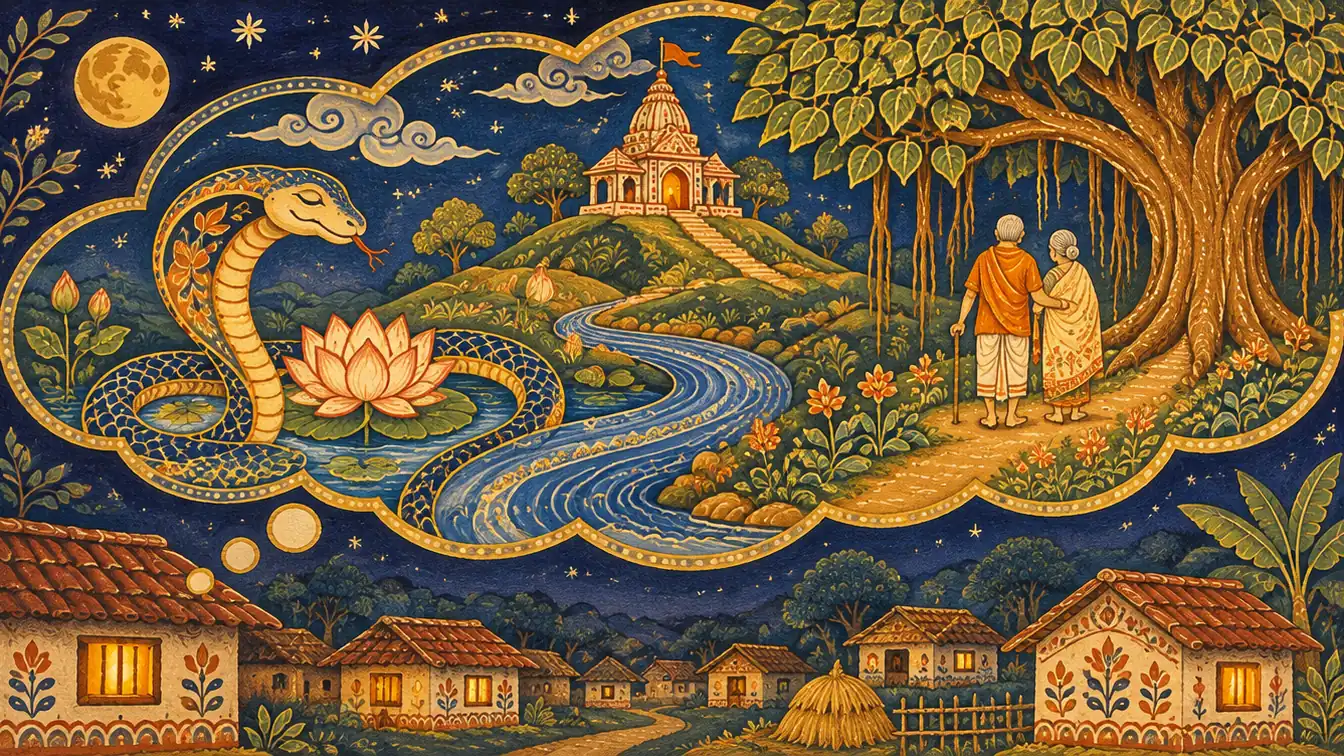
Swapna Shastra: Snakes, Water, Temples and Elders in Dreams
Hindu dream lore, often called Swapna Shastra, reads common symbols through family and regional custom: snakes as hidden worry or sacred energy, clear water as calm, temples and deities as blessing, elders as remembrance or advice. The Charaka Samhita itself says most dreams simply replay what we have seen, heard or wished. Treat meanings as reflection, not prediction.
Key takeaways
- The most quoted early source is the Charaka Samhita, the foundational Ayurvedic text, which discusses dreams in its section on signs.
- Snakes carry heavy meaning in Indian culture, so snake dreams are among the most anxious questions people bring.
- Talk to your doctor, and never stop or change a medication on your own because of dreams.
- A dream interpretation session with Astrologer and Psychic Vijayram brings the traditional symbols into a conversation about your own life, by phone, WhatsApp or video.
Many people raised in Hindu households grew up with a grandmother's dream lore. Dream of a temple and it is a blessing. Dream of a snake and someone is jealous. Dream of clear water and good news is coming. These sayings go by the loose name Swapna Shastra, the science of dreams, and they draw on dream chapters in the Puranas, Ayurvedic texts and a great deal of oral tradition that differs from one region, one community and even one family to the next.
That variety is worth keeping in mind. There is no single authoritative dream dictionary in Hinduism. What follows is how common symbols are often read, offered for reflection, not as a code.
What the classical medical text actually says
The most quoted early source is the Charaka Samhita, the foundational Ayurvedic text, which discusses dreams in its section on signs. In chapter five of the Indriyasthana, it sorts dreams into seven kinds: those about things seen, heard or experienced, those shaped by desire, those created by fancy, those said to presage good or ill, and those arising from imbalance in the body.
Then it does something many modern dream books skip: it tells the physician to regard the first five kinds as "fruitless," along with dreams from daytime sleep and dreams that are too short or too long. It adds that a dream in the first part of the night "has only a small degree of fulfilment." In other words, even the classical text treated most dreams as the mind replaying the day.
Four symbols families ask about most
Snakes
Snakes carry heavy meaning in Indian culture, so snake dreams are among the most anxious questions people bring. Readings pull in opposite directions. Some dream books call a snake a sign of hidden enemies or jealousy; others call a snake bite fortunate, even a sign of coming wealth. In South Indian families with a tradition of Naga worship, a snake may be read as a reminder of the family deity or an unfulfilled vow. A snake shedding its skin is widely read as renewal.
Questions to ask yourself: Is something in my life feeling threatening or hidden? Is there a change I am resisting? Have I been neglecting a family observance that matters to me?
Water
Clear, flowing water, a calm river or a temple tank is commonly read as peace, cleansing and a smooth path. Muddy water, floods or drowning are read as feeling overwhelmed. For people in Chicago, the water in a dream is often Lake Michigan itself: grey and rough, or flat and blue in July. Notice which. The lake's mood in a dream tends to mirror your own.
Temples and deities
Seeing a temple, a deity or your family's chosen form of the divine is almost always read as a blessing, or as a gentle reminder of a practice you have let slip. People who moved to Chicagoland from India often dream of the temple of their childhood town rather than one in Lemont or Aurora. That can say more about home and belonging than about anything spiritual.
Elders
Living elders in a dream, especially parents far away in India, are often read as worry about them or a wish for their advice. Departed elders are a different matter, and a tender one; the post on dreams of relatives who have died looks at them separately, with grief in mind.
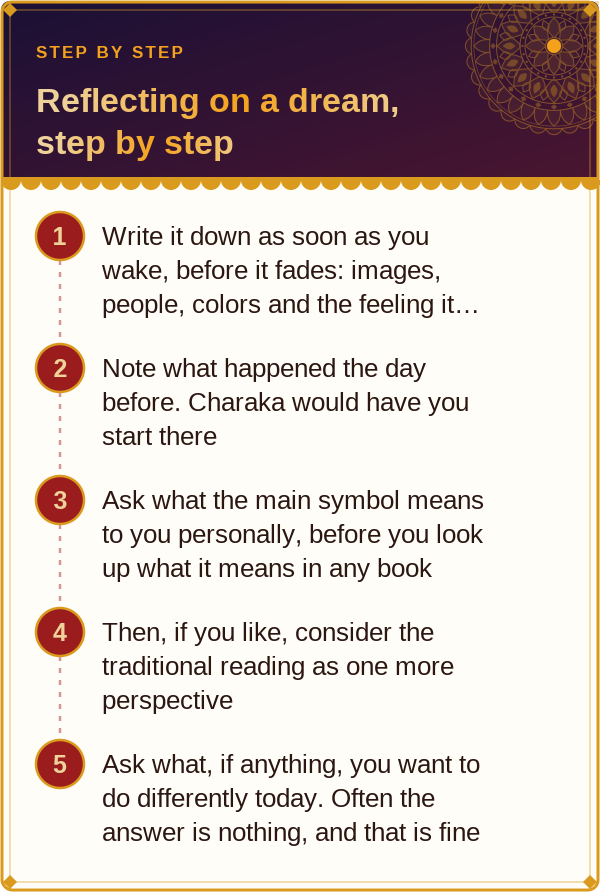
Reflecting on a dream, step by step
- Write it down as soon as you wake, before it fades: images, people, colors and the feeling it left.
- Note what happened the day before. Charaka would have you start there.
- Ask what the main symbol means to you personally, before you look up what it means in any book.
- Then, if you like, consider the traditional reading as one more perspective.
- Ask what, if anything, you want to do differently today. Often the answer is nothing, and that is fine.
When dreams are distressing
Occasional bad dreams are normal. Frequent nightmares that disturb your sleep or follow a frightening experience are a health matter, and MedlinePlus's page on nightmares explains common causes, including stress, some medicines and trauma. Talk to your doctor, and never stop or change a medication on your own because of dreams. The post on what to do with recurring dreams sets out a practical plan.
Where a session fits
A dream interpretation session with Astrologer and Psychic Vijayram brings the traditional symbols into a conversation about your own life, by phone, WhatsApp or video. If a dream keeps pointing toward ancestors or family duties, the ancestral prayers guidance session explains the remembrance customs some families turn to. Neither can tell you what will happen. A dream is a mirror held up at night; what you see in it is for you to weigh.
Common questions
Do dreams near dawn come true?
Many families say so, and the belief is old. The Charaka Samhita discounts dreams from the first part of the night, which is related. But no dream, at any hour, reliably foretells events. Treat a vivid dawn dream as something to reflect on, not to fear.
I dreamed of a snake. Should I do a puja?
Not because of one dream. If snake dreams keep returning and your family has a tradition of Naga worship, you might talk to a priest about it, but only if it brings you peace. No ritual is required, and no one should sell you one through fear.
Is it bad to tell people about an inauspicious dream?
Some families advise keeping troubling dreams private and sharing good ones; others say the opposite. Either way, talking a frightening dream through with someone you trust usually takes the sting out of it.
Can a dream interpretation session tell me what will happen?
No. It helps you explore what the images might reflect in your life now, using tradition as one lens. It does not forecast events or diagnose anything.
Related service

Keep reading

Recurring Dreams: What to Do With Them
Recurring dreams meaning and practical steps: when to see a doctor about sleep, how to keep a two-week dream journal, and how to spot the pattern behind them.
Read article →
Dreams of Relatives Who Have Died
What it can mean to dream of a dead relative: how Hindu and other traditions read these dreams, why they are so common in grief, and gentle things to do next.
Read article →
Intuition: Learning to Listen to Your Own
How to develop intuition with simple daily practices: telling a gut feeling from fear, a hunch log, quiet walks and honest checks, so you rely less on readers.
Read article →Quick answers
Do I have to tell a psychic anything before the reading starts?
What happens in a psychic reading, and what must you share first? Often just your first name and question; you never need to tell more than you wish.
Read answer →What should I do if a reader keeps asking for more money?
How to spot a psychic scam: what to do if a reader uses fear and keeps asking for more money. Stop paying, keep records, report it, and know the warning signs.
Read answer →Talk to Astrologer and Psychic Vijayram
Tell us what you are facing. If a reading is unlikely to help, you will be told that plainly.