

Recurring Dreams: What to Do With Them
A recurring dream usually points to something unresolved, such as stress, a change you are facing or an old fear, rather than a prediction. Keep a short journal for two weeks to find the pattern. If dreams wake you often, follow a frightening event, or come with snoring, gasping or daytime exhaustion, talk to a doctor first.
Key takeaways
- Most recurring dreams are harmless, if tiring.
- Dreams tend to recycle the material of our lives, especially what we have not finished processing.
- Keep a notebook by the bed, not your phone, and spend three minutes each morning on a few columns:
- Once you can see when the dream comes, ask what it might be about:
- Sleep specialists and therapists use a technique called imagery rehearsal for repeated nightmares.
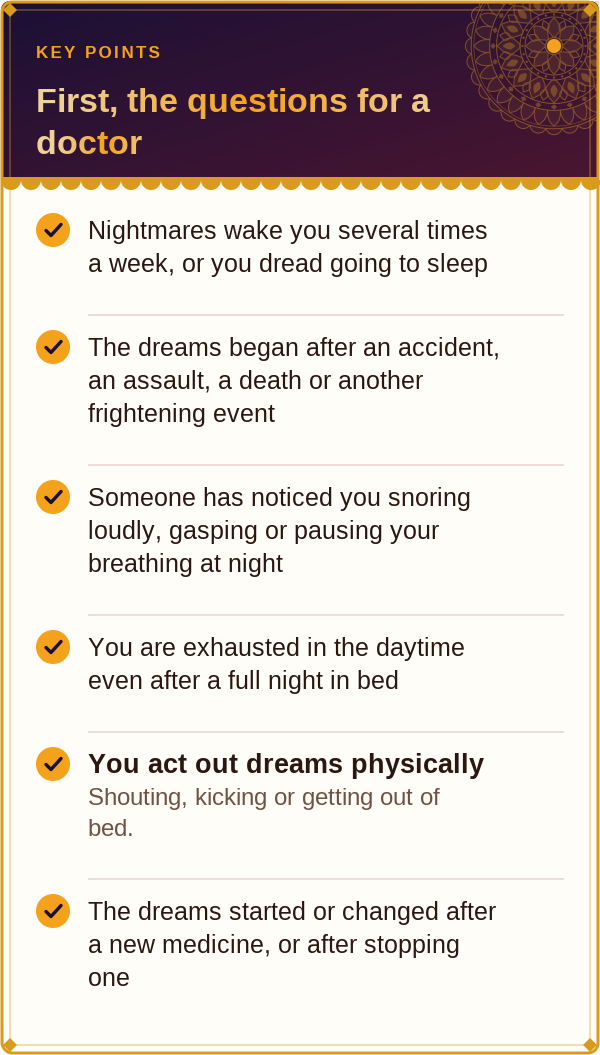
First, the questions for a doctor
Most recurring dreams are harmless, if tiring. Some are worth mentioning to a doctor before you think about meanings at all. Make an appointment if any of these apply:
- Nightmares wake you several times a week, or you dread going to sleep.
- The dreams began after an accident, an assault, a death or another frightening event.
- Someone has noticed you snoring loudly, gasping or pausing your breathing at night.
- You are exhausted in the daytime even after a full night in bed.
- You act out dreams physically: shouting, kicking or getting out of bed.
- The dreams started or changed after a new medicine, or after stopping one.
MedlinePlus explains common causes in its guide to nightmares, and the CDC's pages on sleep and health cover why good sleep matters. Never stop a medication because of dreams without talking to the prescriber. If you are in crisis or thinking of harming yourself, contact the Suicide and Crisis Lifeline, or call emergency services.
Why the same dream comes back
Dreams tend to recycle the material of our lives, especially what we have not finished processing. A dream that returns is often tied to a theme that keeps returning in waking life: pressure at work, a relationship that feels uncertain, a move, an exam you are dreading, a parent's health back home. The classic recurring dreams are familiar for a reason. Being chased. Arriving late. Losing your teeth. Searching a building for a room you cannot find. Missing a flight, which people who travel between Chicago and India often know well.
The details usually matter less than the feeling. Two people can both dream of being chased; one feels terror, the other mild annoyance. That feeling is your best clue.
Keep a two-week dream journal
Writing things down helps you see a pattern instead of a blur, and journaling has its own calming effect, as the University of Rochester Medical Center notes in its piece on journaling for emotional wellness. Keep a notebook by the bed, not your phone, and spend three minutes each morning on a few columns:
| Date | Dream in a sentence | Main feeling | Bedtime and wake time | What happened the day before |
|---|---|---|---|---|
| Mon | Lost in an airport, gate keeps moving | Panic | 12:40 / 6:15 | Argument about a family trip; late coffee |
| Tue | No dream remembered | None | 10:50 / 6:15 | Quiet evening, walked home |
After two weeks, read it back in one sitting. Look for links: does the dream show up after late nights, heavy meals, alcohol, certain conversations, Sunday evenings before the work week? Does it vanish on calm days?
Reading the pattern
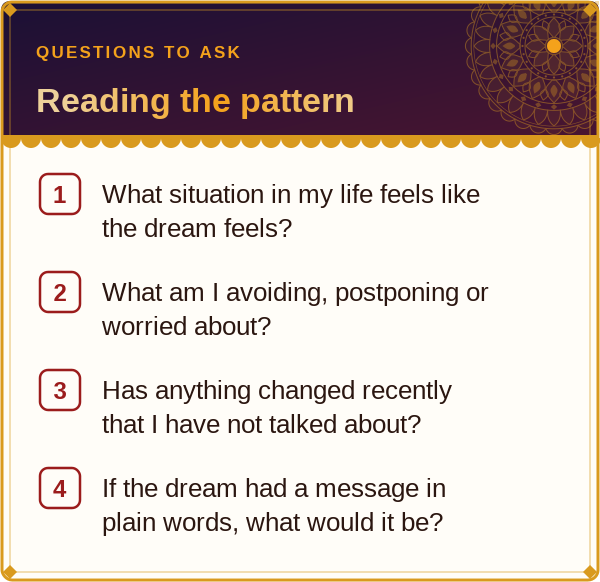
Once you can see when the dream comes, ask what it might be about:
- What situation in my life feels like the dream feels?
- What am I avoiding, postponing or worried about?
- Has anything changed recently that I have not talked about?
- If the dream had a message in plain words, what would it be?
You will not always get a clean answer. Even a partial one, such as "this comes when I feel unprepared," gives you something practical to work on during the day.
Changing the ending
Sleep specialists and therapists use a technique called imagery rehearsal for repeated nightmares. While awake, you write the dream down, change the ending to something neutral or safe, and picture the new version for a few minutes each day. Many people find the dream softens or fades. If the nightmares follow trauma, do this with a therapist rather than alone.
Small changes to the evening
- Keep a steady bedtime and wake time, including weekends.
- Cut caffeine after midday and keep alcohol light; both disturb sleep.
- Put screens away half an hour before bed.
- Get daylight in the morning. In a Chicago winter, when the sun rises late and sets early, a morning walk does more for sleep than people expect.
- End the day with something calming: a short prayer, a page of reading, a few slow breaths. The mantra and meditation guidance session can help you choose a simple practice if you would like one.
The darkest weeks of the year bring their own sleep troubles; the post on a Chicago morning practice for the solstice weeks has more ideas.
Where tradition fits
Once health questions are covered, some people like to look at a recurring dream through the symbols of Indian dream lore, explained in the post on Swapna Shastra and common dream symbols. A dream interpretation session with Astrologer and Psychic Vijayram can explore your journal with you as reflection. It cannot diagnose a sleep problem, it does not predict events, and it never replaces your doctor.
Common questions
I have had the same dream since childhood. Is that unusual?
No. Many adults have a dream that returns now and then across decades, often at stressful times. If it does not disturb your sleep, it is usually a familiar signal of strain rather than a problem in itself.
Can a medicine cause vivid or repeating dreams?
Some can, and so can stopping certain medicines or alcohol. Mention the dreams to your doctor or pharmacist, and never stop or change a prescription on your own because of them.
Does a recurring dream mean someone has done something to me?
No. A repeating dream is not evidence of a curse, the evil eye or anyone's ill will. It is far more often linked to stress, sleep habits or an unresolved feeling, which you can work on directly.
Should I chant a mantra before sleep?
If it calms you, a few minutes of a familiar mantra or prayer can be a gentle part of winding down. It is optional, and it does not replace medical care for sleep problems.
Related service

Keep reading

Dreams of Relatives Who Have Died
What it can mean to dream of a dead relative: how Hindu and other traditions read these dreams, why they are so common in grief, and gentle things to do next.
Read article →
Intuition: Learning to Listen to Your Own
How to develop intuition with simple daily practices: telling a gut feeling from fear, a hunch log, quiet walks and honest checks, so you rely less on readers.
Read article →
At a Crossroads: What a Life Path Reading Covers
What a life path reading covers at a crossroads: career, relationships and place, taken one at a time, with what to prepare and what it cannot decide.
Read article →Quick answers
Do I have to tell a psychic anything before the reading starts?
What happens in a psychic reading, and what must you share first? Often just your first name and question; you never need to tell more than you wish.
Read answer →What should I do if a reader keeps asking for more money?
How to spot a psychic scam: what to do if a reader uses fear and keeps asking for more money. Stop paying, keep records, report it, and know the warning signs.
Read answer →Talk to Astrologer and Psychic Vijayram
Tell us what you are facing. If a reading is unlikely to help, you will be told that plainly.