

Intuition: Learning to Listen to Your Own
You develop intuition by noticing it, testing it and giving it quiet room. Pause before decisions and check how your body responds, write down hunches and see later which ones held up, and learn to tell calm knowing from fear or wishful thinking. Over time you need readings less, which is how good guidance should work.
Key takeaways
- Intuition is the sense of knowing something before you can fully explain why.
- Fear can protect you, and hope can carry you.
- Everyone remembers the hunches that came true and forgets the ones that did not.
- Some decisions are genuinely tangled, and talking with someone outside the situation helps.
It may seem odd for a site that offers readings to encourage you to need them less. But good guidance should leave you steadier on your own feet, not waiting for the next session before you can decide anything. The practices below are simple, take only a few minutes, and work whether or not you ever book a reading.
What intuition is, in plain terms
Intuition is the sense of knowing something before you can fully explain why. Part of it is ordinary pattern recognition: years of experience compressed into a quick feeling. Part of it, many traditions say, is something deeper. Hindi speakers call it the antaratma ki awaaz, the voice of the inner self. You do not need to decide which explanation is right to get better at hearing it.
The hard part is not having intuition. It is telling it apart from the other voices that sound similar.
Intuition, fear and wishful thinking
| Intuition | Fear | Wishful thinking | |
|---|---|---|---|
| How it feels | Quiet, steady, often neutral | Urgent, tight, loud | Excited, eager, a little breathless |
| How it speaks | Brief: "not this one," "call her" | Stories of what could go wrong | Stories of how wonderful it will be |
| Over a day or two | Stays about the same | Rises and falls with stress | Fades when the excitement does |
| When you are rested | Still there | Often weaker | Often weaker |
None of these columns is bad. Fear can protect you, and hope can carry you. The point is to know which one is talking.
Seven simple practices
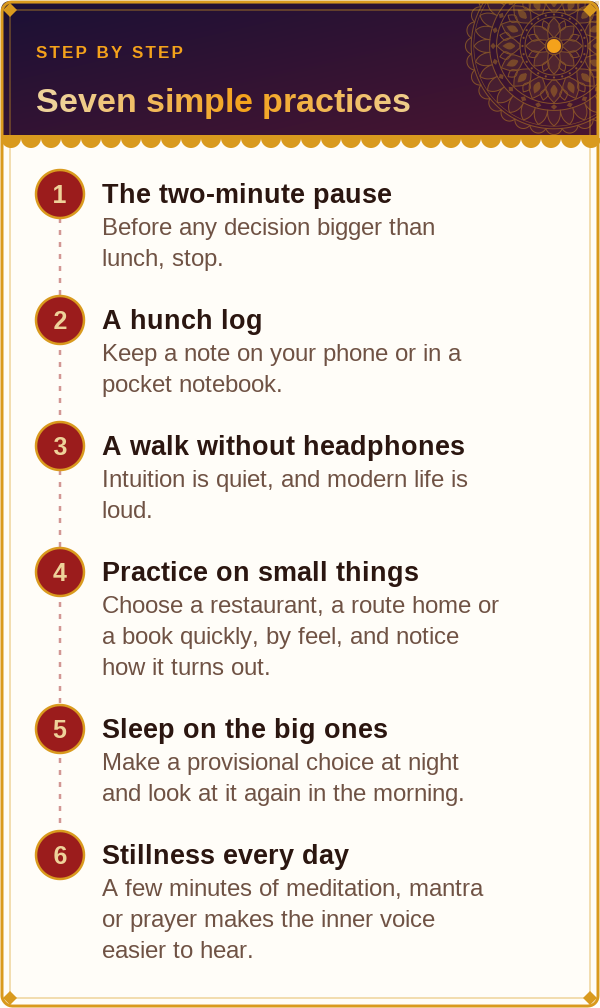
- The two-minute pause. Before any decision bigger than lunch, stop. Breathe slowly five times. Imagine choosing option A and notice your body: does your chest loosen or tighten? Then option B. Write down what you noticed.
- A hunch log. Keep a note on your phone or in a pocket notebook. Each time you have a gut feeling about something checkable, such as a job lead, a person or a plan, write it down with the date. Look back after a month. This is the single most useful habit for learning when your intuition is reliable.
- A walk without headphones. Intuition is quiet, and modern life is loud. Twenty minutes on the Lakefront Trail, in a forest preserve or simply around the block, with no podcast and no calls, gives it room. In January, a brisk loop counts.
- Practice on small things. Choose a restaurant, a route home or a book quickly, by feel, and notice how it turns out. Low stakes make it easier to listen without fear.
- Sleep on the big ones. Make a provisional choice at night and look at it again in the morning. Note whether the feeling held. Intuition tends to survive a night's sleep; anxiety and excitement often do not.
- Stillness every day. A few minutes of meditation, mantra or prayer makes the inner voice easier to hear. The evidence on meditation is modest but encouraging for stress and anxiety, according to the NCCIH's review of meditation and mindfulness. The post on a five-minute mantra for the Metra or the 'L' fits one into a commute.
- Say it aloud. Tell a trusted friend what your gut says before you decide. Hearing yourself say it often makes it clearer, or shows you it was fear all along.
Test your hunches honestly
Everyone remembers the hunches that came true and forgets the ones that did not. Psychologists call this confirmation bias, and it can make intuition seem more reliable than it is. Your hunch log is the antidote. When you look back, sort entries into three groups: clearly right, clearly wrong, and unclear. You may find your intuition is sharp about people and poor about money, or the reverse. That is valuable to know.
The same honesty test works on readings. The post on keeping notes after a reading shows how to check what a reader said against what actually happened.
When not to rely on your gut
- When your safety or someone else's is at stake. Act on danger signals, and call emergency services if needed.
- When you have physical symptoms. See a doctor, whatever your gut says.
- When large sums of money, contracts or legal matters are involved. Get qualified advice.
- When you are exhausted, grieving, very angry or newly in love. Every inner voice gets distorted then.
Where a reader still fits
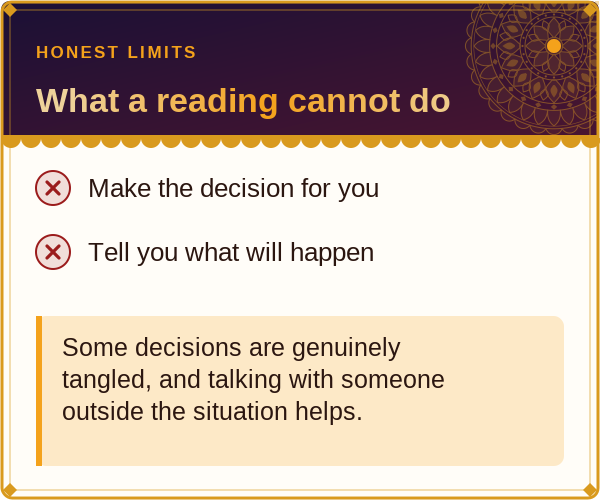
Some decisions are genuinely tangled, and talking with someone outside the situation helps. A life path and purpose reading with Astrologer and Psychic Vijayram can reflect your situation back to you, by phone, WhatsApp or video, and help you hear what you already sense. It cannot make the decision for you or tell you what will happen. If you notice you are booking readings to avoid deciding, the post on a month without readings offers a gentle reset.
Common questions
Is intuition a psychic gift?
Everyone has intuition. Some people describe a stronger sense of it and some traditions treat it as spiritual, but you do not need any special gift to listen to your own inner sense and get better at it.
How long does it take to trust my intuition more?
Many people notice a difference after a few weeks of keeping a hunch log and pausing before small decisions. The aim is not perfect accuracy but a clearer sense of when your inner voice is worth following.
What if my intuition and my family disagree?
Write down both views and what each is based on. Sometimes intuition picks up something others miss; sometimes family sees what you cannot. Talking it through calmly, perhaps with a neutral person, usually helps more than choosing a side.
Can a reading strengthen my intuition?
A good reading can help you hear your own thoughts more clearly by reflecting them back. It should leave you more confident in your own judgment, not more dependent on the reader.
Related service

Keep reading

At a Crossroads: What a Life Path Reading Covers
What a life path reading covers at a crossroads: career, relationships and place, taken one at a time, with what to prepare and what it cannot decide.
Read article →
Are Phone Readings as Useful as Face to Face?
Are phone psychic readings accurate? What changes without face-to-face contact, what stays the same, and a simple way to judge any reading afterward.
Read article →
Keep Notes After a Reading: A Simple Honesty Test
Why keep psychic reading notes? A simple template for writing down what was said, how to record a call lawfully in Illinois, and how to check it months later.
Read article →Quick answers
Do I have to tell a psychic anything before the reading starts?
What happens in a psychic reading, and what must you share first? Often just your first name and question; you never need to tell more than you wish.
Read answer →What should I do if a reader keeps asking for more money?
How to spot a psychic scam: what to do if a reader uses fear and keeps asking for more money. Stop paying, keep records, report it, and know the warning signs.
Read answer →Talk to Astrologer and Psychic Vijayram
Tell us what you are facing. If a reading is unlikely to help, you will be told that plainly.