
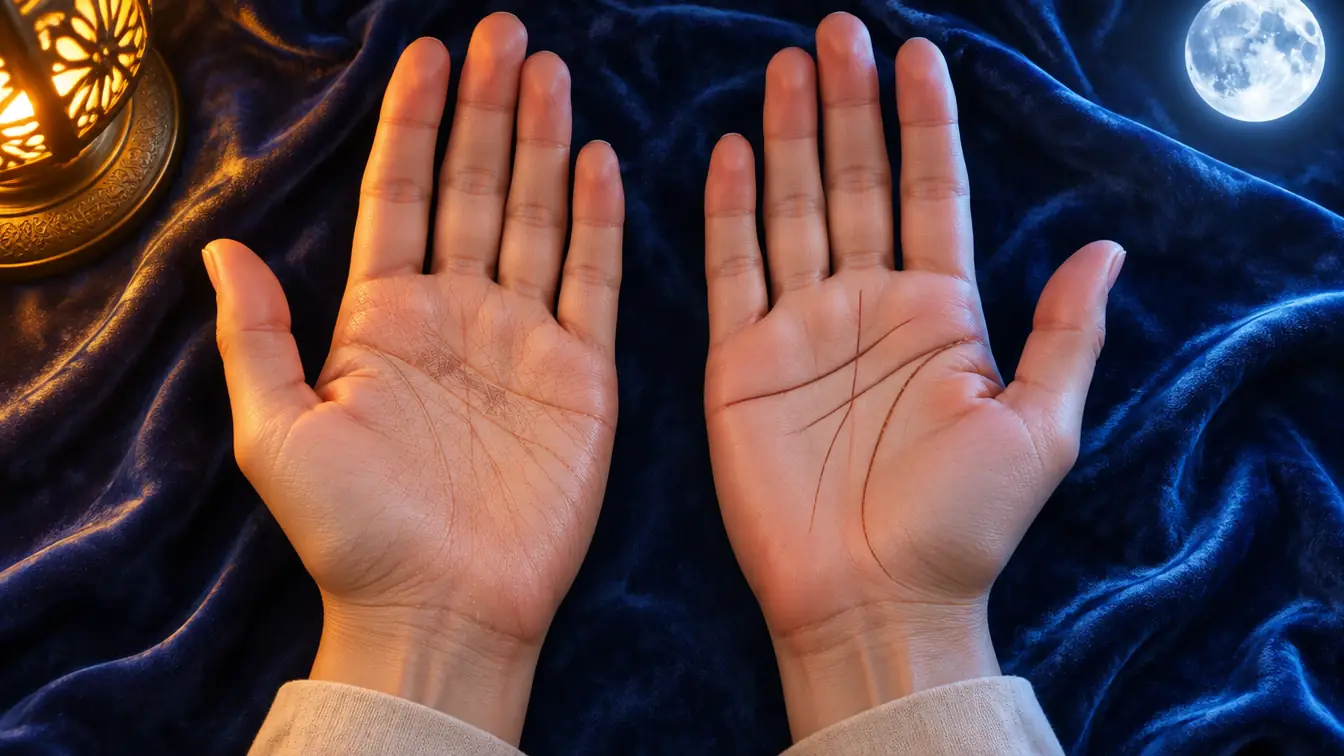
Comparing Both Palms: What Changes Between Your Left and Right Hand
Most modern palm readers look at both hands. In the Western convention the dominant hand shows what you have developed and the other shows inborn tendencies. The older Indian rule reads a man's right palm and a woman's left. Many readers now treat differences between the two hands as the most telling part, read as themes rather than forecasts.
Key takeaways
- Most careful readers look at both hands for everyone, regardless of gender.
- Comparing hands works best as a conversation.
- Astrologer and Psychic Vijayram reads palms by phone, WhatsApp or video, either live on camera or from photos sent ahead.
One of the first things people ask before a palm reading is which hand to hold out. Relatives may have told you that only the right hand counts for men and the left for women. A palmist at a fair may have reached for your writing hand without a word. Both habits come from real traditions, and neither is the whole story.
Two conventions you may have heard
The older Indian rule
Mrs. J. B. Dale's 1895 Indian Palmistry puts it plainly: "The general rule in the East is that the right palm of the male and the left palm of the female ought to be examined." The very next line adds a practical exception that often gets forgotten: "In either case take the hand in which the signs and lines are clearly shown." Even the old rule, in other words, was never rigid.
The Western dominant-hand rule
Western palmists from the late nineteenth century onward, including Cheiro, read the hand you use most as the developed or active hand and the other as your natural inclinations. Cheiro's Palmistry for All tells students that "both the hands should be examined together to see if they accord," and that a sign on the passive hand alone is a tendency that may never come to anything. That idea, inborn on one side and lived on the other, is now the most common approach in Chicago and across the US.
What most readers do today
Most careful readers look at both hands for everyone, regardless of gender. They treat the dominant hand as the current picture and the other as background: temperament, family patterns, the starting point. For a left-handed person the roles simply swap. The traditional Indian rule is still respected by some families, and a good reader will ask which approach you would prefer rather than assume.
The short answer on whether a palm reading changes if you are left-handed covers that case in a few lines.
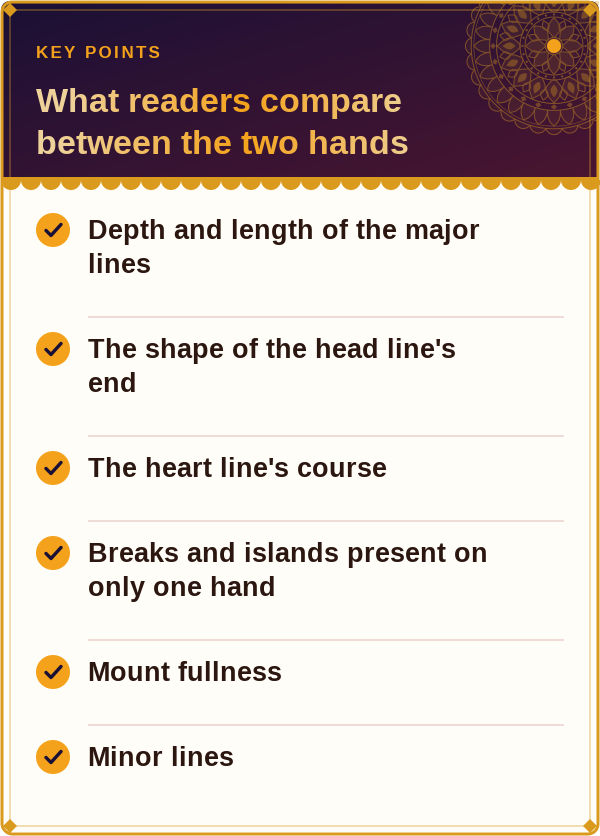
What readers compare between the two hands
- Depth and length of the major lines. A head line that is fainter on the passive hand and clearer on the dominant one is read as thinking skills you have worked at.
- The shape of the head line's end. A line that forks on one hand and runs straight on the other is read as imagination that has been channeled into practical work, or the reverse.
- The heart line's course. A curve on one hand and a straight run on the other is often read as feelings you express differently from how you were raised to.
- Breaks and islands present on only one hand. On the passive hand alone, they are read as a tendency that did not play out; on the dominant hand alone, as something that came with circumstances rather than temperament.
- Mount fullness. Differences in the pads at the base of the fingers, explained in the post on the mounts of the palm and their planets.
- Minor lines. Fine lines change fastest, so they show most clearly where the two hands have drifted apart.
Reading the differences, gently
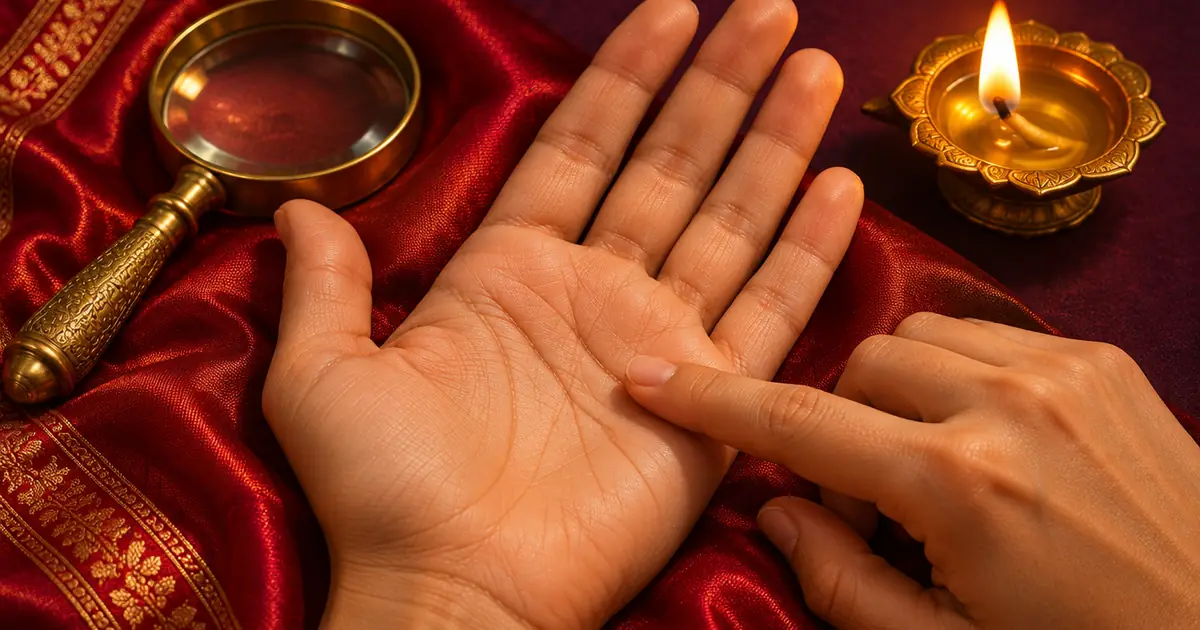
Comparing hands works best as a conversation. A reader might notice that your dominant hand shows a stronger, straighter head line than the other and ask whether you had to become more practical than you naturally are, perhaps through a demanding job, a move to a new country or caring for family. You say yes or no. The reading grows from your answer.
What comparison cannot do is predict. A difference between the hands describes change that has already happened or is under way. It does not reveal what will happen next, and it says nothing about health. The post on breaks, forks and islands on the major lines covers the markings people worry about most.
Photos for a remote reading
Astrologer and Psychic Vijayram reads palms by phone, WhatsApp or video, either live on camera or from photos sent ahead. Good pictures make a large difference:
- Wash your hands and remove rings, which hide lines at the base of the fingers.
- Stand near a window in daylight. Overhead kitchen lights cast shadows; flash flattens fine lines.
- Photograph each palm flat, fingers together, filling the frame.
- Photograph each hand from the outer edge, with the fingers gently curled.
- Use the same light and distance for both hands, so the comparison is fair.
- Avoid sending photos while fresh henna is on your hands. Dark mehndi covers the lines, which is why the post on short readings at mehndi nights and Diwali parties suggests reading palms before the henna goes on.
A palm reading in the Hasta Samudrika tradition uses both hands this way, as a mirror for reflection on temperament and change. It cannot tell you the future or replace advice from a doctor, a counselor or anyone qualified in the question you bring.

Common questions
Is it true that women's left hands are read in Indian palmistry?
That is the traditional rule, and some readers still follow it. Many Indian palmists today read both hands for everyone and treat the dominant hand as the current picture, which matches how most people now live and work.
My two palms look almost identical. Does that mean anything?
Older Western books read near-identical hands as someone who has stayed close to their starting temperament. Modern readers mostly see it as steadiness. It is a description, not a judgment.
I am ambidextrous. Which hand is dominant?
Use the hand you write with, or the one you would reach out with to catch something. If that is still unclear, a reader will simply treat both hands as equally current.
Do I need both hands on camera for a video palm reading?
Yes. The reader will ask to see each palm flat, then each from the side, and may ask you to curl the fingers slightly to show small lines. Daylight from a window helps more than any lamp.
Related service
Keep reading

Life Path Numbers One to Nine
Life path number meaning from one to nine: how to calculate yours from your birth date, a note on each number, master numbers and what numerology cannot do.
Read article →
Changing Your Name After Marriage: A Numerology View for Chicago Couples
Thinking about a name change after marriage? The Cook County paperwork comes first; then what numerology claims about a new surname, hyphen or spelling tweak.
Read article →
Seeing 11:11 and Other Repeating Numbers
1111 meaning, in perspective: why 11:11 and other repeating numbers seem to follow you, what numerology and angel-number books say, and a calm way to use them.
Read article →Quick answers
Does a palm reading change if I am left-handed?
Which hand is used for palm reading if you are left-handed? How readers treat the dominant hand, the Indian convention, and why many look at both palms.
Read answer →Do I have to tell a psychic anything before the reading starts?
What happens in a psychic reading, and what must you share first? Often just your first name and question; you never need to tell more than you wish.
Read answer →Talk to Astrologer and Psychic Vijayram
Tell us what you are facing. If a reading is unlikely to help, you will be told that plainly.