
Ayurveda and Jyotish: Where They Meet and Where We Stop
Ayurveda and astrology grew from the same Vedic culture and share ideas: the five elements, the three doshas and close attention to time and rhythm. Classical texts pair each planet with a dosha. A chart reading can use that language to talk about routine and rest, but diagnosis, treatment and remedies for illness belong with licensed health professionals.
Key takeaways
- Jyotisha, the science of light and time, is one of the six Vedangas, the auxiliary disciplines attached to the Vedas.
- The Brihat Parashara Hora Shastra, a foundational astrology text, describes each planet's nature, including its dosha, in its chapter on the characteristics of the planets .
- In a health and wellbeing astrology reading , this language is used for one purpose: to talk about rhythm and self-care in a way that feels familiar.
- The National Center for Complementary and Integrative Health's overview of Ayurvedic medicine gives two reasons for care.
- After a hospital stay, the post on mantra, rest and your care team shows how faith practice can sit beside recovery.
Families who keep both traditions often ask how Ayurveda and astrology fit together. A grandmother may talk about pitta in the same breath as a Mars period; a chart reading may mention that a planet "rules" digestion. The two traditions do share deep roots. They also need a clear line between them and modern medicine, and this post is about both: where they meet, and exactly where this practice stops.
Shared roots
Jyotisha, the science of light and time, is one of the six Vedangas, the auxiliary disciplines attached to the Vedas. Ayurveda, the knowledge of life, is traditionally linked with the Atharvaveda. The overview of Ayurveda traces its classical texts and its central ideas. Both traditions share a picture of the world built from five elements, earth, water, fire, air and space, and both pay close attention to rhythm: Ayurveda through daily and seasonal routines, Jyotisha through planetary periods and auspicious times.
Both also use the language of the three doshas, vata, pitta and kapha, the qualities of movement, heat and structure that Ayurveda uses to describe a person's constitution.
Planets and doshas
The Brihat Parashara Hora Shastra, a foundational astrology text, describes each planet's nature, including its dosha, in its chapter on the characteristics of the planets. The pairings below are the ones most astrologers use:
| Planet | Traditional dosha |
|---|---|
| Sun | Pitta |
| Moon | Vata and kapha |
| Mars | Pitta |
| Mercury | A mix of all three |
| Jupiter | Kapha |
| Venus | Kapha and vata |
| Saturn | Vata |
Rahu and Ketu are often treated like Saturn and Mars respectively. Astrology also links each house with parts of the body, from the head in the first house to the feet in the twelfth, and reads the sixth, eighth and twelfth houses for illness, long-term difficulties and hospitals.
How this practice uses the overlap
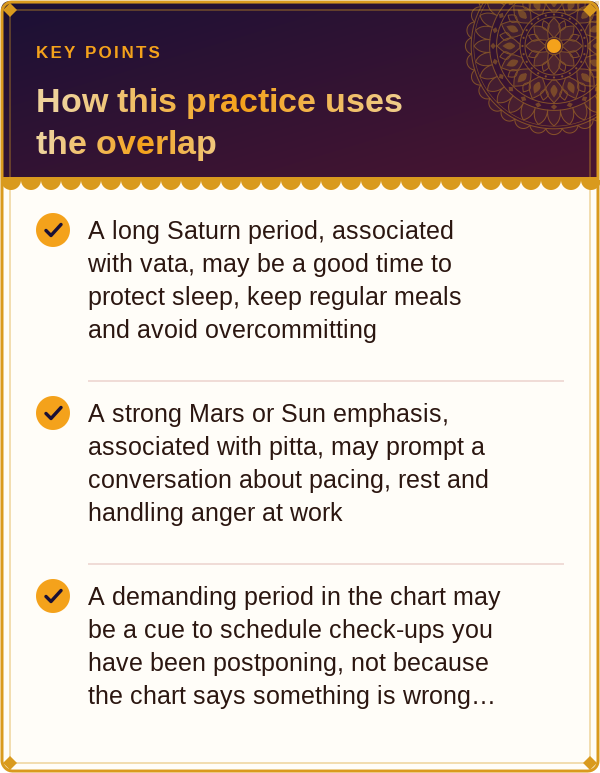
In a health and wellbeing astrology reading, this language is used for one purpose: to talk about rhythm and self-care in a way that feels familiar. For example:
- A long Saturn period, associated with vata, may be a good time to protect sleep, keep regular meals and avoid overcommitting.
- A strong Mars or Sun emphasis, associated with pitta, may prompt a conversation about pacing, rest and handling anger at work.
- A demanding period in the chart may be a cue to schedule check-ups you have been postponing, not because the chart says something is wrong, but because it is a sensible moment to look after yourself.
Mantra, charity and steady routines may be suggested. Diet advice stays at the level of common sense: regular meals, enough water, not skipping breakfast before a long commute.
Where we stop
This is the important part. In a reading here, the reader will not:
- Diagnose any condition, or suggest what might be wrong with you.
- Predict illness, recovery or the timing of either.
- Recommend herbs, supplements, oils, metals or Ayurvedic products.
- Comment on your medication, treatment or surgery decisions.
- Suggest a gemstone as a health remedy. The post on who should not wear Jyotish gemstones explains the caution.
Health questions go to licensed practitioners: your doctor, a nurse practitioner, a pharmacist, a registered dietitian or a licensed therapist. If surgery is in the picture, the post on why your doctor's schedule comes first for surgery dates explains how we handle timing questions.
Why the line matters
The National Center for Complementary and Integrative Health's overview of Ayurvedic medicine gives two reasons for care. First, some Ayurvedic preparations have been found to contain lead, mercury or arsenic in amounts that can be toxic. Second, there is no significant regulation of Ayurvedic practice or education in the United States, and no state licenses Ayurvedic practitioners. It advises talking to your health care providers before using any Ayurvedic product and telling them about everything you take.
None of this disrespects Ayurveda as a tradition. It reflects the simple fact that your health deserves care from people who are trained, licensed and accountable for it.
What a chart reading cannot do
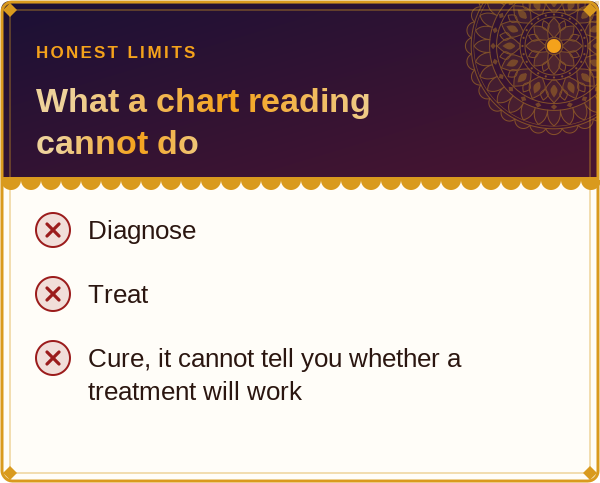
A chart cannot diagnose, treat or cure, and it cannot tell you whether a treatment will work. If you have symptoms, see a doctor; in an emergency, call emergency services. After a hospital stay, the post on mantra, rest and your care team shows how faith practice can sit beside recovery. Astrologer and Psychic Vijayram uses the shared language of Ayurveda and Jyotish only for reflection on rhythm and rest, alongside your medical care and never instead of it.
Common questions
Can my chart tell me my Ayurvedic body type?
Some astrologers estimate a constitution from the ascendant, the Moon and strong planets, but it is a rough sketch at best. An Ayurvedic constitution is traditionally assessed in person, and any health decision should rest on a medical assessment, not a chart.
Will you suggest Ayurvedic herbs or supplements?
No. This practice does not recommend herbs, supplements or Ayurvedic products. Some preparations have been found to contain toxic metals, and any product can interact with medication. Ask your doctor or pharmacist before taking anything.
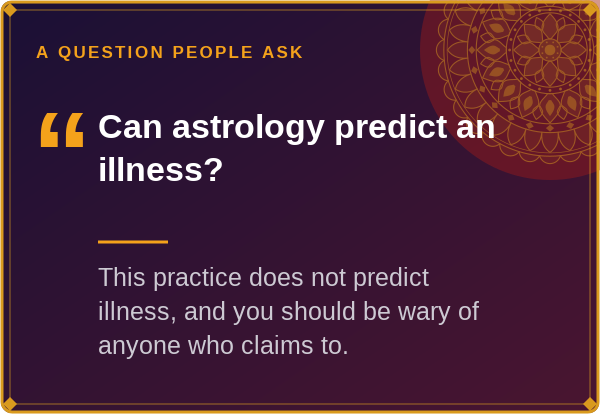
Can astrology predict an illness?
This practice does not predict illness, and you should be wary of anyone who claims to. A wellbeing reading can point to demanding periods when extra rest and support may help, which is guidance for routine, not a forecast about your body.
Is it all right to see an Ayurvedic practitioner alongside my doctor?
That is your choice. Tell your doctor exactly what you are doing and taking, never stop prescribed treatment, and remember that in the United States Ayurvedic practitioners are not licensed by any state.
Does a Saturn or Rahu period mean I will get sick?
No. Planetary periods last years, and most people pass through them in good health. A demanding period is, at most, a reminder to look after the basics: sleep, regular meals, movement and the check-ups your doctor recommends. Anyone who uses a planet to frighten you about your health is not offering guidance.
Related service

Keep reading

Home From a Chicago Hospital: Mantra, Rest and Your Care Team
Prayer for recovery after surgery, for the weeks at home: following the discharge plan, quiet mantra in bed, family support and Chicago winter sense.
Read article →
Vastu for a Chicagoland Split-Level: Half-Floors, Basements and Entrances
Vastu for a split level house in the Chicago suburbs: the stair-facing entrance, half-floors, the kitchen level and finished basements, with no building work.
Read article →
Who a Spiritual Healing Session Suits, and Who Should See a Doctor First
Looking for a spiritual healer in Chicago? Who a prayer and mantra session suits, the signs that mean see a doctor first, and questions to ask any healer.
Read article →Quick answers
How will I know if an aura cleansing helped?
What is aura cleansing, and how do you know if it helped? What people describe afterward, the plain limits of a traditional practice, and when to see a doctor.
Read answer →Should I tell my doctor I am having spiritual healing sessions?
Is spiritual healing medical treatment? No. Why to tell your doctor about spiritual healing sessions, and how faith practice can sit beside your medical care.
Read answer →Talk to Astrologer and Psychic Vijayram
Tell us what you are facing. If a reading is unlikely to help, you will be told that plainly.