

Terahvin, Barsi and the First Anniversary: Where a Medium Session Fits
There is no fixed rule, but many Hindu families wait until the thirteenth-day rites (terahvin) are complete, and many people find a medium reading after a death more helpful near or after the first anniversary, the barsi. In the first weeks, family, faith community, doctors and grief counselors usually help more than any session can.
Key takeaways
- The National Library of Medicine's page on bereavement lists further help.
- For many Hindu families the days after a death are already full.
- Some families keep a monthly shraddha on the lunar day of the death through the first year.
- The first death anniversary, called barsi in many North Indian homes and kept as the first annual shraddha in others, is a major observance.
- People who come to Astrologer and Psychic Vijayram belong to many traditions, and each has its own rhythm of mourning.
First, the help that does not wait for any calendar
Grief keeps no ritual dates. If the death is recent, lean first on people: family, friends, your doctor, a grief counselor, a support group, your temple, gurdwara, mosque or church. If your loved one was in hospice care, ask the hospice what bereavement support it offers; Medicare-certified hospices must provide bereavement services to the family for up to a year after the death, under the federal rule on hospice core services. The National Library of Medicine's page on bereavement lists further help. If grief brings thoughts of ending your life, contact the Suicide and Crisis Lifeline at any hour, or call emergency services.
A medium session is a faith practice. It can sit beside that support. It never replaces it, and it cannot confirm where your loved one is or what they feel.
The first thirteen days
For many Hindu families the days after a death are already full. There is the funeral and cremation, the collecting of ashes, daily prayers at home, relatives landing at O'Hare from India or calling across a time difference of ten and a half hours or more. Customs vary by region and community. The overview of Antyesti, the Hindu last rites notes that some communities hold a remembrance meal on the tenth, eleventh or twelfth day. Many North Indian families mark the thirteenth day, terahvin, with prayers, a meal and often a priest, as the close of the first period of mourning.
During these days a medium session is usually the wrong fit. The house is crowded, the rituals have their own rhythm, and the mind is still taking in the fact of the loss. Many priests and elders also feel the departed should be allowed to complete these rites undisturbed. Even families who are open to mediumship tend to wait.
The long middle of the first year
Some families keep a monthly shraddha on the lunar day of the death through the first year. Others mark only the major dates. Either way, the months between terahvin and the first anniversary are often the hardest stretch: visitors have flown home, work has resumed, and people around you assume you are doing better.
This is when some people start thinking about a medium session. If that is you, a few honest questions help:
- Are you hoping for comfort and a chance to say something unsaid? A session can hold space for that.
- Are you hoping for proof, or for answers about how or why the death happened? A session cannot give those. Medical questions belong with the doctors involved, and blame belongs nowhere near a reading.
- Are you sleeping, eating and getting through the workday? If not, see your doctor first.
- Would your family be hurt to learn of it? Some families welcome mediumship; others feel strongly against it. Think that through before, not after.
The barsi and the first anniversary
The first death anniversary, called barsi in many North Indian homes and kept as the first annual shraddha in others, is a major observance. Families gather, a priest may perform rites, food is given in the person's name, and the formal year of mourning comes to a close. In some households, weddings and festivals set aside during the year resume after it.
Many people find a medium session around this time feels more settled than one in the early months. The sharpest shock has softened, and there is a natural sense of looking back over the year. Some book a few weeks before the barsi, as part of preparing for it; others wait until afterward, so the ritual comes first. Either is reasonable.
One practical point: many families set the barsi by the lunar calendar, so it can fall on a different date from the day of death, and the Chicago date may differ from the one printed in an Indian calendar. Ask your priest, or use a panchang calculated for Chicago.
Other calendars Chicago families keep
People who come to Astrologer and Psychic Vijayram belong to many traditions, and each has its own rhythm of mourning. Sikh families often hold a Sahaj Paath or Akhand Paath ending in an Antim Ardas at the gurdwara. Many South Asian Muslim families mark the fortieth day, often called chehlum. Jewish families sit shiva for the first week and observe the yahrzeit each year. Many Catholic families arrange a memorial Mass on the anniversary. Whatever your tradition, the same principle holds: let the community's rites come first, and treat any reading as something gentle that comes later, if at all.
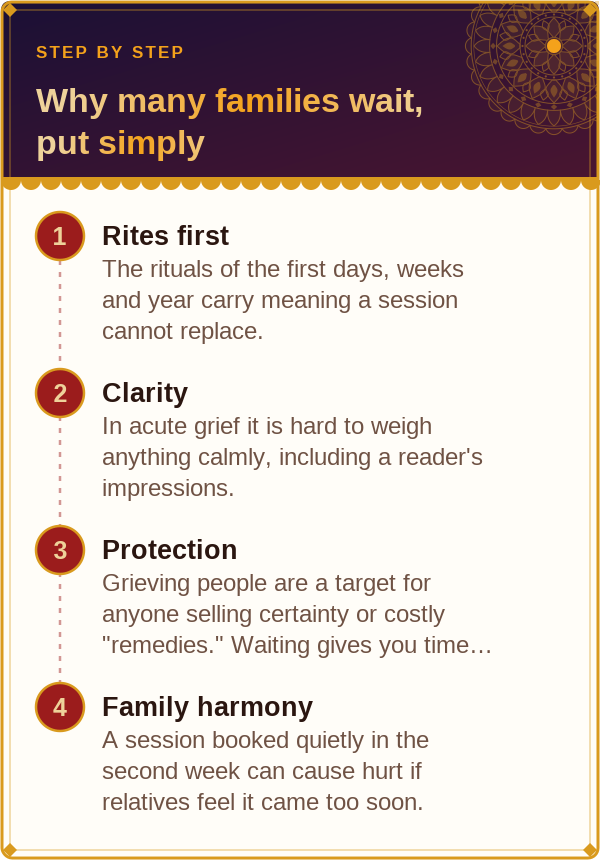
Why many families wait, put simply
- Rites first. The rituals of the first days, weeks and year carry meaning a session cannot replace.
- Clarity. In acute grief it is hard to weigh anything calmly, including a reader's impressions.
- Protection. Grieving people are a target for anyone selling certainty or costly "remedies." Waiting gives you time to choose carefully, and the checklist of red flags in Chicago psychic ads helps.
- Family harmony. A session booked quietly in the second week can cause hurt if relatives feel it came too soon.
If you decide to book
The prayer-led psychic medium session opens and closes with prayer in the form your family follows, moves at your pace and stops whenever you ask. The post on what to expect from a first medium session walks through it in detail. If the person has been appearing in your dreams, the post on dreams of relatives who have died may help too.
Common questions
Is it wrong to want a medium session before terahvin?
It is not wrong to want comfort. Most families and priests would gently suggest waiting until the first rites are complete, and many people later say they were glad they did. In the meantime, talk to family, your priest or a grief counselor.
Our barsi falls on a weekday. Should the session be on the anniversary itself?
It can be, but many people keep the anniversary for family rites and book a session a few days before or after. Sessions are by phone, WhatsApp or video, so an evening in Central Time usually fits around work and temple.
Can relatives in India join a session around the barsi?
Yes, on a video or WhatsApp group call. Allow for the time difference, which is ten and a half hours while Chicago is on daylight time and eleven and a half in winter, and agree beforehand who will speak.
Does a death in the family mean we now have pitru dosha?
No. A death does not by itself create a dosha, and no one should frighten you with that idea. If you want to understand how ancestral remembrance is read in a chart, the ancestral prayers (Pitru) guidance session explains the tradition calmly.
Related service

Keep reading
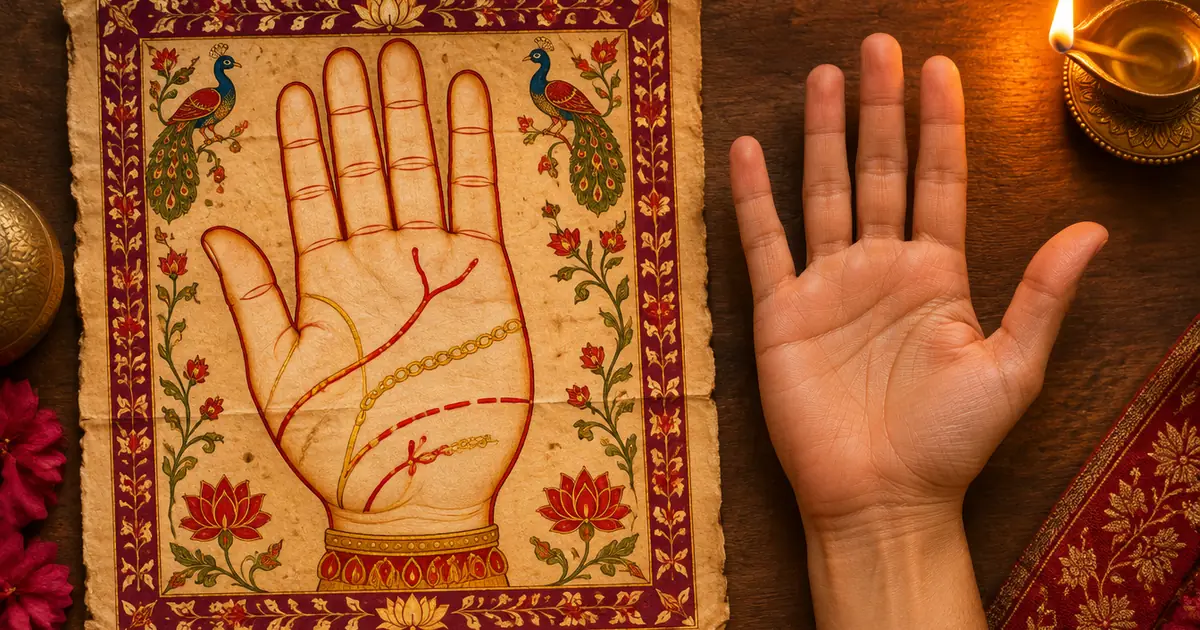
Broken, Forked and Chained Lines: What Palmists Say About Markings
Palm lines meaning, marking by marking: how palmists read breaks, forks, islands and chains on the heart, head and life lines, and the misreadings to drop.
Read article →
The Marriage Line in Palmistry
Marriage line palm reading explained: where the short lines under the little finger sit, what palmists take them to mean, and why they cannot count marriages.
Read article →
The Mounts of the Palm and Their Planets
Mounts in palmistry, mapped to the planets of Jyotish: what the Jupiter, Saturn, Sun, Mercury, Venus, Moon and Mars mounts are taken to show, and their limits.
Read article →Quick answers
Is it normal to feel worse after a medium session?
What does a psychic medium do, and is it normal to feel worse afterward? Why grief can surface strongly after a session, and where to find real support.
Read answer →Do I have to tell a psychic anything before the reading starts?
What happens in a psychic reading, and what must you share first? Often just your first name and question; you never need to tell more than you wish.
Read answer →Talk to Astrologer and Psychic Vijayram
Tell us what you are facing. If a reading is unlikely to help, you will be told that plainly.