
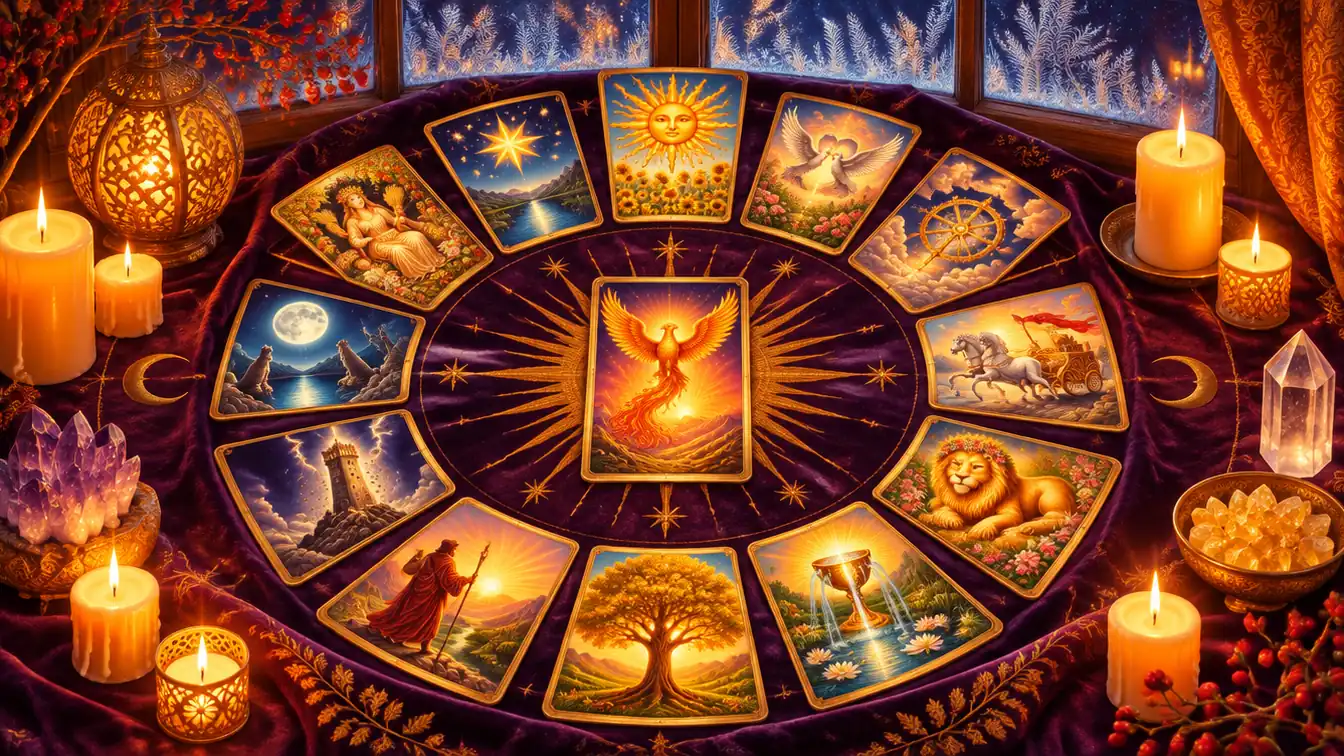
The Twelve-House Tarot Spread: A January Layout Borrowed From the Birth Chart
This new year tarot spread lays one card in each of the twelve astrological houses instead of one per month. Each card becomes a theme for an area of life, such as home, work or partnership, across the whole year. Chicago readers can lay it in January's quiet first week and revisit it through 2027 as reflection, not prediction.
Key takeaways
- The month-by-month spread has a built-in problem.
- A thirteenth card in the center, drawn last, can stand for the overall theme of the year.
- Place the twelve cards in a circle like a clock face, with the 1st house at nine o'clock and the houses running counterclockwise, the way Western charts are drawn.
- The spread earns its keep when you return to it.
- A year spread is long, and some people prefer a reader to lay it and talk through the connections.
January in Chicago has a particular quiet. The holiday lights come down, the cold settles in properly, and on the coldest mornings the lake steams like a kettle. It is a natural week to take stock. Many people lay a year-ahead tarot spread now, and the most common version uses twelve cards, one for each month. This post suggests a different layout, borrowed from the birth chart: twelve cards for the twelve houses of life.
Why houses instead of months
The month-by-month spread has a built-in problem. It turns tarot into a calendar of predictions. Draw the Three of Swords for April and you may spend the spring braced for heartbreak; draw the Sun for August and you may wait for a good month that has no reason to arrive on schedule. Tarot is better at describing themes than dates.
Astrology already has a structure for themes. A chart is divided into twelve houses, each governing an area of life. The Vedic names for these houses are set out in classical texts such as the Brihat Parashara Hora Shastra's list of the twelve bhavas. Laying one card per house gives you twelve themes that run through the whole year, which you can watch unfold without waiting for a particular month.
The twelve positions
| House | Area of life | Question for the card |
|---|---|---|
| 1st | Self, body, how you meet the world | How am I showing up this year? |
| 2nd | Money, family, speech | What needs attention in what I earn, keep and say? |
| 3rd | Courage, siblings, short trips, skills | Where do I need nerve and effort? |
| 4th | Home, mother, inner peace | What does home need from me? |
| 5th | Children, creativity, study, romance | What wants to be created or learned? |
| 6th | Daily work, habits, health routines, disputes | Which routine needs changing? |
| 7th | Partnership, contracts, others | What is the theme in my closest relationships? |
| 8th | Change, shared resources, what is hidden | What is shifting beneath the surface? |
| 9th | Faith, teachers, long journeys, fortune | Where will I find meaning and guidance? |
| 10th | Career, reputation, duty | What is the theme of my work this year? |
| 11th | Gains, friends, networks, hopes | Which hope or friendship deserves investment? |
| 12th | Rest, retreat, expenses, letting go | What do I need to release or rest from? |
A thirteenth card in the center, drawn last, can stand for the overall theme of the year.
Two ways to lay it out
The clock
Place the twelve cards in a circle like a clock face, with the 1st house at nine o'clock and the houses running counterclockwise, the way Western charts are drawn. Put the thirteenth card in the middle.
The North Indian diamond
If you know Vedic charts, lay the cards in the North Indian pattern: the 1st house in the top center diamond, the 4th on the left, the 7th at the bottom and the 10th on the right, with the other houses in the triangles between. Our post on reading a North Indian chart shows the pattern. This layout makes it easy to compare your spread with your actual birth chart.
Reading the spread
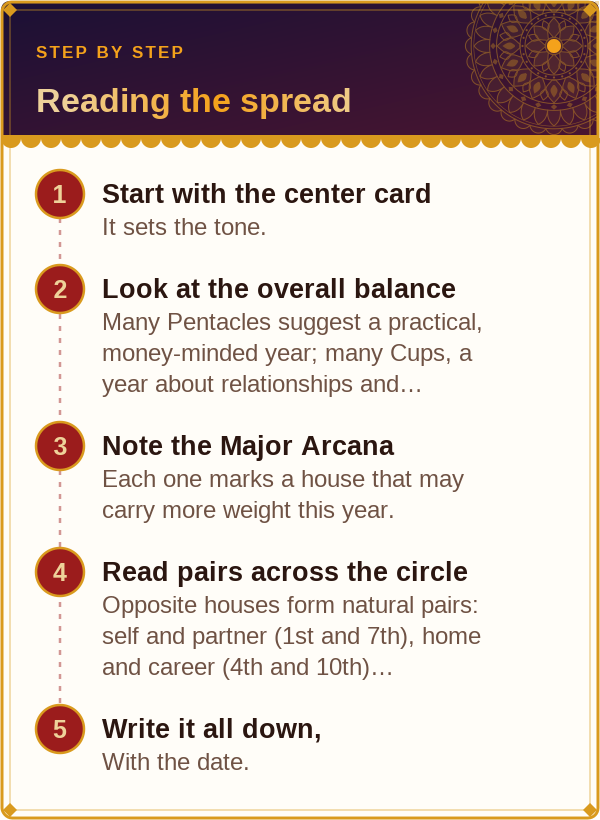
- Start with the center card. It sets the tone.
- Look at the overall balance. Many Pentacles suggest a practical, money-minded year; many Cups, a year about relationships and feelings; many Swords, decisions and difficult conversations; many Wands, energy and new ventures.
- Note the Major Arcana. Each one marks a house that may carry more weight this year.
- Read pairs across the circle. Opposite houses form natural pairs: self and partner (1st and 7th), home and career (4th and 10th), creativity and community (5th and 11th). Cards facing each other often comment on each other.
- Write it all down, with the date.
Revisiting through the year
The spread earns its keep when you return to it. Some useful checkpoints: Makar Sankranti in mid-January, the spring equinox, your birthday, Diwali in autumn. Each time, look at the houses and ask which themes have shown up and which have not. A card that made no sense in January may make perfect sense by July. If you want the spread connected to your actual chart, our post on the 2027 year-ahead astrology outlook for Chicago looks at the planets, and a Varshaphal year-ahead reading calculates your own solar-return chart.
Having it read
A year spread is long, and some people prefer a reader to lay it and talk through the connections. A tarot reading with Astrologer and Psychic Vijayram can use this layout, by phone, WhatsApp or video, with the cards shown on camera and a copy sent afterwards. Bring your own deck to the call if you would like to lay a parallel spread.
The limit holds for every spread: a twelve-house layout offers themes for reflection. It does not forecast what 2027 will bring, and a hard card in any house is a prompt to pay attention, not a sentence.
Common questions
Why not use one card per month?
Month-by-month spreads tend to turn into forecasts, and people then wait anxiously for March to bring what its card seemed to promise. House-based cards describe themes that run through the year, which is closer to what tarot can honestly offer.
What does a Major Arcana card in a house mean?
It suggests that area of life may carry more weight this year: a turning point rather than routine. Several Major Arcana cards in a year spread are common and are not a cause for alarm.
Should I lay the spread on January 1?
Any day in early January works. Some people prefer their birthday, Makar Sankranti in mid-January or their own cultural new year, such as Ugadi, Vaisakhi or Diwali.
Can a reader lay this spread for me by video?
Yes. On video you can watch each card go into its house, and a copy of the layout can be sent afterwards so you can revisit it through the year.
Related service
Keep reading
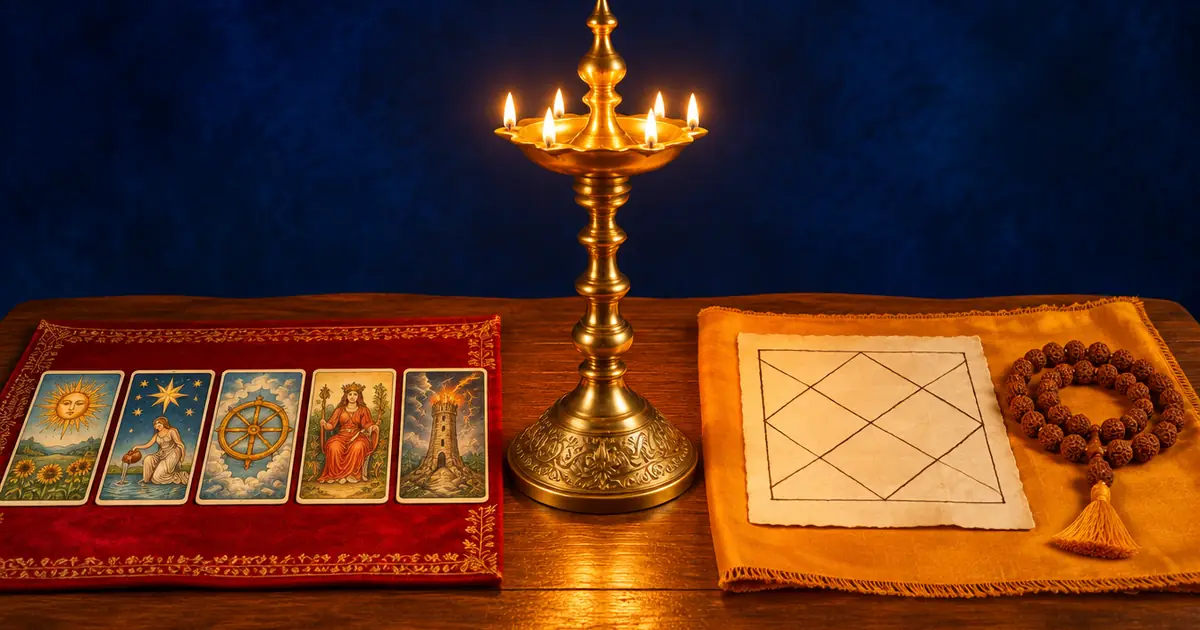
Tarot or Vedic Astrology? How Chicago Clients Choose
Tarot vs astrology for Chicago clients: tarot answers the situation in front of you, Vedic astrology maps timing across years. When to use which, or both.
Read article →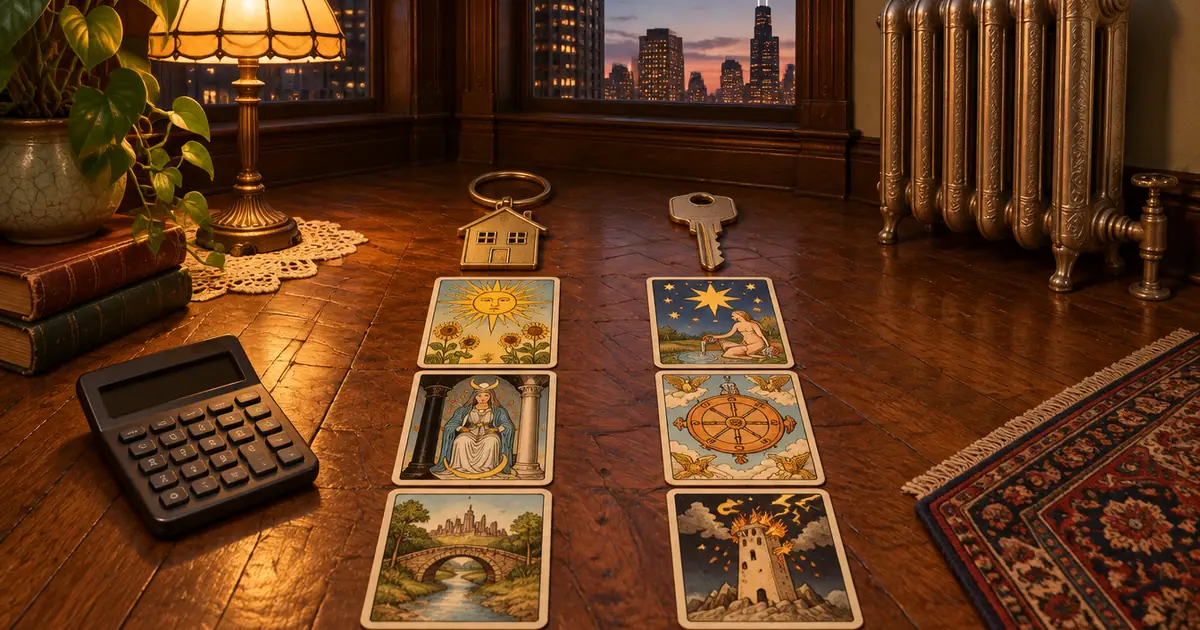
Renew the Lease or Buy? A Two-Path Spread for Chicago Renters
A two-path rent or buy tarot spread for Chicago renters facing a lease renewal: seven positions, a worked example, and why your lender's numbers come first.
Read article →
Tarot Readings for Naperville and the Western Suburbs
How a tarot reading works for Naperville and western suburbs clients by phone, WhatsApp or video: what to prepare, the questions people bring, and the limits.
Read article →Quick answers
Does it matter who shuffles the tarot deck?
How does a tarot reading work, and does it matter who shuffles the deck? Shuffling customs in person and at a distance, and what matters more than hands.
Read answer →Is a tarot reading a forecast or a mirror?
Can tarot predict the future? Why readers use tarot to reflect on a situation and its likely direction rather than to fix events, and how to use it well.
Read answer →Talk to Astrologer and Psychic Vijayram
Tell us what you are facing. If a reading is unlikely to help, you will be told that plainly.