

Changing Careers Mid-Life: A Five-Card Tarot Spread
A career change tarot spread for mid-life works best as a way to sort fear from fact. Five cards look at the loudest fear, the fact beneath it, the skills that transfer, what the new path asks, and a small test step. Real financial planning sits beside the cards; the deck cannot tell you whether you can afford the leap.
Key takeaways
- Do this part first, and do it with real numbers.
- Imagine a forty-seven-year-old accountant in Oak Park who has wanted to teach high school math for years.
- For many people raised in South Asian families in Chicago and the suburbs, a first career was chosen partly for parents: medicine, engineering, accounting, a family business.
- A career and job tarot reading can be built around this spread, with your budget notes and research on the table beside the cards.
At twenty-five, changing careers feels like an adventure. At forty-seven, with a mortgage, children or aging parents, a retirement account and twenty years in one field, it feels like stepping off a ledge. The wish to change is often just as strong. What is different is the weight of everything you could lose, and the noise of fears that may or may not be true.
This five-card spread is built for that moment. It does not tell you whether to leap. It helps you sort which of your fears are facts you need to plan for, and which are stories you have been telling yourself.
Before the cards: the money conversation
Do this part first, and do it with real numbers. Write down how many months of expenses you could cover without income, what would happen to your health coverage, what you owe and when, and what retraining would cost. If you have retirement savings, find out what touching them would mean before you assume you will. The SEC's guide to working with an investment professional explains the different kinds of financial advisers and how to check their background, which is worth reading before you sit down with one.
Then look outward. The Department of Labor's My Next Move lets you search careers by interest or by your current job and see what different roles involve, including the training they usually need. In Chicagoland, community colleges such as the City Colleges of Chicago, College of DuPage and Harper College are common places for adults to retrain.
With those facts in hand, the cards have something solid to talk to.
The fear-or-fact spread
Lay five cards in a row.
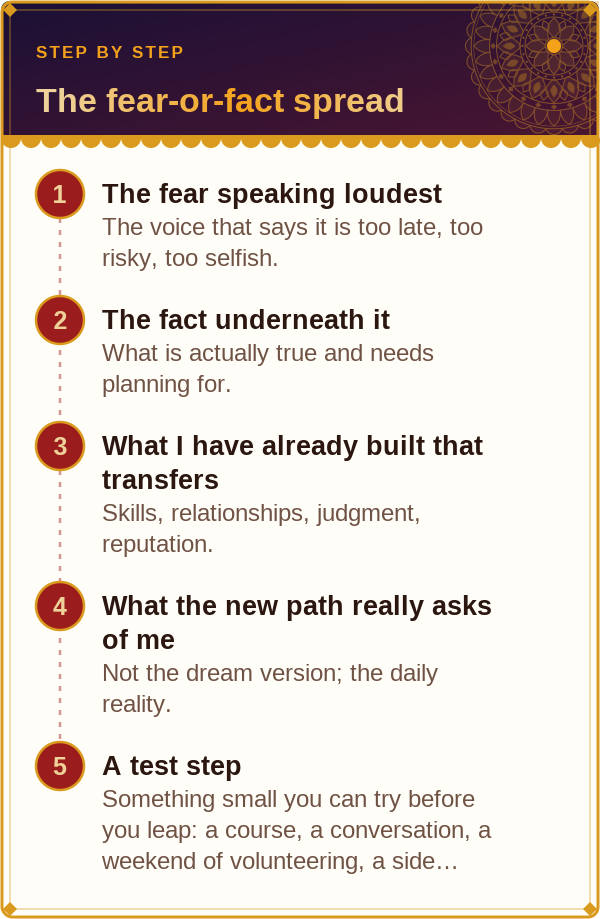
- The fear speaking loudest. The voice that says it is too late, too risky, too selfish.
- The fact underneath it. What is actually true and needs planning for.
- What I have already built that transfers. Skills, relationships, judgment, reputation.
- What the new path really asks of me. Not the dream version; the daily reality.
- A test step. Something small you can try before you leap: a course, a conversation, a weekend of volunteering, a side project.
The heart of the spread is the pairing of cards one and two. Read them together and ask: is the fear in card one proportionate to the fact in card two? Often the fear is bigger. Sometimes the fact is bigger, and that is just as useful to know.
An illustration
This is an example, not a real client. Imagine a forty-seven-year-old accountant in Oak Park who has wanted to teach high school math for years.
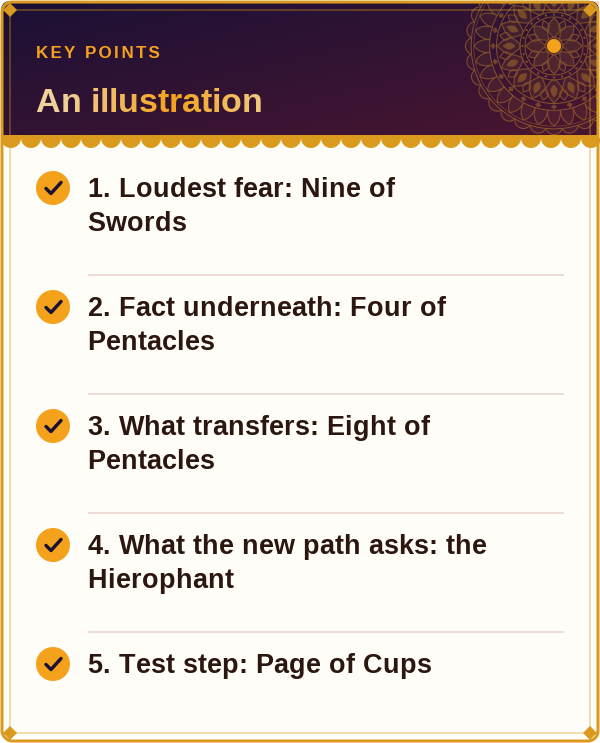
- 1. Loudest fear: Nine of Swords. Sleepless worry. The fear is anxious and repetitive rather than specific.
- 2. Fact underneath: Four of Pentacles. Money security is the real issue. Teaching would mean a pay cut, and that needs a plan.
- 3. What transfers: Eight of Pentacles. Years of patient, precise work. Explaining numbers to clients is closer to teaching than it seems.
- 4. What the new path asks: the Hierophant. Formal training and certification, entering an institution with its own rules.
- 5. Test step: Page of Cups. A gentle, curious start: tutoring a few students, or volunteering in a classroom, to see how it feels.
Put plainly: the fear is louder than it needs to be, but there is a real money question underneath. The skills transfer. The path requires credentials. Tutoring for a semester would test the dream without risking the mortgage. Each of those points can be checked with real information, which is exactly what a good reading should produce.
Common fears, sorted
| The fear | Often a story, or often a fact? | How to check |
|---|---|---|
| "I'm too old to start over." | Usually a story | Talk to two people who changed fields at your age |
| "We can't afford it." | Sometimes a fact | A budget with a fee-only planner or a trusted adviser |
| "I'll lose my identity." | Partly both | Write down what you would keep, whatever the job |
| "My family will think I've failed." | Usually a story | Ask them, rather than assuming |
| "I'll have to retrain." | Usually a fact | Look up the actual requirements and time |
When cards meet family expectations
For many people raised in South Asian families in Chicago and the suburbs, a first career was chosen partly for parents: medicine, engineering, accounting, a family business. A mid-life change can feel like breaking a promise. Card one in this spread sometimes turns out to be a parent's fear rather than your own. Naming that difference can make the conversation at home kinder on both sides.
Other tools for the same question
If the Eight of Cups or the Ten of Wands keeps showing up in your work readings, the guide to eight career tarot cards worth knowing explains them. If your question is really about timing, a dasha and transit reading looks at the periods ahead in your chart, and the career and business astrology reading looks at vocation more broadly. If the question is deeper than work, about meaning and direction, the life path and purpose reading may suit you better.
Reading your career change question
A career and job tarot reading can be built around this spread, with your budget notes and research on the table beside the cards. Astrologer and Psychic Vijayram reads by phone, WhatsApp or video, often in the evening when working clients have time to think.
The limit matters more here than almost anywhere: no card can tell you whether you can afford a change, whether you will be hired in a new field or how it will turn out. It is faith-based guidance for reflection. The leap, and the planning that makes it safe, are yours.
Common questions
Am I too old to change careers?
A card cannot answer that, and neither can anyone who does not know your finances, health and field. Plenty of people change direction in their forties and fifties. The useful question is what the change would require of you, which is what the spread is built to explore.
Should I quit before I have the new job lined up?
That is a financial decision, not a card decision. Look at your savings, health coverage and obligations with a professional before resigning. A small test step while employed is usually the safer start.
Can astrology show a good time to make the change?
Astrology looks at timing through planetary periods in the birth chart, which tarot does not. A dasha and transit reading can show which stretches of the coming years look more settled for a change, as guidance rather than a guarantee.
What if my family disapproves of the change?
That is common, especially when a career was chosen with family hopes in mind. The spread can help you separate their fears from your own, which makes the conversation with them easier.
Related service

Keep reading
Is Tarot at Odds With Hindu Belief?
Tarot and Hinduism: how a European card tradition sits beside Jyotish in practice, why Hindu views on it vary, and what to ask yourself before using the cards.
Read article →
Tarot and Anxiety: When to Pause the Cards
When tarot readings start feeding anxiety instead of easing it: the signs, who to talk to first, how to take a real break from the cards, and how to return.
Read article →
No Card Requires a Paid Fix: Tarot Without Fear Selling
Tarot ethics in plain terms: why a frightening card is never a reason to buy a ritual, the lines an ethical reader keeps, and what to do if you are pressured.
Read article →Quick answers
Does it matter who shuffles the tarot deck?
How does a tarot reading work, and does it matter who shuffles the deck? Shuffling customs in person and at a distance, and what matters more than hands.
Read answer →Is a tarot reading a forecast or a mirror?
Can tarot predict the future? Why readers use tarot to reflect on a situation and its likely direction rather than to fix events, and how to use it well.
Read answer →Talk to Astrologer and Psychic Vijayram
Tell us what you are facing. If a reading is unlikely to help, you will be told that plainly.