
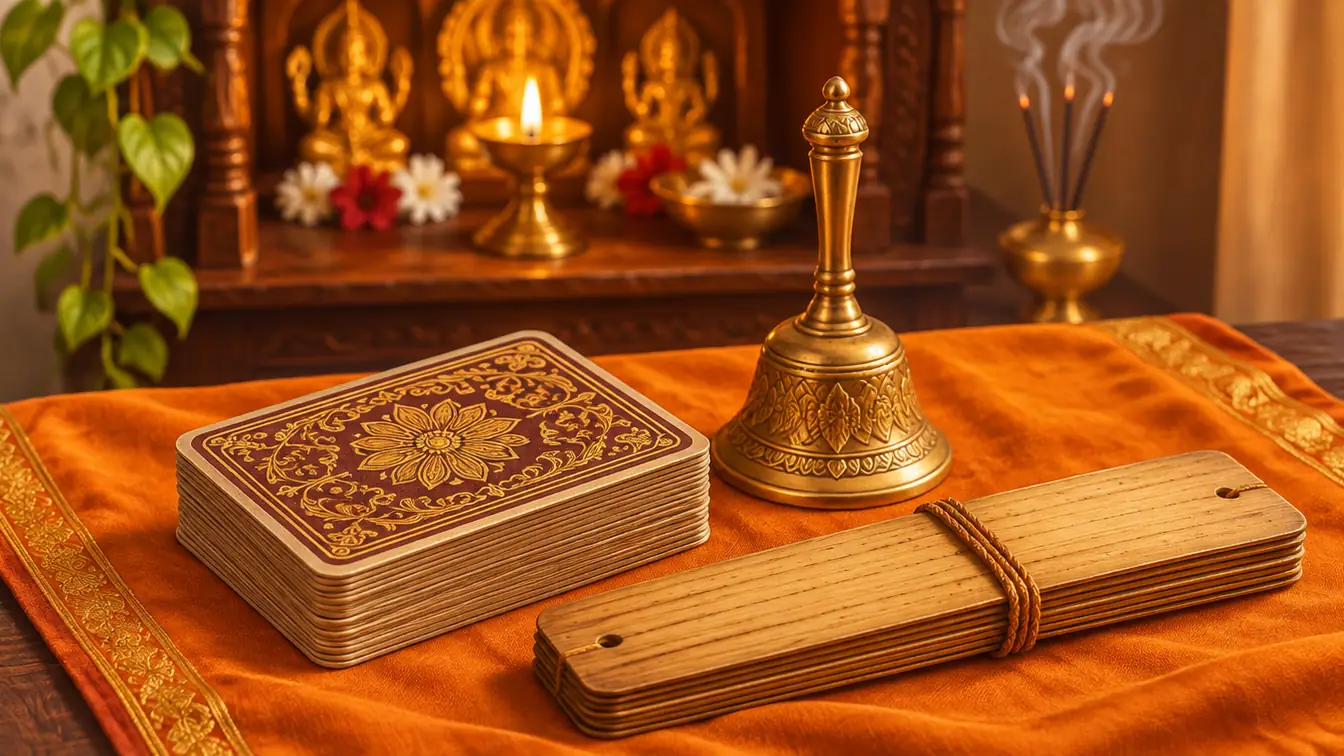
Is Tarot at Odds With Hindu Belief?
Hinduism has no single authority that rules on tarot, so views vary by family, tradition and teacher. Tarot is a European card tradition with no place in Hindu scripture, but used as a tool for reflection it does not require worshipping anything. Many Hindus use it alongside Jyotish; others prefer to avoid it. The choice is personal.
Key takeaways
- Hinduism is not organized around one central authority that issues rulings.
- As the overview of the tarot deck explains, the cards appeared in fifteenth-century Italy for a trick-taking game, and were only taken up for divination in eighteenth-century France.
- Jyotish has deep roots in Hindu tradition.
- Rather than looking for a ruling, these questions can help you decide what fits your own practice:
- Chicagoland has several, including the Hindu Temple of Greater Chicago in Lemont, the Sri Venkateswara temple in Aurora and the BAPS mandir in Bartlett.
The question usually comes up quietly. A client from a Hindu family in Schaumburg or Naperville books a tarot reading, then pauses before the session: "Is this all right? My mother says it is not part of our tradition." It is a fair question, and it deserves a straight answer rather than reassurance or alarm.
The short version is that there is no single Hindu answer. The longer version says something useful about both tarot and Hinduism.
Hinduism has no single rulebook on this
Hinduism is not organized around one central authority that issues rulings. Families follow different sampradayas, gurus, regional customs and scriptures, and many hold their faith as a way of life rather than a fixed list of permitted and forbidden things. The Hindu American Foundation describes this diversity of traditions and practice, which is part of why the same question can get a relaxed answer in one household and a firm no in another.
So the honest answer to "Is tarot against Hindu belief?" is: it depends on whose guidance you follow. Nothing in the major scriptures addresses tarot, for the simple reason that it came from somewhere else.
Where tarot actually comes from
Tarot began as a card game. As the overview of the tarot deck explains, the cards appeared in fifteenth-century Italy for a trick-taking game, and were only taken up for divination in eighteenth-century France. The imagery is European and often Christian: angels, a pope figure in the Hierophant, a devil, Judgement with its trumpet. There is nothing Hindu about it, and nothing anti-Hindu either. It is a set of pictures from another culture.
Some Hindus find that imagery uncomfortable and prefer to stay away. Others see it the way they might see a European painting: symbolic art that can prompt thought without asking for worship.
How it sits beside Jyotish
Jyotish has deep roots in Hindu tradition. The overview of Hindu astrology describes Jyotisha as one of the Vedangas, the auxiliary disciplines connected with the Vedas, used historically for timing rituals and reading the influence of the grahas. Tarot has no such standing.
In practice, the two answer different kinds of questions. Jyotish works from your birth chart and planetary periods, which makes it suited to timing and life patterns over months and years. Tarot works from a single situation as it looks today. Many clients use both: a chart reading for when, and tarot for a specific choice. The comparison of tarot and Vedic astrology for Chicago clients goes into which suits which question.
Hindu tradition also has its own ways of asking about a single question. Prashna, the question chart, casts a horoscope for the moment a question is asked. Shakuna, the reading of omens, has a long history. Some families place two folded slips of paper before a deity and let a child pick one. If you would rather keep to a method rooted in Hindu tradition, a Prashna question-chart consultation does a job similar to a single tarot question.
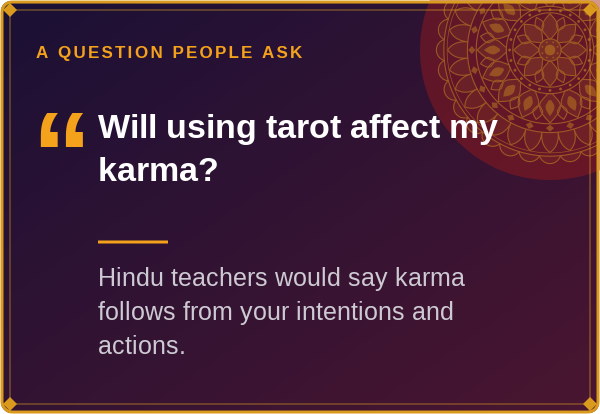
Questions to ask yourself
Rather than looking for a ruling, these questions can help you decide what fits your own practice:
- Does my guru or family tradition speak to this? If someone whose guidance you follow has said no, that is worth respecting.
- Does it replace something important? If cards begin to take the place of prayer, seva or honest conversation, something has gone wrong.
- Does it make me more fearful or more responsible? A practice that leaves you anxious, superstitious or passive is not serving you, whatever its origin.
- Am I using it to avoid a decision? Karma, in most Hindu understandings, rests on your own actions. A card cannot carry that responsibility for you.
Talking it through at home or at the temple
If the question is causing tension in the family, it can help to speak to a priest at a temple your family trusts. Chicagoland has several, including the Hindu Temple of Greater Chicago in Lemont, the Sri Venkateswara temple in Aurora and the BAPS mandir in Bartlett. Priests and elders vary in their views just as families do, and hearing one directly is better than guessing.
How this practice handles both traditions
Astrologer and Psychic Vijayram offers Vedic astrology and tarot as separate tools and says which one is being used. In a tarot card reading, the cards are read as prompts for reflection: no deity is invoked through them, no karma is "read" from them, and no ritual is ever recommended because of a card. If you want the astrological view, a session with the Vedic astrologer works from your kundli instead. Some clients enjoy combining the two through exercises such as reading the zodiac cards of the Major Arcana through your Vedic Moon sign; others keep them firmly apart. Both are fine.
The limit is the same either way. A tarot reading is faith-based guidance for reflection, not a religious ruling, a prediction or a substitute for the guidance of your own teachers, family or conscience.
Common questions
Will using tarot affect my karma?
Hindu teachers would say karma follows from your intentions and actions. Drawing a card to reflect on a choice is not, in itself, an action that harms anyone. What matters more is what you do with the reflection, and whether the cards push you toward fear or toward responsibility.
Is it all right to keep a deck near my home shrine?
Families differ. Many people prefer to keep a tarot deck separate from the mandir, out of respect for both. If you are unsure, ask the elder or priest whose guidance your family follows.
Does tarot call on any god or spirit?
Not in the way it is read here. The cards are treated as pictures that prompt reflection, with no invocation of any deity or spirit. Some readers in other traditions add prayers of their own, and you can ask about that before booking.
Do I have to believe in tarot to have a reading?
No. Many people approach a reading with curiosity rather than belief, and use it as a structured conversation about their situation. Skepticism is welcome.
Related service
Keep reading
Tarot and Anxiety: When to Pause the Cards
When tarot readings start feeding anxiety instead of easing it: the signs, who to talk to first, how to take a real break from the cards, and how to return.
Read article →
No Card Requires a Paid Fix: Tarot Without Fear Selling
Tarot ethics in plain terms: why a frightening card is never a reason to buy a ritual, the lines an ethical reader keeps, and what to do if you are pressured.
Read article →
A Daily Card for Reflection, Not Prediction: Five Ways to Read It
A daily tarot card works best as a short reflection, not a forecast. Five prompts for your morning card, an evening check-in and a simple weekly journal habit.
Read article →Quick answers
Does it matter who shuffles the tarot deck?
How does a tarot reading work, and does it matter who shuffles the deck? Shuffling customs in person and at a distance, and what matters more than hands.
Read answer →Is a tarot reading a forecast or a mirror?
Can tarot predict the future? Why readers use tarot to reflect on a situation and its likely direction rather than to fix events, and how to use it well.
Read answer →Talk to Astrologer and Psychic Vijayram
Tell us what you are facing. If a reading is unlikely to help, you will be told that plainly.