

Tarot for Job Decisions in the Chicago Market
A career tarot reading for a Chicago job decision lays out each option side by side: what it offers, what it asks of you, and what you may be missing. It suits choices like a new offer versus staying, a Loop job versus a suburban campus, or hybrid versus remote. The cards prompt reflection; the facts still decide.
Key takeaways
- The new job looks better on paper, but you like your team, you have seniority and you know how things really work.
- Major Arcana cards in an option's column suggest the choice carries more weight than it seems, a turning point rather than a routine move.
- After the spread, take a sheet of paper and list the hard facts for each option next to the cards:
- Our post on tarot for a career change handles that kind of question, and a chart-based look at timing may help more; see relocation astrology for job offers in other cities .
- A career and job tarot reading with Astrologer and Psychic Vijayram lays out your real options, names each card as it turns, and leaves time to set the spread beside your list of facts.
Chicago job decisions rarely come down to one question. An offer from a firm downtown means a longer Metra ride and a higher salary. A suburban campus in Schaumburg or along the I-88 corridor means easy parking and a team you have not met. Your current employer wants you back at a desk three days a week; the new one is fully remote but younger and riskier. Spreadsheets help with the numbers. A tarot spread can help with the part spreadsheets miss: how each path sits with you.
Three dilemmas Chicago clients bring
The offer or the job you have
The most common. The new job looks better on paper, but you like your team, you have seniority and you know how things really work. The question is less "which is better?" than "what am I really choosing between?"
Downtown or the suburbs
The Loop remains the region's biggest concentration of offices, served by every 'L' line and most Metra routes. Suburban employers offer shorter drives for people who already live in DuPage or the northwest suburbs, but fewer options if the job ends. Commute time, childcare pickup and winter driving all weigh in.
Hybrid, remote or back at a desk
Some people thrive at home; others feel cut off by February. Return-to-office rules have turned this into a genuine career question, and the cards can help you notice which arrangement you actually miss or dread.
The two-track spread
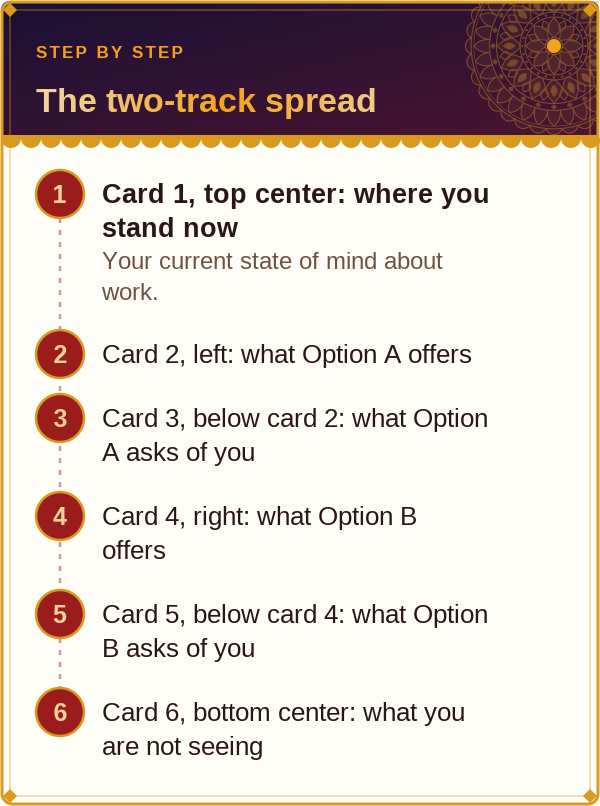
This seven-card layout puts two options side by side, like two platforms at the same station. Lay the cards in three rows:
- Card 1, top center: where you stand now. Your current state of mind about work.
- Card 2, left: what Option A offers.
- Card 3, below card 2: what Option A asks of you.
- Card 4, right: what Option B offers.
- Card 5, below card 4: what Option B asks of you.
- Card 6, bottom center: what you are not seeing.
- Card 7, beside card 6: what to carry into either choice.
Name the options clearly before shuffling: "A is staying at my current firm; B is the offer from the company in Oak Brook." For three options, add a third column.
Reading the suits at work
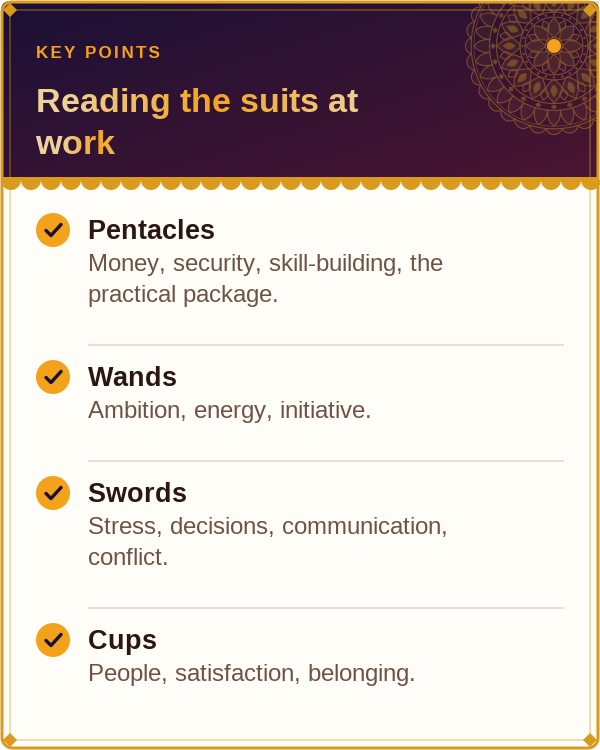
- Pentacles: money, security, skill-building, the practical package. The Eight of Pentacles often points to steady growth through craft.
- Wands: ambition, energy, initiative. The Ten of Wands, shown in the Victoria and Albert Museum's original Rider-Waite-Smith card as a figure bent under a bundle of staves, is the classic card of taking on too much.
- Swords: stress, decisions, communication, conflict. Several swords on one side may point to a tense environment or a hard conversation ahead.
- Cups: people, satisfaction, belonging. The Four of Cups can describe boredom, or an offer you are overlooking.
Major Arcana cards in an option's column suggest the choice carries more weight than it seems, a turning point rather than a routine move. Our post on career tarot cards to know goes deeper on the cards that come up most in work readings.
Putting the cards beside the facts
After the spread, take a sheet of paper and list the hard facts for each option next to the cards:
- Total pay and benefits, in writing
- Commute time door to door, in January as well as June
- Who you would report to, and what you know about them
- Stability of the company or team
- Effect on family: childcare, a partner's work, elderly parents
- Visa or licensing implications, if any
Where the cards and the facts agree, decide. Where they disagree, look harder. If the cards keep pointing to strain in an option that looks perfect on paper, ask what you know about the manager or the culture that you have not written down. If they look bright for an option the numbers do not support, ask what you are hoping it will give you, and whether you can get that another way.
When the question is bigger than one offer
If you are asking whether to change fields, start a business or move cities, tarot's focus on the present situation may be too narrow. Our post on tarot for a career change handles that kind of question, and a chart-based look at timing may help more; see relocation astrology for job offers in other cities.
A reading for your decision
A career and job tarot reading with Astrologer and Psychic Vijayram lays out your real options, names each card as it turns, and leaves time to set the spread beside your list of facts. Sessions run by phone, WhatsApp or video, and a short one fits a lunch break.
The plain limit: the cards cannot see a company's finances, a reorganization being planned upstairs or whether a hiring manager has already chosen someone else. They help you hear your own judgment more clearly, and your judgment, backed by facts, makes the choice.
Common questions
Can tarot tell me whether I will get the job?
Tarot is better at helping you think about a choice than at forecasting someone else's decision. Ask how you feel about each path, and what each would ask of you, rather than whether a hiring manager will say yes.
What if I draw the Ten of Swords for an option?
It is a dramatic card, usually read as an ending or a low point that has already peaked. In a job spread it might point to burnout risk or an exhausting situation to leave behind. It is a prompt to look closer, not a verdict.
How many options can one spread handle?
Two is easiest. Three can work if each gets its own column. Beyond that, narrow the list with facts first, then bring the finalists to the cards.
Should I use tarot or astrology for a career decision?
Tarot suits a specific choice in front of you now. Astrology suits bigger timing questions, such as whether this is a good period to change fields. Many people use both.
Related service

Keep reading

Snowed In With a Deck: Tarot Spreads for a Chicago Blizzard Weekend
Winter tarot spreads for a snowed-in Chicago weekend: a one-card check-in, a three-card shovel spread, a solstice layout and a five-card deep-winter review.
Read article →
The Twelve-House Tarot Spread: A January Layout Borrowed From the Birth Chart
A new year tarot spread borrowed from the birth chart: one card for each of the twelve houses, read as themes for the year, not month-by-month forecasts.
Read article →
Tarot or Vedic Astrology? How Chicago Clients Choose
Tarot vs astrology for Chicago clients: tarot answers the situation in front of you, Vedic astrology maps timing across years. When to use which, or both.
Read article →Quick answers
Does it matter who shuffles the tarot deck?
How does a tarot reading work, and does it matter who shuffles the deck? Shuffling customs in person and at a distance, and what matters more than hands.
Read answer →Is a tarot reading a forecast or a mirror?
Can tarot predict the future? Why readers use tarot to reflect on a situation and its likely direction rather than to fix events, and how to use it well.
Read answer →Talk to Astrologer and Psychic Vijayram
Tell us what you are facing. If a reading is unlikely to help, you will be told that plainly.