
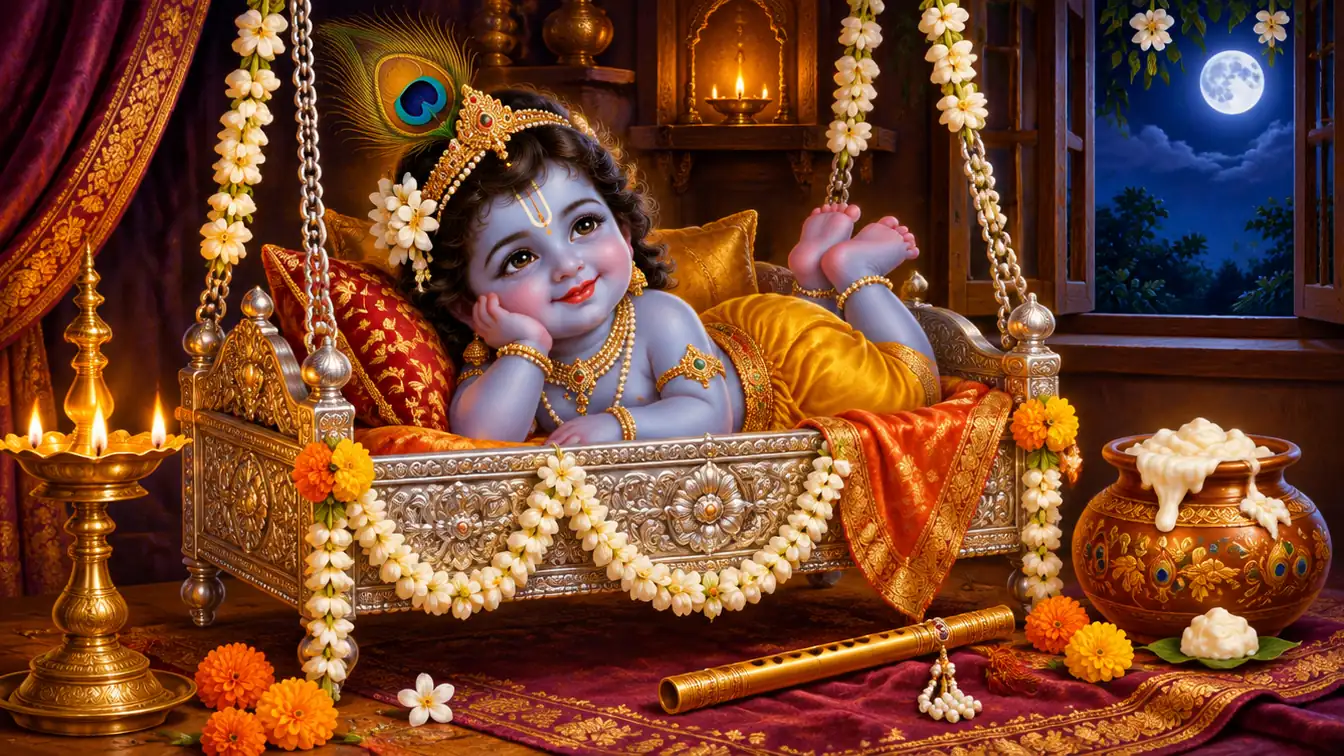
Janmashtami After a Workday: Keeping the Midnight Puja in a Chicago Home
Janmashtami in Chicago centers on Nishita Kaal, the window around local midnight, which in late summer falls at roughly 12:30 to 1:10 a.m. Central Daylight Time. Working families often fast lightly through the day, set up the altar before work, rest in the evening and keep a short midnight puja, with an earlier version for young children.
Key takeaways
- Krishna Janmashtami falls on the eighth lunar day of the waning Moon in the month of Bhadrapada (Shravana in the southern calendar), ideally with the Moon in Rohini, one of the 27 nakshatras .
- Many people in Chicago keep a phalahar fast at work: fruit, milk, nuts and water, rather than a waterless fast.
- Few five-year-olds make it to 12:30 a.m.
- Many Chicago-area temples hold Janmashtami programs, often on the nearest weekend as well as the night itself.
- Many households chant "Om Namo Bhagavate Vasudevaya" or the Hare Krishna mahamantra during the vigil.
Krishna was born at midnight, the story says, in a prison cell in Mathura, during a storm. In a Chicago home on Janmashtami, midnight arrives after a full workday, a commute and a school-night bedtime. Keeping the vigil takes a bit of planning, and a little knowledge of when midnight really is.
When "midnight" is in Chicago
Krishna Janmashtami falls on the eighth lunar day of the waning Moon in the month of Bhadrapada (Shravana in the southern calendar), ideally with the Moon in Rohini, one of the 27 nakshatras. The puja is held in Nishita Kaal, the small window around the middle of the night.
That middle is measured by the Sun, not the clock. Night runs from sunset to sunrise, and its midpoint, local solar midnight, falls in late summer at about 12:50 a.m. by Chicago clocks, because daylight saving time and the city's place in the Central zone both push it later. By our own calculation, Nishita Kaal in a typical late-August or early-September year here runs from roughly 12:30 to 1:10 a.m. A panchang made for Chicago will give the exact minutes for each year; the post on reading a Chicago panchang explains how these windows are calculated.
A working-day plan
Before work
- Set up the altar: a clean cloth, the Bal Gopal murti or a picture, a small cradle or jhula if you have one, new clothes or a piece of cloth for Krishna, a lamp, flowers, tulsi leaves if you can get them.
- Put the panchamrit ingredients (milk, yogurt, honey, sugar, ghee) in one place in the fridge.
- Prepare or buy the prasad the night before: makhan-mishri, panjiri, peda, fruit.
During the day
Many people in Chicago keep a phalahar fast at work: fruit, milk, nuts and water, rather than a waterless fast. Late August can be hot and humid here, and a commute on a crowded train or a long drive is no place to faint. Anyone who is pregnant, diabetic, on regular medication or simply unwell should eat normally; a fast is an offering, not an obligation.
After work
Rest. A nap between 8 and 11 p.m. is the single most useful thing a working devotee can do. Some families sing bhajans or read the Bhagavata stories of Krishna's birth in the late evening, then pause before the main puja.
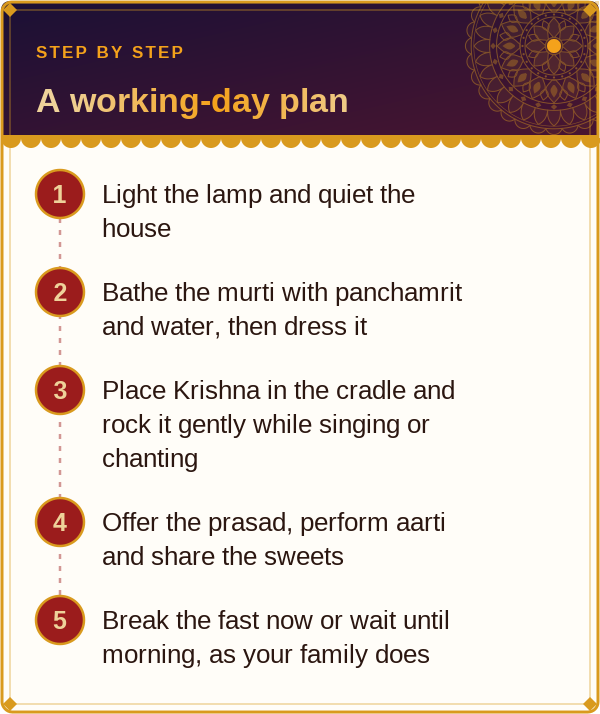
At Nishita Kaal
- Light the lamp and quiet the house.
- Bathe the murti with panchamrit and water, then dress it.
- Place Krishna in the cradle and rock it gently while singing or chanting.
- Offer the prasad, perform aarti and share the sweets.
- Break the fast now or wait until morning, as your family does.
Done this way, the core puja takes half an hour. You can be asleep soon after 1:30 a.m. and still function the next day, especially if you have asked for a later start at work.
Young children and the midnight problem
Few five-year-olds make it to 12:30 a.m. Many families hold an early "birth" for the children at bedtime: the cradle, a short story, a sweet, and Krishna placed in the jhula. The adults then keep the real Nishita puja later. Children love the story of the basket carried across the flooded Yamuna, and telling it at bedtime makes the night theirs. Older children can be woken briefly for the aarti if they want to be part of it.
Temple celebrations
Many Chicago-area temples hold Janmashtami programs, often on the nearest weekend as well as the night itself. The BAPS mandir in Bartlett, for example, counts Krishna Janmashtami among its major annual festivals. Check each temple's website for its schedule and parking arrangements; festival nights are busy. More about Bartlett is on the Bartlett page. In Marathi families, the next day brings Dahi Handi, the clay pot of curd broken by a human pyramid, a custom that tends to happen in community gatherings rather than suburban driveways.
A mantra for the night
Many households chant "Om Namo Bhagavate Vasudevaya" or the Hare Krishna mahamantra during the vigil. If you want a practice that continues after Janmashtami, personal mantra and meditation guidance can help you choose one and fit it into a working day, and the post on choosing a mantra covers the basics. Astrologer and Psychic Vijayram offers these sessions by phone, WhatsApp or video. For the other great night vigil of the Hindu year, see planning a Maha Shivaratri temple visit.
A note on the birth chart
Astrologers sometimes cast Krishna's traditional chart, with the Moon exalted in Taurus in Rohini at midnight, as a teaching example. It is a beautiful exercise in tradition. It is not a template for your own child's chart, and a baby born on Janmashtami is not thereby destined for anything in particular.
What the vigil cannot do
Keeping Janmashtami at the exact minute is an act of love, not a transaction, and missing the window because a train was late does not undo your devotion. No fast or ritual on this night should be presented as a way to secure a wish.
Common questions
Why is Chicago's midnight puja closer to 1 a.m. than 12?
Nishita Kaal is centered on local solar midnight, not the clock's midnight. In late summer, with daylight saving time and Chicago's position in the time zone, solar midnight falls around 12:50 a.m.
Why are there sometimes two Janmashtami dates?
Smarta and Vaishnava traditions use different rules for combining the Ashtami lunar day and the Rohini nakshatra. When they fall apart, the two communities may observe on consecutive days. Follow your own family or temple.
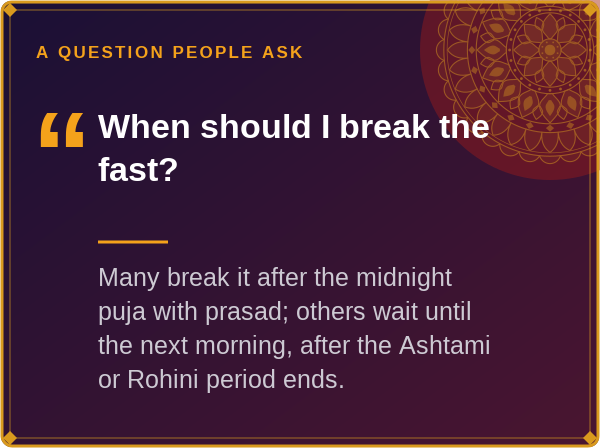
When should I break the fast?
Many break it after the midnight puja with prasad; others wait until the next morning, after the Ashtami or Rohini period ends. Anyone with a medical condition should eat as their doctor advises.
Can I keep the puja without a murti of Bal Gopal?
Yes. A picture of Krishna, a lamp, flowers and a little butter and sugar are enough. Devotion is the center of the night, not the objects.
Related service
Keep reading
Shivaratri Abhishekam at Chicago-Area Temples: Planning a Family Visit
Maha Shivaratri in Chicago: how the four prahar times are set for local sunset and sunrise, what to bring to an all-night vigil, and planning a family visit.
Read article →
Holika Dahan on a Cold March Night: Timing Holi in Chicago
Holi in Chicago: how the Holika Dahan bonfire night is set by the Phalguna full moon and the Bhadra rule, and why color play here often moves indoors or later.
Read article →
Clay, Paper or Metal? Choosing a Ganesh Murti for a Chicago Apartment
Ganesh Chaturthi in Chicago: choosing a murti's size and material for an apartment, dissolving clay at home, and checking local rules before outdoor immersion.
Read article →Quick answers
Can a Western birth chart printout be turned into a kundli?
What is a kundli, and can a Western birth chart printout become one? Yes, from the same birth data. Here is what the sidereal shift and Indian layout change.
Read answer →How exact does my birth place need to be: city, hospital or village?
The birth chart reading details needed: date, clock time and town. Why the nearest city is usually close enough, and when a more exact birthplace helps.
Read answer →Talk to Astrologer and Psychic Vijayram
Tell us what you are facing. If a reading is unlikely to help, you will be told that plainly.