
Indian Palmistry or a Storefront Palm Reading? What Chicagoans Should Know
A quick storefront palm reading in Chicago usually looks at one hand and the three main lines for a few minutes. Indian palmistry, Hasta Samudrika, reads both hands, the mounts, thumb, fingers, hand shape and small signs together, often alongside the birth chart, and takes longer. Neither one can show lifespan or promise events.
Key takeaways
- Palm reading in Chicago covers a wide range.
- The point is not that one is genuine and the other fake.
- The thumb's length, flexibility and the proportion of its two sections are read as will, reasoning and how a person acts on decisions.
- The most common worry people bring to a palmist is the life line, and the most common myth is that its length shows how long you will live.
- Astrologer and Psychic Vijayram reads palms by phone, WhatsApp or video, from photographs you send before the session:
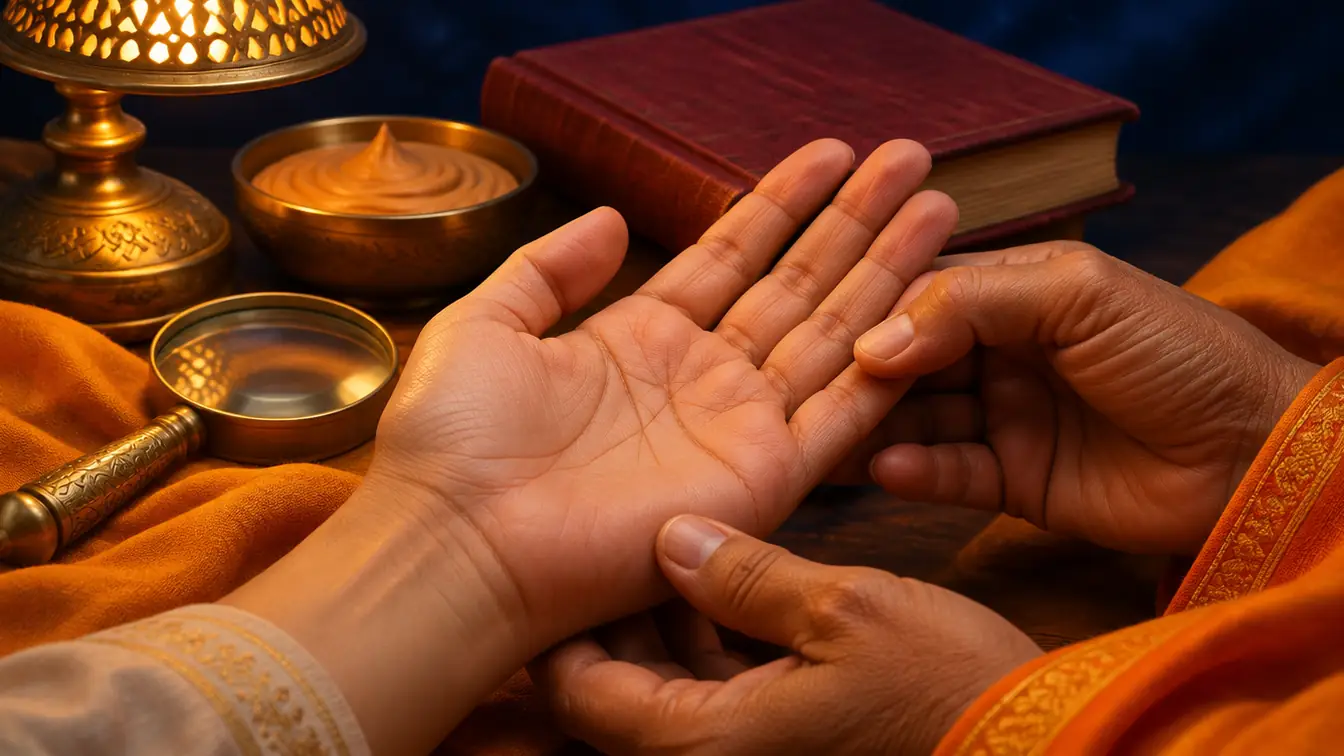
Walk down a busy Chicago street and you may pass a neon hand in a window offering palm readings. Grow up in a Gujarati, Punjabi or Tamil household and you may remember a family elder holding your hand under a lamp, tracing the lines and talking about your thumb. Both are called palm reading. They are not quite the same thing, and knowing the difference helps you choose what you actually want.
Two traditions under one name
Palm reading in Chicago covers a wide range. WBEZ described the long menu of services Chicago psychics offer, with palm reading sitting beside tarot, mediumship and aura work, and sessions running anywhere from a few minutes to an hour. Many storefront readings follow the Western palmistry popularized in Europe and America in the nineteenth and twentieth centuries.
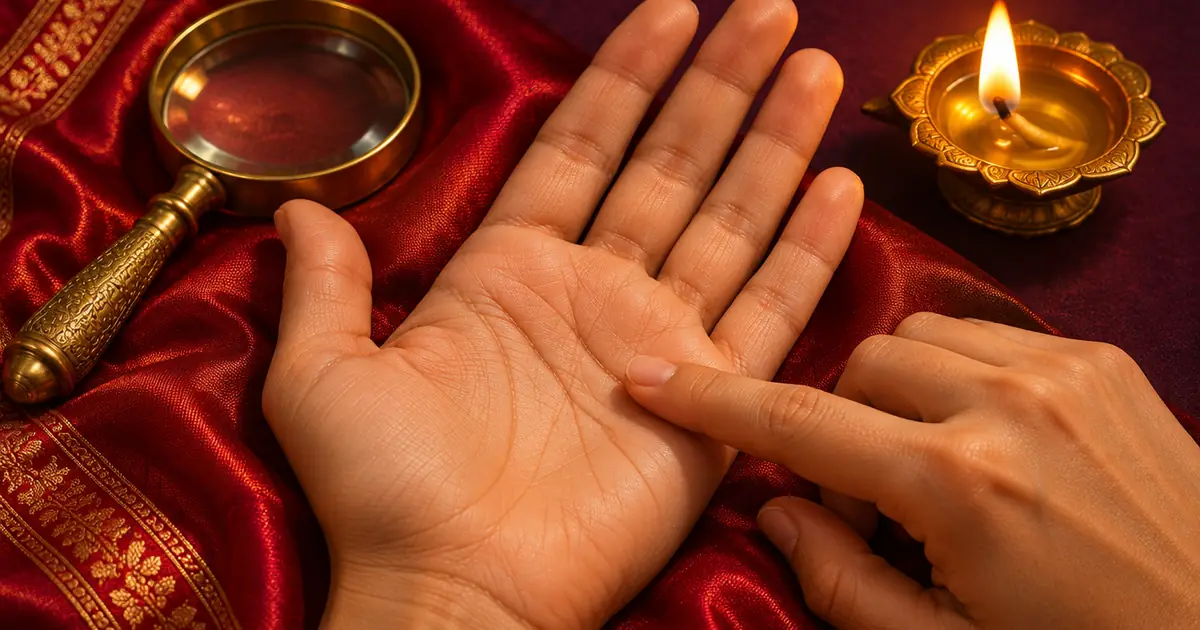
Indian palmistry comes from a different root. It is part of Samudrika Shastra, the traditional Indian study of the body's features, and the palm branch is often called Hasta Samudrika. It shares some ideas with Western palmistry but places them in a wider system linked to Vedic astrology, with the mounts of the palm named for the grahas, the planets of the birth chart.
Side by side
| Quick storefront reading | Indian palmistry (Hasta Samudrika) | |
|---|---|---|
| Hands read | Often one | Both, compared |
| What is examined | Mainly the heart, head and life lines | Lines, mounts, thumb, finger lengths and gaps, hand shape, skin texture, and small signs such as a fish, conch or lotus |
| Typical length | A few minutes to a quarter of an hour | Usually longer, to allow time for the whole hand and your questions |
| Context | Stands alone | Often read alongside the birth chart |
| Price clarity | Varies; sometimes a low opening price followed by suggestions of more work | Should be agreed in full before the reading, with no upsell tied to what the palm "shows" |
The point is not that one is genuine and the other fake. Plenty of storefront readers are honest, and plenty of people offering "Indian palmistry" are not. The difference lies in method and depth, and in whether the price is settled up front.
What an Indian palm reading looks at
The thumb
Many Indian palmists start here. The thumb's length, flexibility and the proportion of its two sections are read as will, reasoning and how a person acts on decisions.
The mounts
The fleshy pads under each finger and at the base of the palm are named for planets: Jupiter under the index finger, Saturn under the middle, the Sun under the ring finger, Mercury under the little finger, Venus at the base of the thumb and the Moon opposite it. A well-formed mount is read as a strength; an overdeveloped one as an excess. The post on the mounts of the palm covers each.
The lines
The life, head and heart lines, the fate line and the Sun line are read together, along with smaller lines for relationships, travel and health. See the heart, head and life lines for the basics.
Auspicious signs
Indian texts describe small markings such as a fish, a conch, a lotus or a flag, read as signs of particular blessings. A careful reader treats these as traditional symbolism, not certainties.
What no palm reading can show
The most common worry people bring to a palmist is the life line, and the most common myth is that its length shows how long you will live. It does not. A university anatomy study measured the life line on sixty donated cadavers and found no significant correlation between line length and longevity. A responsible reader will tell you this and will never predict a death, illness or accident from your hand. If you have a health concern, see a doctor.
How a palm reading works by phone or video
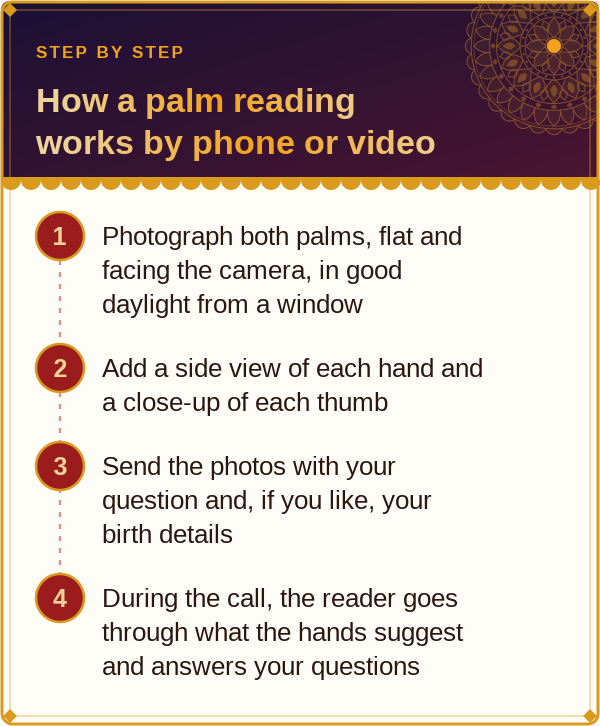
Astrologer and Psychic Vijayram reads palms by phone, WhatsApp or video, from photographs you send before the session:
- Photograph both palms, flat and facing the camera, in good daylight from a window.
- Add a side view of each hand and a close-up of each thumb.
- Send the photos with your question and, if you like, your birth details.
- During the call, the reader goes through what the hands suggest and answers your questions.
Photos often show the lines more clearly than a dim storefront would, and you can keep them to compare in a few years. The short answer on whether a palm reading changes if you are left-handed and the post on left or right hand explain how the two hands are weighed.
Choosing well
- Ask how long the reading lasts and what the total fee is before you start.
- Ask whether both hands will be read.
- Walk away from anyone who finds a curse, a "block" or a danger in your palm and pressures you into costly work to fix it.
- Be wary of precise dates or ages read from lines, especially for marriage or health. The post on the marriage line explains why timing is broad at best.
Booking
For a fuller description of the service, see palm reading (Hasta Samudrika). You can send photos and book through the contact page, with times confirmed in Central Time.
What a palm reading cannot do
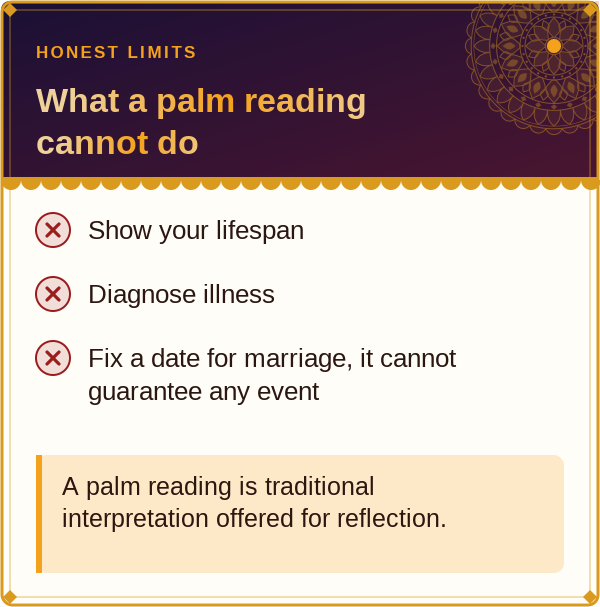
A palm reading is traditional interpretation offered for reflection. It cannot show your lifespan, diagnose illness or fix a date for marriage, and it cannot guarantee any event. It can offer a thoughtful look at temperament and tendencies, read with care.
Common questions
Which hand does Indian palmistry read?
Both. Many Indian palmists give extra weight to the right hand for men and the left for women, a traditional convention, while others read the dominant hand as the active one and the other as inherited tendencies. A good reader explains which convention they follow.
Can my palm lines change?
Minor lines and the depth of creases can change over the years, and many palmists see that as a sign of how choices shape a life. The basic shape of the hand and the main lines change far less.
Can a palm reading tell me when I will marry?
Some palmists read timing from the marriage lines and other markings, but this is traditional interpretation, not a forecast. Treat any timing as a broad tendency to reflect on, not a date to wait for.
Do I need my birth chart for a palm reading?
No. A palm reading stands on its own. Adding a birth chart gives the reader a second reference point, which many clients from Indian families find familiar, but it is optional.
Related service
Keep reading

Privacy on a Busy Street: Why Many Devon Avenue Clients Choose Phone Readings
In a close-knit shopping district where neighbors know each other, a private phone reading keeps your questions to yourself. How Devon Avenue clients book one.
Read article →
How Naperville Clients Use Video Readings: Timing, Privacy and Family at Home
How Naperville households fit a video reading at home: scheduling around school runs and the BNSF, finding a quiet room, and including a partner or parent.
Read article →
Parents Visiting From India: Phone Readings in a Full Schaumburg House
Parents visiting from India for months? How Schaumburg families find privacy for a phone reading at home, and schedule remote sessions along the I-90 corridor.
Read article →Quick answers
Does a palm reading change if I am left-handed?
Which hand is used for palm reading if you are left-handed? How readers treat the dominant hand, the Indian convention, and why many look at both palms.
Read answer →Do I have to tell a psychic anything before the reading starts?
What happens in a psychic reading, and what must you share first? Often just your first name and question; you never need to tell more than you wish.
Read answer →Talk to Astrologer and Psychic Vijayram
Tell us what you are facing. If a reading is unlikely to help, you will be told that plainly.