

Tarot When You Are Starting a Business
A business tarot spread works best beside a written business plan, not instead of one. Six cards can mirror the main planning questions: why you want this, what customers need, your strength, your blind spot, what to watch with money and a first step. The cards help you reflect; the numbers, the market and professional advice decide.
Key takeaways
- Imagine someone planning a small catering business out of a shared commercial kitchen.
- Many South Asian business owners like to open on an auspicious day.
- A career and job tarot reading can be built around this spread, by phone, WhatsApp or video, with your plan open on the table.
Some of Chicago's best-known businesses started small. Devon Avenue is a good example: one sari shop in 1973, then grocers, restaurants and jewelers, until the street became the heart of the city's South Asian shopping. NBC News has told the story of how the first Patel Brothers grocery store opened on Devon before the chain spread across the country. Every one of those businesses began with someone deciding to take a risk.
If you are at that point, a tarot spread can be a useful way to think. It cannot replace a business plan, a lender or an accountant, and this post is built around that idea: a six-card spread designed to sit beside a real plan, not stand in for one.
Start with the plan, not the deck
The U.S. Small Business Administration's guide to writing a business plan describes two common formats: a detailed traditional plan, which lenders and investors usually ask for, and a shorter lean startup plan. A traditional plan covers an executive summary, a company description, market analysis, organization and management, your product or service, marketing and sales, a funding request and financial projections.
Write at least a rough version first. Then lay the cards with the plan open beside you, so each card has something concrete to talk to.
The business planning spread
Six cards in two rows of three.
| Card | Position | Plan section it sits beside |
|---|---|---|
| 1 | Why I want this | Executive summary and mission |
| 2 | What my customers need | Market analysis |
| 3 | My real strength | Organization and management |
| 4 | My blind spot | Any section you skimmed |
| 5 | What to watch with money | Funding request and projections |
| 6 | A first step for the next ninety days | Marketing and sales |
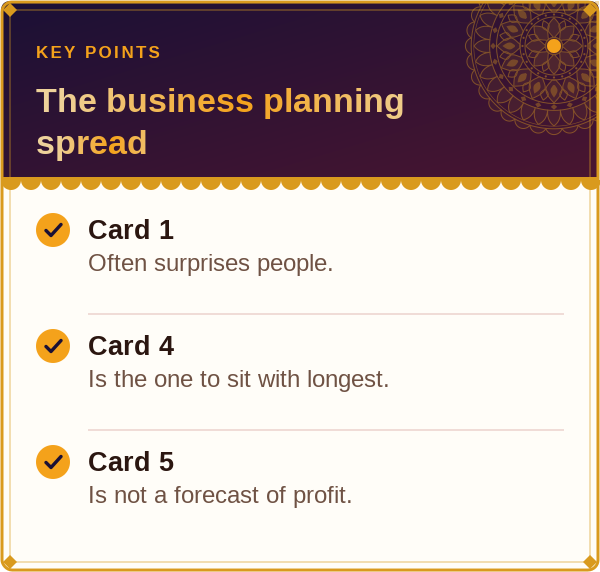
Card 1 often surprises people. A business started for freedom reads differently from one started to prove something to a parent, and both are different from one started because a market is crying out for it. All three can work, but you should know which one you are.
Card 4 is the one to sit with longest. Whatever turns up, ask which part of your plan it might describe. A card of conflict near the partnership section is worth a second look at your agreement. A card of overload near your schedule is a reminder that founders burn out.
Card 5 is not a forecast of profit. Read it as a prompt about your relationship with money in this venture: caution, overconfidence, generosity, fear.
An example, for illustration
Imagine someone planning a small catering business out of a shared commercial kitchen. The cards fall:
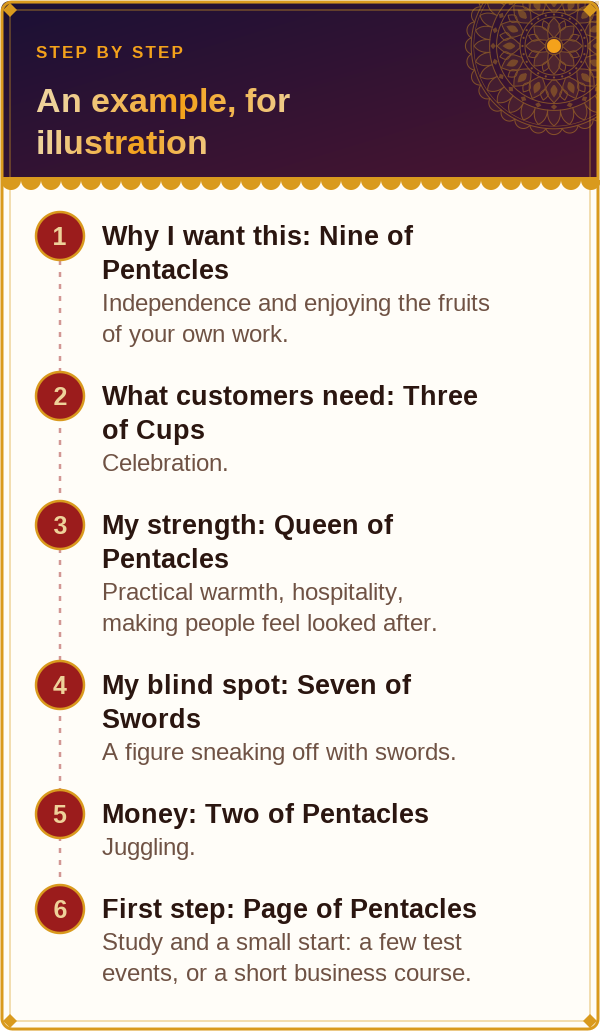
- Why I want this: Nine of Pentacles. Independence and enjoying the fruits of your own work.
- What customers need: Three of Cups. Celebration. The market is parties, weddings and gatherings, which fits.
- My strength: Queen of Pentacles. Practical warmth, hospitality, making people feel looked after.
- My blind spot: Seven of Swords. A figure sneaking off with swords. Perhaps paperwork or permits being dodged, or an idea that could be copied.
- Money: Two of Pentacles. Juggling. Seasonal income means cash flow needs careful handling.
- First step: Page of Pentacles. Study and a small start: a few test events, or a short business course.
Put beside a plan, this reading gives three pieces of homework: check every license and food safety requirement, build a cash cushion for the slow months, and start small. None of that came from magic. It came from the cards prompting questions the founder had not fully asked.
What to take to professionals
A spread can raise questions. Answering them is a job for people with the right expertise:
- An accountant for structure, taxes and projections.
- A lawyer for partnership agreements, leases and contracts.
- The SBA and its resource partners, such as SCORE mentors and Small Business Development Centers, for guidance and training.
- Your bank or a lender for financing options.
Opening day and blessings
Many South Asian business owners like to open on an auspicious day. That is a question for astrology rather than tarot: a muhurta consultation chooses a date and time from the panchang and the planetary positions for Chicago. Some also ask for a prayer before opening the doors; the shop and office blessing for Chicago businesses explains what that involves, and it is always optional. If you want a longer look at your working life and its timing, the career and business astrology reading works from your birth chart.
Reading your business question
A career and job tarot reading can be built around this spread, by phone, WhatsApp or video, with your plan open on the table. Astrologer and Psychic Vijayram will ask about the plan before laying cards, because a reading grounded in real details is far more useful than one in the abstract. For individual cards that tend to appear in work spreads, see eight career tarot cards worth knowing.
The limit is firm. No spread can promise that a business will succeed, tell you how much to borrow or replace legal and financial advice. It is faith-based guidance for reflection, and the decisions belong to you and the professionals you trust.
Common questions
Can tarot tell me if my business will succeed?
No. Success depends on the market, the money, the work and many things outside anyone's control. A spread can help you think about your plan more honestly, which is useful, but it cannot forecast the result.
Should I choose my opening date with tarot?
Tarot is not a timing tool. Families who want an auspicious opening day usually ask for a muhurta, which is chosen from the Hindu calendar and the planetary positions for Chicago.
Can my business partner join the reading?
Yes, if they want to. Each partner can draw their own strength and blind spot cards, which often makes for a frank and useful conversation about who does what.
What if the cards look discouraging but my plan looks solid?
Treat the cards as a prompt to double-check, not a stop sign. Ask what the discouraging card might be pointing at, such as cash flow, partners or your own energy, and look at that part of the plan again.
Related service

Keep reading

Changing Careers Mid-Life: A Five-Card Tarot Spread
A career change tarot spread for your forties or fifties: sort fear from fact, name what transfers and try a small test step, with financial planning first.
Read article →
Is Tarot at Odds With Hindu Belief?
Tarot and Hinduism: how a European card tradition sits beside Jyotish in practice, why Hindu views on it vary, and what to ask yourself before using the cards.
Read article →
Tarot and Anxiety: When to Pause the Cards
When tarot readings start feeding anxiety instead of easing it: the signs, who to talk to first, how to take a real break from the cards, and how to return.
Read article →Quick answers
Does it matter who shuffles the tarot deck?
How does a tarot reading work, and does it matter who shuffles the deck? Shuffling customs in person and at a distance, and what matters more than hands.
Read answer →Is a tarot reading a forecast or a mirror?
Can tarot predict the future? Why readers use tarot to reflect on a situation and its likely direction rather than to fix events, and how to use it well.
Read answer →Talk to Astrologer and Psychic Vijayram
Tell us what you are facing. If a reading is unlikely to help, you will be told that plainly.